
 E-Paper



Benyamin: “Courage is basic to writing”
At the Kerala Literature Festival, the award-winning Malayalam author whose novels, The Second Book of Prophets and Silent Journeys have recently been translated into English, talks about his writing and about translation as a creative process

 Prefer HTon Google


You won the inaugural JCB Prize for Literature in 2018 with Jasmine Days, translated by Shahnaz Habib. And Goat Days was made into a movie, Aadujeevitham: The Goat Life. Both are translations, in a way, and have widened your readership (or viewership). How do you work with different translators rendering your works in different forms?
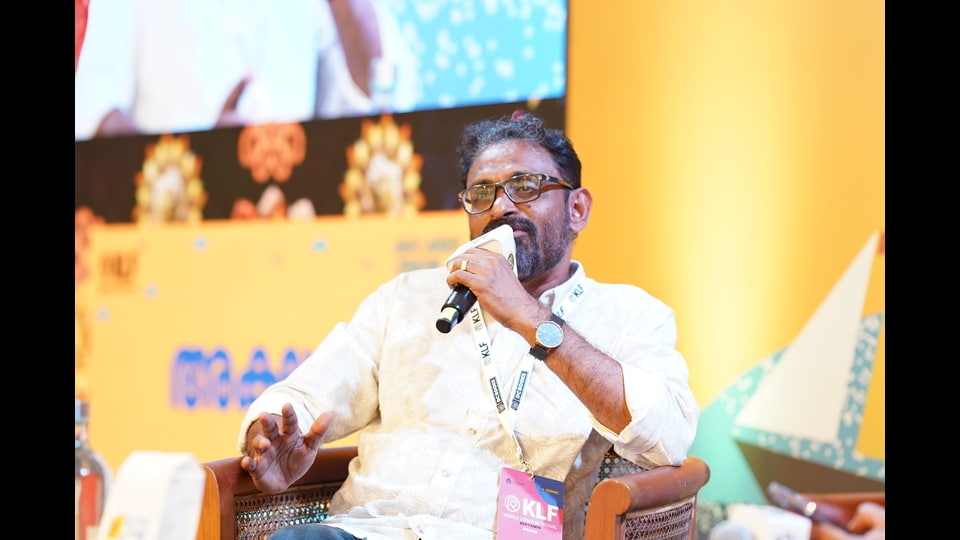
Translation is a creative process. I give freedom to my translators, because only then can they really do their creative work. I don’t advocate for word-to-word translations. As long as the soul or the idea is there, I’m fine. Whenever my books come out in English, I read to check and see if it’s there. But how many languages can you read? Maybe someone is translating them into Arabic or Tamil or other languages, and I can’t read them. So all I can do is trust and believe in my translator(s).
Cinema, on the other hand, is an entirely different medium. It requires a huge group of people working together. Their collective creativity is reflected in a movie. But I think of it in the same way. If they can take the essence of the book, then it’s fine; the rest can be anything else, their own ideas, views, or visions, they can implement whatever they feel works. Of course, I feel happy that my work is being converted into a different medium as it helps reach a different audience – because not everyone is a reader. When a movie reaches people, it reaches a different part of society altogether. But that can only happen if I allow people the freedom to change the original.

Your works have a historically significant event as the backdrop. Arab Spring features in Jasmine Days. Migration, of course, most prominently features in most of your works. Are you invested in weaving personal and collective memory? Or do you realise what you’re going to do only when you begin writing a story?
No, I was actually in that situation, the one in Jasmine Days. I experienced these events during that period. I was in the Gulf countries, and I witnessed what was happening. So, I felt it should reflect in the work. But the book isn’t a personal story; I wanted the historical event to affect fictional characters. Several things and issues were going on at the time, and people of different nationalities were facing a variety of issues.
Migration is an entirely different issue. It’s different for different people. Some migrants wanted the contemporary situation to continue; for the regime in power then to continue to rule. Then, there was another group that wanted to do away with the regime. How this conflict plays out at the same time in a scenario was interesting to me because there were migrants who were part of the regime — they were working in the police or military forces, but they were either forced to or wanted to suppress those who were protesting.
A novel should give something new to people. I wanted to write about how a migrant would approach such a situation. At the same time, these incidents were personal to me, too, because I met several people in that period, interviewed them, and asked about their experience, which greatly helped me write the book. It’s something contradictory, actually, working on something like that.
Such contradictions seem to be reflected greatly in Malayalam literature. Would you say that is because Malayalam readers are reading everybody including Gabriel García Márquez and Mario Vargas Llosa in Malayalam, which informs their works in a way. When I read VJ James’ The Book of Exodus, translated by Ministhy S, (who has also translated one of your latest books, The Second Book of Prophets), I was blown away.
Certainly, that’s very much the case. As you said, all world-class literature has been translated into Malayalam. We’re very familiar with international languages and writings, and different storytelling styles. I think, when we write, we’re writing fully knowing that we’re, in a way, competing with them. So we must reach that level in order for our works to reach a variety of readers, who’ll accept them as they’ve accepted works by international writers. I think a good translation helps it reach that level. Again, that’s why translation is so important, because it has helped writers improve their own writings.
In The Second Book of Prophets, one finds an unusual Jesus. We meet a contemporary man, who’s probably partly wise, partly angry, but entirely human. It’s an origin story in a way. But religion is a sensitive issue. Were you afraid that it might irk readers? How did you navigate this challenge?
Every saga, whether it is The Mahabharata, The Ramayana, or the Holy Bible, has the ability to define the same thing in different ways. We have inherited so many stories from each of them. But whenever you get a chance to collect a story, you tend to reinterpret it with your vision, so the work becomes new.
Actually, playing with religion is not as big an idea as we think it is. As a writer, if you wish to write something, you shouldn’t be afraid because, as such, all kinds of issues come up when you’re writing about anything. You must be brave enough to write anyway, but you must be thorough on your subject, and you must go ahead with it without being afraid.
If you’re afraid to write something, your creativity will be lost. Courage is basic to writing. So, when I began working on this novel, I wasn’t afraid because such issues come up all the time.

I asked about the challenges because often writers bear the cost of putting a creative work out there. Salman Rushdie is an example. Perumal Murugan too had to brave several attacks. Writers have been ostracised for their works in the past. In the face of such events, what would you say writers must do to develop the courage to continue doing creative work?
This courage that I talked about, I’ve got it from writers before me, including the ones you’ve named. They wrote regardless of those religious fires or regimes. So many rulers or governments have been against writers. For aeons, rulers and religions have been against writing. But we have so much historical evidence of great fictional works surviving the test of time because their creators weren’t afraid. They may have been jailed or killed. Some may have been hanged. Yet they wished to write, and they did write. Had they not survived or overcome the situations they were faced with, we wouldn’t have the great works we have today. So, I derive courage from such works and writers.
Please describe your writing process.
Whenever I have an idea, I think, how do I extend it? Is it strong enough? How many possibilities are in it? Is there any historical evidence that I can add to this idea? So, after an idea strikes me, I do some research on my own, that’s first. Then, I meet people. Travel to places to collect material.
After all this, I make notes on one incident. I don’t know if any such note or paragraph will be placed in the novel, but I don’t think about it when I’m making a note or writing a paragraph. That’s the third stage. Then, in the fourth stage, I start writing chapters, connecting this or that, expanding a paragraph, or rewriting it.
I’ve never been able to write any of my novels linearly, going from one chapter to another. Never. Maybe what I’m writing initially will become a 33rd chapter of a novel. While writing it, I don’t know where it’ll fit, but I know it’ll fit somewhere later.
The last bit involves linearising the narrative, connecting loose ends, and reconnecting them. Editing the whole manuscript. It’s an incredibly long process. I feel writing a novel is like collecting several threads, and you happen to make a net. You can’t describe how you do it; you only know that you’ll try connecting one thread to another and just endure this slow process. It takes me three to four years to write a novel, but I very much enjoy this process. Whenever I have an idea, I look for new situations, characters, or something, and doing that is very enjoyable to me. It gives me a headache sometimes, too, [laughs]
Saurabh Sharma is a Delhi-based writer and freelance journalist. They can be found on Instagram/X: @writerly_life.


