
 E-Paper



Book Box | Meet award-winning mystery writer Angie Kim
This Stanford and Harvard-educated former lawyer dips heavily into her own life and adds research to craft pacy and prizewinning whodunits

 Prefer HTon Google


Dear Reader,
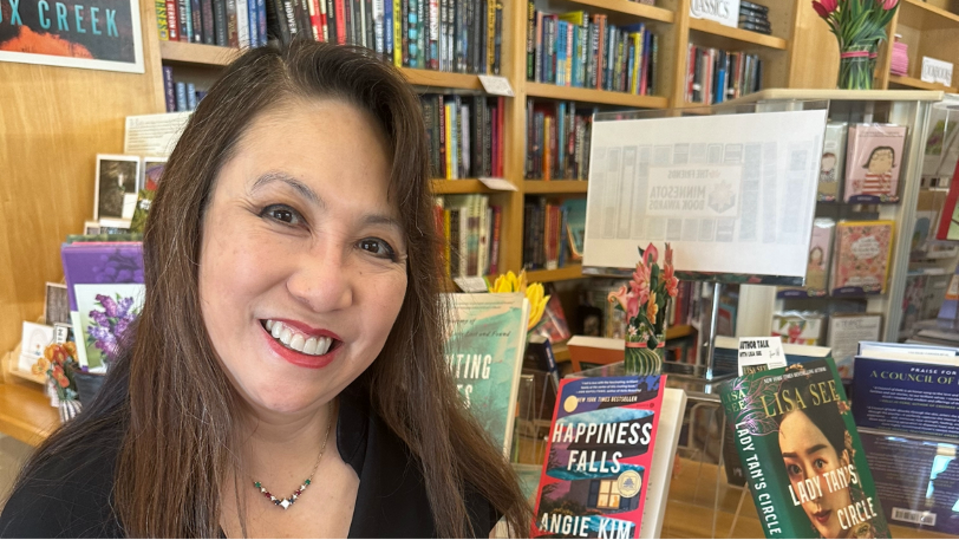
It’s a monsoon evening in Mumbai. The rains have been heavy and incessant, and the lift wells in our building are flooded. And now the lights have gone out.
We’ve been discussing Happiness Falls; enthralled with this thriller that says so much about human intelligence and communication. And curious too — who is this author who picks up medical problems, philosophical and scientific questions and turns them into racy pacy whodunits?
It's exciting to have this author, Angie Kim, join us today for a conversation. But I am in a state of mild panic — please let the lights come back on.
I sit in a darkening room, with my mobile hotspot connected and rapidly depleting laptop battery, as people log on from different parts of the world — Mumbai, Delhi, Manali, Bangalore, Hong Kong, Boston, New York and then suddenly there is Angie Kim — from Baltimore in the US. And the lights come back on! It feels sort of symbolic.
And here for you are edited excerpts of our conversation, as well as a recommendation from all of us, to read both Miracle Creek and Happiness Falls.
Where are you right now?
You're seeing me in my writing closet. There’s no window and I'm sitting on the floor. I started writing in my 40s to deal with my feelings, and to process what I had been through with my three boys, who are all fine now, but they all had medical issues as babies. I was desperate to have a quiet place of my own where they could not find me. I found this tiny little cupboard under the attic, it's under the roofline. The ceiling is sloped down, kind of like Harry Potter's closet, it's this dusty tiny thing that nobody even knows was there. And my family would be like, 'Where is mom? We can't figure out where she is.' The wi-fi router was not strong enough to reach this area, so I didn't have any temptation to go online. It was really the perfect place for me to write. And now I have these big monitors, and because I love writing by the sea, I turn them on to different beach cams throughout the day, so that it feels like I'm in a tiny little nook outside a beach somewhere, looking out. That's my mind trick to myself.
It looks cosy
Very cosy. But sitting on the floor for this many hours, my back specialists would be like, that's why you're having all that back pain. But whenever I don't know how to write a particular sentence, or how to make an image come alive, I have all the confidence in the world that all I have to do is sit at this exact place and it will come to me somehow --- I ascribe these magical abilities to this spot. So even though now I have these beautiful bedrooms with desks in them, I still come here to write.
You were eleven years old when you moved from Seoul to the suburbs of Baltimore. How was that experience?
My parents and I, just the three of us, lived in Seoul in one room of another family’s house, without indoor plumbing, the kitchen was a stove outside, that kind of thing. One day, when I was in third grade, I volunteered to run for class president. The teacher asked me to come to the front of the class and hold out my hand, and then he hit my hand with a ruler for thinking that a girl could be president of anything. That day my mother said, "I want to get us out of this country." She had been worried about my future, especially because South Korea is such a patriarchal society, she’d seen some of the things that had happened to her, such as her education getting put aside for her brothers. She didn't want that to happen to me.
What was that experience of moving to America like?
I didn't speak any English other than hello, and goodbye, and that too with a heavy accent, so people couldn't understand even that. It was a revelation for me because I had always been a very talkative girl in South Korea, at the top of my class. I thought that I was smart, and could talk my way out of anything. And now to come to a place where I could no longer speak. I realised that in our society, we equate intelligence with verbal fluency. And I had that deep assumption within myself too. So even though I knew my intelligence level hadn't changed overnight, I still felt stupid and ashamed, and I lost the sense of myself.
And because I couldn't speak English, people assumed I couldn't understand the language. They made fun of my clothes, made fun of my hair, saying it to my face, but also kind of smiling. I would sometimes think, "Oh, they're being nice to me." At first, I felt it was all in my mind, that I was being paranoid. I would think that not everybody was like this, but a lot of people were, this was middle school, and kids are awful in middle school.
And then you turned to a novel to help you learn English better?
My aunt told me she learned a lot of English by reading novels, writing down phrases and memorising them, especially phrases that people said in dialogue with each other. I needed to learn conversational English, TV was too fast for me to follow, and I needed something that I could sit down and figure out.
I picked one of my aunt's books, Rage of Angels by Sidney Sheldon. I was into the Bible at that time, and I thought it was maybe about the first group of angels who were cast out of Eden or something. That was so ridiculous. The book is the story of a bright young woman, who becomes a litigator, and then becomes the lover of a US senator sort of like JFK, and she also becomes the mistress of the most powerful mafia boss in the country. There was a lot of sex, it was totally inappropriate for an 11-year-old girl, but I memorised phrases from it that I thought would come in handy. I would look them up and guess the way figurative language worked like the phrase ‘eat your heart out’. And then I would try it out on people, not realising the many inappropriate sexually laden contexts.
So, what inspired you to write a prize-winning short story about this experience?
I wrote an essay and it won an award in the Glamor magazine. Jesmyn Ward, Erin Morgenstern and Jane Smiley were the judges, so it was really wonderful. You can read the story, it's available online on my website. It's too embarrassing to recount.
Today, you have two rich languages to draw upon. How does that help in your writing?
I'm actually not fully bilingual anymore. My parents did so much of a number on me, to get me to be fluent in English. We were only speaking in English to help us grasp the language. And then I went to boarding school for 10 years, and except for the holidays when I was around my entire extended family, I did not speak Korean. Finally, my parents were like, 'Okay, now you obviously got English, we can go back to Korean'. By this point, I was so much more comfortable speaking in English. When my parents spoke to me in Korean, oftentimes I replied in English.
You were a trial lawyer, a consultant at McKinsey, and a dot com entrepreneur. It seems like a dream career with so many successes
I define success as being able to find that thing that makes me happy, both at the micro and macro level, loving what you're doing day-to-day, and stepping back and looking at your life with a feeling of satisfaction.
I had been trying to find that combination as a lawyer. I found being in the courtroom thrilling and fun, being able to tell the story and sculpt it in a way to judges and juries, that was great. But most of the day-to-day stuff, I really, really hated, especially because it was couched in so much conflict, just people being nasty to each other. And as much as I loved helping companies and things with McKinsey, that sort of satisfaction of creating something on my own wasn’t there.
Same thing with being a dot com entrepreneur. I loved creating my own company, but it was stressful, and I just don't think that I could have dealt with it for more than a few years. I felt like my co-founders and I were going to, like, kill each other at some point. So I think it's that idea of trying to find that thing that you love at both the micro and the macro levels.
And so, at the age of 40, writing became that thing for you?
Actually, my first novel, Miracle Creek, came out the week I turned 50. Since I started pursuing writing in my 40s, the first five years or so, I spent writing short stories and submitting them to contests and getting them published and things like that. And then I started working on my first novel, which took me five years. I had to find an agent, an editor and a publishing house. So it takes time.
But just when you find that one sentence that really encapsulates what you're trying to say about the human condition or some emotion, it can be one dopamine hit per day. I love editing and sculpting stories. And when you know a story, a scene or the whole book is done, being able to hold that in your hand, whether it be something that you just printed out, or submitted to a magazine and they're paying you nothing at all except giving you a free copy of the magazine that it appears in. Or walking into a bookstore and seeing your book there. There's such satisfaction in that.
How did you start writing fiction?
My husband, a lawyer and who's a practical man, once said that he loved the stories that I was writing, our personal stories about the kids and the medical issues that they've gone through and the catharsis out of that. He said to me, 'I'm just worried, though, about medical privacy and future insurability for the kids, if some of these details about their medical conditions come out. So why not try fiction?' And I said that I didn't know how to write fiction. I've been an avid reader all my life, but I've never tried my hand at writing fiction. But when I wrote my first story, I found I loved everything about this, even though I find writing fiction to be a struggle.
The power of your fiction comes from extensive research as well as your own experience. Like when you write about a hyperbaric treatment submarine and the community of mothers of autistic children in your first novel. Were you anything like the character Elizabeth in Miracle Creek?
Yes, definitely. My oldest had all these medical issues. He was deaf in one ear. He had apraxia. He had some motor issues concerning his mouth, so it delayed his speech. He also had ulcerative colitis and celiac disease, and so he had to be gluten-free at a time when, like, there was no gluten-free. I was one of these moms who was trying one thing after another. I had spreadsheets for everything. I was doing all of these therapies for him, like auditory processing therapy, speech therapy and physical therapy for his apraxia. I tried hyperbaric oxygen therapy for his ulcerative colitis because a friend of mine had told me about this experimental treatment that she was trying for her autistic child. But nothing was working for him. He wasn't growing. He was sometimes vomiting, and always crying and saying, it hurts. I was willing to try anything. I tried hyperbaric oxygen therapy, where you go into the seal chamber that kind of looks like a mini-submarine with other families, and then the kids, the patients, put on these oxygen tanks, suits, and they breathe in pure oxygen. And so that's where Miracle Creek comes from, because in that book there's a group of families that do that for their kids.
At the surface level, the family in Happiness Falls is a lot like my own family. I am a Korean immigrant. My husband is a White American guy. Our kids are biracial, some of whom are kind of like Mia, with more Asian features, and some of whom, like John, look completely White.
How did the idea for Happiness Falls originate?
I started thinking about this story in my mind, way before I started writing it. It was about this cute little dad who is obsessed with the idea of happiness experiments, his quirky family, and about the relativity of happiness.
I knew this quirky family; I had written a short story about them when they were a little bit younger. I knew about Eugene, the son who doesn't speak, and wanted that to be an element. But then I started researching spelling therapy and discovered that kids that we had assumed to have IQs of 50 or 60 with the spelling therapy, had these gorgeous ideas and essays which showed that they were so intelligent. It blew me away. My story quickly changed into something where Eugene, the son with the inability to speak, had to be central to the storyline. To a story where the dad is passively in peril and the only person who knows about it is Eugene. It all came together for me, also because of the experience that I had as an 11-year-old in the US, of not being understood. And what I went through is nothing compared to what these non-speakers like Eugene are going through. And yet it was so traumatic for me. And so, what must it have been like for somebody like Eugene?
That's so interesting. So what you're saying is that you started with a certain idea, and as you were writing, other emotional elements came in, and the story took on a life of its own?
Absolutely. I almost thought about taking the happiness element out because I didn't want it to be a distraction. My editor and I talked about it, and we just decided, no, it's too much of a thread in the novel. And also, he just personally found it so fascinating. So he was like, 'No, let's leave that in'.
How do you picture these intertwining narratives in Happiness Falls?
It's a Venn diagram. The three circles are the missing dad investigation arc, the voice fluency arc, and the happiness quotient experiment. I sold this book to my editor with this Venn diagram, the first 60 pages, and a three-page explanation of the Venn diagram of what this book is about.
How did you decide on the title Happiness Falls?
I wanted ‘Happiness Quotient’, but my sales and marketing people decided that it was a little too non-fiction and they were like, some people don't really know what quotient means. But I kept rooting for it. We had so many discussions, we had like 150 things that were everything from variations on happiness to variations on the theme of happiness. And then my UK editor said, How about ‘Happiness Falls’? I like that falls has so many different meanings. You know, there is a waterfall and it's also like the father falls, but Mia also falls in the beginning, and all that kind of stuff. And also happiness falls and rises, you know, that kind of thing.
And, finally, when do we get to see your novels on screen?
Miracle Creek has been bought by Paramount Pictures and Happiness Falls has been optioned by an amazing production company, they were the people behind Station 11 ( based on the book of the same name by Emily St. Mandel) And Ethan Hawke has signed on to be executive producer, with the thought that he would play the father.
…
With that its a wrap for now. Until next week, happy reading.
Sonya Dutta Choudhury is a Mumbai-based journalist and the founder of Sonya’s Book Box, a bespoke book service. Each week, she brings you specially curated books to give you an immersive understanding of people and places. If you have any reading recommendations or suggestions, write to her at sonyasbookbox@gmail.com
The views expressed are personal


