
 E-Paper



Frankfurt between Goethe and Hoffman
From the poet and statesman’s reconstructed childhood rooms to the lurid punishments of Struwwelpeter, the city is a storehouse of German literary memory

 Prefer HTon Google


Frankfurt in June smells faintly of river mud and hot brakes. By late morning, cyclists are cutting through intersections with hard confidence, and tram windows are clouded with greasy fingerprints. Office workers sit on the embankment wall of the river Main eating currywurst from cardboard trays as they watch boatloads of tourists. A man is reading Ingeborg Bachmann in the shade of a plane tree.
People still talk about Frankfurt as though it were a bank with a postcode: the airport city, the financial engine. Yet, books have always been a feature of the city. At Hauptwache, a kiosk selling Marlboros and scratch cards has a revolving rack of paperback editions of literary classics. There’s Goethe beside Kleist beside Kafka. The city treats writers the way some places treat military heroes; there are plaques on the walls, and school routes, museums and streets are named after them.
Goethe House stands on Großer Hirschgrabe. Johann Wolfgang von Goethe was born here in 1749. His wealthy father, Johann Caspar Goethe, collected books, paintings and maps and supervised his son’s education with grim intensity. His mother, Catharina Elisabeth, brought theatre, gossip and movement into the home. The son inherited both temperaments.
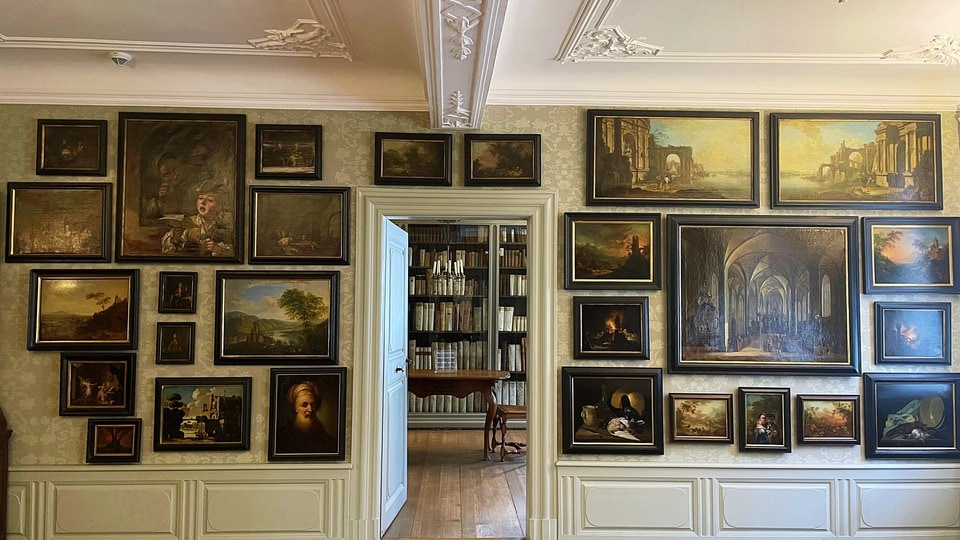
The original house was burned down during the Allied bombings of March 1944 along with much of the old city. Strangely, Goethe’s birthplace was destroyed on the anniversary of his death, one of those details historians distrust because it sounds made up. Reconstruction plans began even before the war ended and by 1951, the house had risen again from inventories, photographs and surviving architectural fragments. Inside, the rooms are smaller than expected. It is a surprise because Goethe occupies such an exalted position in European culture that the visitor assumes the building itself would be monumental. Instead, the place with its cabinets, porcelain, music stands, and windows admitting a measured amount of light, is a picture of bourgeois discipline. In the study where Goethe drafted parts of Faust, the desk has been polished to a dark sheen and pens gleam under glass.
Goethe is revered in Germany. Schoolchildren memorise his writing before they can understand him. Quotations float loose from the texts: “Grey, dear friend, is all theory, and green the golden tree of life.”
The house still preserves traces of the difficult young prodigy. The visitor can imagine his private tutors, French theatre performed in family rooms, puppet stages, and Latin exercises. Outside, Frankfurt must have traded and argued as it still does today. Then came The Sorrows of Young Werther in 1774 and Europe briefly lost its mind. Young fanboys dressed like the hero, reports of inspired suicides circulated across the continent, and Napoleon carried the novel during military campaigns. The museum alludes to all this even as it avoids theatrics. German literary museums often place their faith in objects: a chair, a manuscript page, a cracked banister polished by generations of hands.
Outside, in the afternoon heat, trams shriek around curves near Willy-Brandt-Platz, and tour groups shelter under umbrellas. The reconstructed old town looks faintly implausible in direct sunlight, its timbered facades restored so meticulously they resemble enlarged stage scenery. As I walked east toward the Struwwelpeter Museum, I noticed posters for the Frankfurt Book Fair already hanging in bookshop windows although October is still quite far away. It would seem the fair never entirely leaves Frankfurt, which remains one of the main hubs where books are converted into contracts and freight shipments.
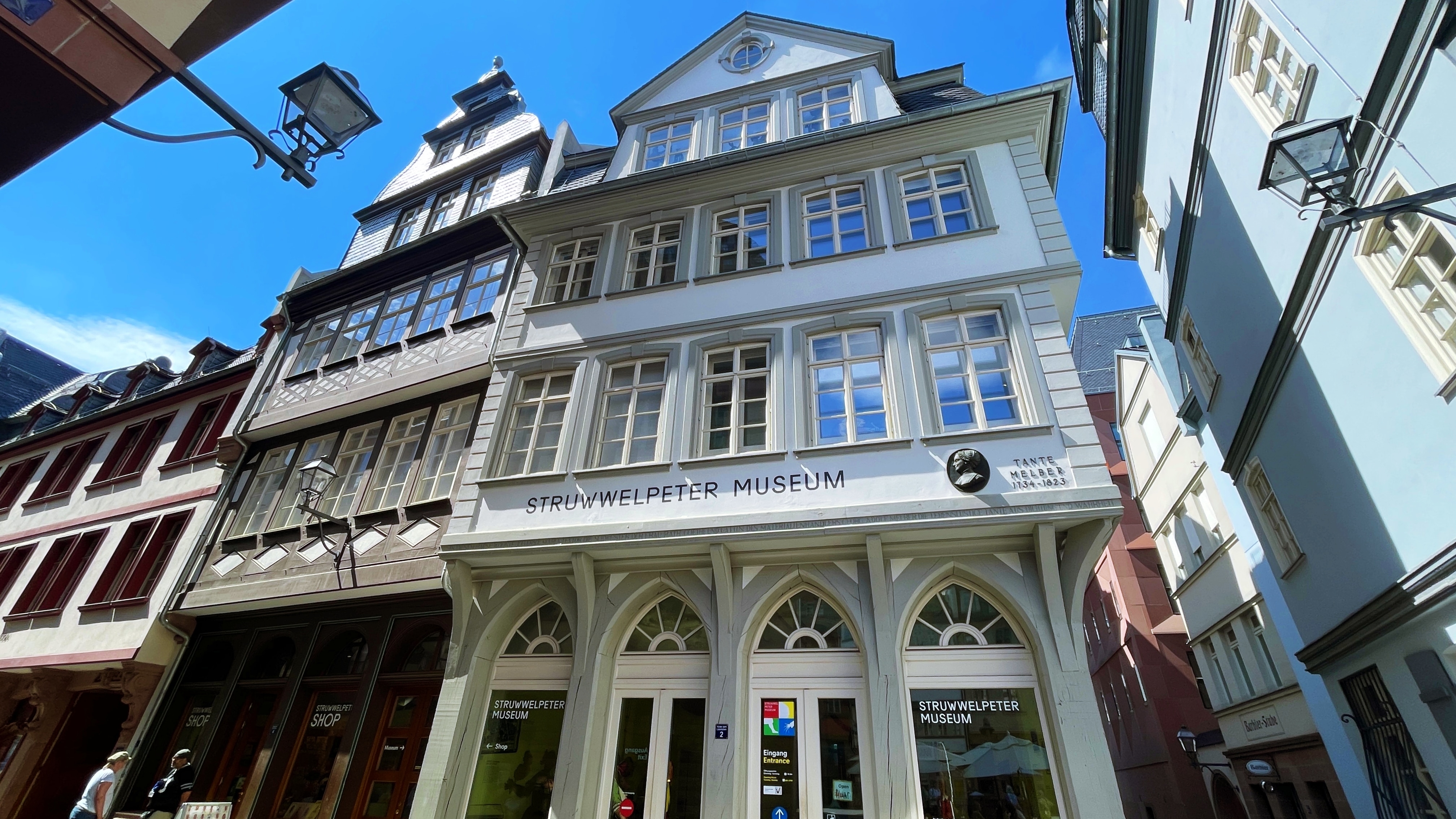
The Struwwelpeter Museum sits in the Neue Altstadt, close to where Heinrich Hoffmann once lived and practised medicine. While Goethe House encourages lowered voices, Struwwelpeter greets visitors with magnified sound. A little boy near the entrance kept hammering a button that made metal blades snap open and shut above his head. His father laughed once, then stopped. Born in Frankfurt in 1809, Hoffmann trained as a physician before becoming a psychiatrist during the rough early decades of institutional mental health care. In 1844, unable to find a suitable Christmas present for his three-year-old son, he wrote and illustrated a book himself. Der Struwwelpeter, which was published the following year, featured children burnt alive after playing with matches, a boy who wastes away from refusing soup, and thumbs severed by a towering scissor-man with red legs. Europe couldn’t get enough of the stories that move merrily, toward mutilation.
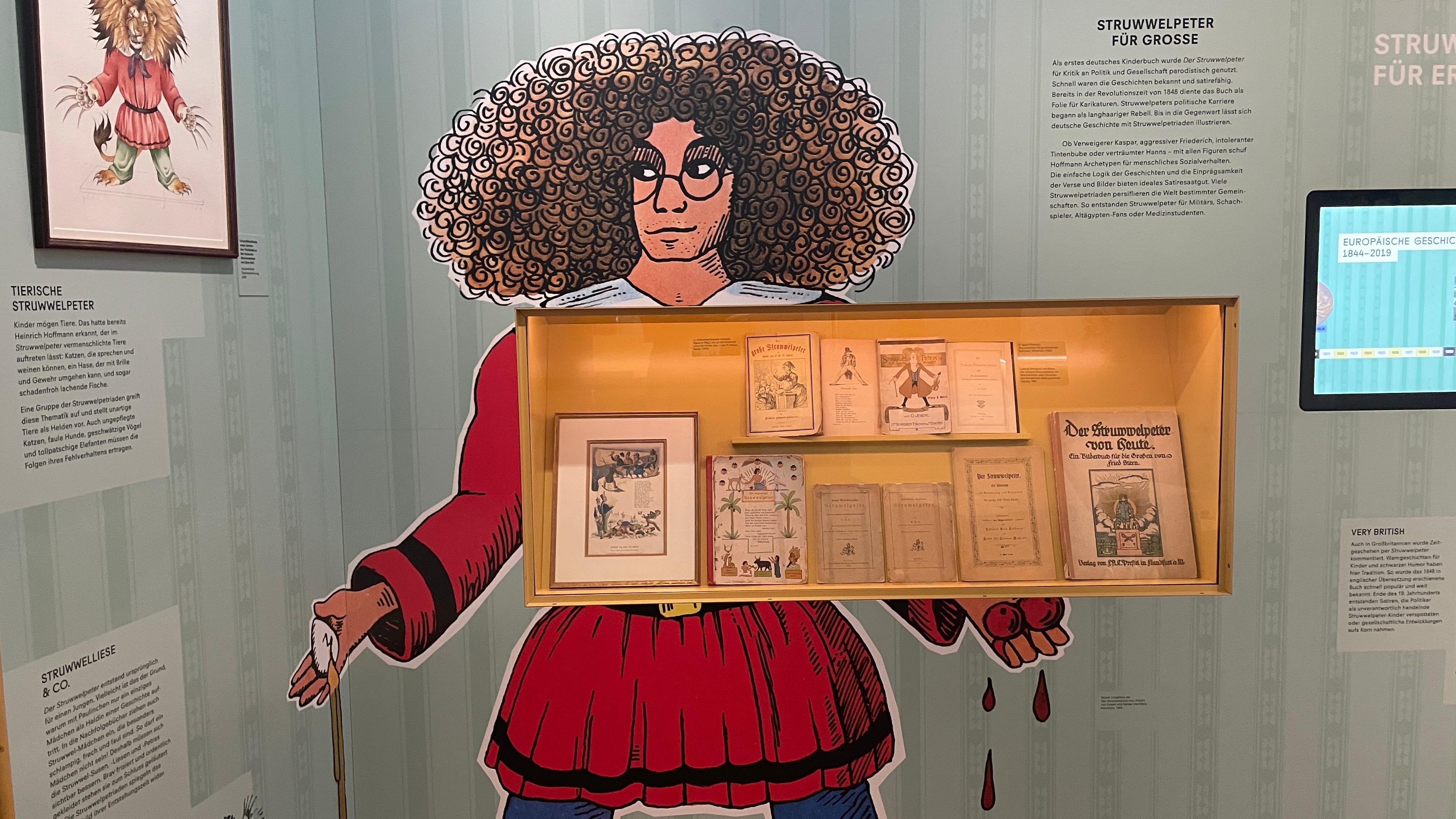
The museum has the good sense not to soften any of this. First editions sit beneath glass beside translations, political parodies, and puppet adaptations. Children climb through interactive installations while adults reread the stories with increasingly uncertain expressions. Hoffmann understood something publishers still exploit: children enjoy danger when it arrives rhythmically.
“When the children have been good/That is good of the children.” The lines begin with nursery rhyme simplicity before disaster enters carrying blades. One gallery projects Hoffmann’s illustrations across entire walls so that the wild haired Struwwelpeter looms several metres high above visitors holding museum maps. Another traces the book’s afterlife through theatre productions, cartoons and educational debates. Nearby sits a display of nineteenth-century editions whose pages are now the colour of weak tea.
Goethe stretches outward. Hoffmann cuts downward. Goethe tried to pull theology, science, eros and philosophy into one enormous intellectual system while Hoffmann worked like a caricaturist in a bad mood, all quick strokes and instant consequences. Yet both are intrinsic to German reading culture. The two writers also expose a class divide in literary inheritance: Goethe entered the canon through universities, ministries and opera houses while Hoffmann survived through family bookshelves and bedtime reading. Frankfurt preserves both with equal municipal diligence.
Toward evening, the light over the Main turned the office towers soft around the edges. Students sat drinking beer on the riverbank beside men still wearing conference lanyards. A woman reading Werther in Turkish has filled the margins with pencil notes. Across the water, a cargo barge carrying stacked containers moved upriver.
It occurs to you that literary museums can easily become mausoleums. Frankfurt mostly sidesteps the problem by folding literature into ordinary civic movement. So, school groups arrive flushed from tram rides, pensioners complain about admission prices, and children sprint through exhibits before being steered toward ice cream shops. Here, books survive through repetition, rebuilt walls, catalogues, guided tours and family inheritance. In this city that re-emerged from the rubble of WW2, it is certain that writers will always find room.
Veidehi Gite is an independent journalist.


