
 E-Paper



HT Picks; New Reads
On the reading list this week is a collection of the poetry of Sufi mystic Bullhe Shah, an intimate portrait of a wild tiger who roamed the Tadoba-Andhari reserve in Maharashtra, and the story of how mathematics has been used to study the mind

 Prefer HTon Google


One of the glories of Punjabi literature
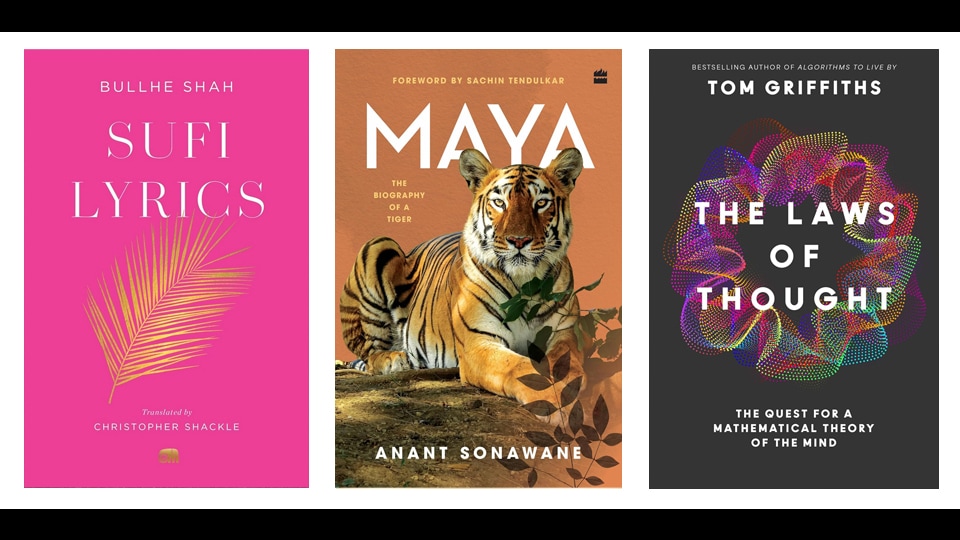

The poetry of Bullhe Shah (d. 1758) is considered one of the glories of premodern Punjabi literature. Born in Uch, Punjab, in present-day Pakistan, Bullhe Shah drew profoundly upon Sufi mysticism in his writings. His lyrics, famous for their vivid style and outspoken denunciation of artificial religious divisions, have long been held in affection by Hindus, Muslims, and Sikhs, and they continue to win audiences today across national boundaries and in the global Punjabi diaspora. Indeed, many young people in South Asia are already acquainted – albeit unknowingly at times – with the iconic eighteenth-century poet’s words through popular musical genres of the twenty-first century.
The book is also part of a box set of Nine Jewels from The Murty Classical Library of India alongside works by Guru Nanak, Biharilal, Mir Taqi Mir, Nandi Timmana, Shah Abdul Latif, Surdas, Tulsidas and a collection of poems of the first Buddhist women.*
Burning bright

In November 2023, Maya — one of the most beloved tigresses of Maharashtra’s Tadoba-Andhari reserve — vanished without a trace. Her disappearance made national headlines, and those who had followed her life at Tadoba for years were left stunned and full of concern for what might have become of her.
Maya’s legend had been years in the making. Born in 2010 and orphaned early, she grew into a tigress of striking composure. She hunted in the open, carried her kills past idling jeeps and often paused before cameras as if aware of the attention she drew from admiring humans. Her calm around people, hold over a vast and contested territory and fierce care for her cubs pushed Maya’s story far beyond Tadoba’s forest roads.
In this deeply observed account, Anant Sonawane retraces that life — from Maya’s precarious beginnings to her rise as a matriarch who moved with quiet assurance under constant human watch. Clear-eyed and deeply attentive, Maya offers an intimate portrait of a wild tiger seen up close, yet never reduced to distortion or myth.*
Mysteries of the mind

Everyone has a basic understanding of how the physical world works. We learn about physics and chemistry in school, letting us explain the world around us in terms of concepts like force, acceleration, and gravity — the Laws of Nature. But we don’t have the same fluency with concepts needed to understand the world inside us — the Laws of Thought. While the story of how mathematics has been used to reveal the mysteries of the universe is familiar, the story of how it has been used to study the mind is not.
The head of Princeton’s AI Lab and a renowned expert in the field of cognitive science, Tom Griffiths explains the three major approaches to formalizing thought — rules and symbols, neural networks, and probability and statistics — introducing each idea through the stories of the people behind it. As informed conversations about thought, language, and learning become ever more pressing in the age of AI, The Laws of Thought is an essential read for anyone interested in the future of technology.*
All copy from book flap.


