
 E-Paper



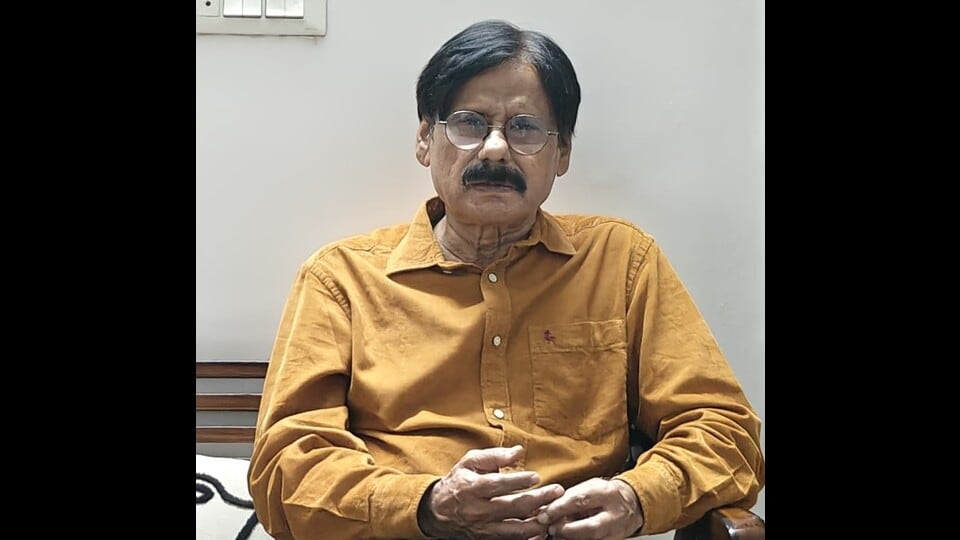
Khalid Jawed: “I keep saying that feeling is more important than understanding”
The author of A Book of Death and the JCB Prize-winning The Paradise of Food on his early life, death, violence

 Prefer HTon Google


While reading this book, I didn’t think until the end that the central character was mad. He is, rather, a writer wrestling with the woes of this world. Is he?
The protagonist calls the mental asylum a university and says that knowledge systems fail to explain the things that the asylum has taught him. That’s why, ultimately, we end up sitting at the edge of that wall of madness. He says that by going mad, he has learned about the world. The difference between being sane and being truly mad is not something you can explain away by saying “most people are like this.” If a single human is mad, you can pronounce him ill. But if an entire country, or an entire community becomes mad, we call it power, we call it politics. When a person’s small conscious layer shifts to the other side, as Durkheim says in his theories of suicide, it can push toward both madness and a kind of euphoria.
When the distance between a man and his society grows smaller to an extent that he loses all sense of a ‘private life,’ it will inevitably turn him into a madman and closer to suicide. To the point where society will not care and keep him marginalized. So, what you said — that he’s a kind of writer — makes sense: his whole narrative becomes commentary on the world, on humans. He could be a writer in that way.

How did you deal with violence in the book? There are many scenes where the traditional meaning of violence is broadened.
Yes, it is existential violence. There’s an entire trauma in existence; that becomes the violence. The dog in the story has its own violence — when it’s frightened, its behaviour becomes vicious. There are big, terrifying scenes. When readers first read those parts, many said they felt like crying; the intensity is very strong.
Each of us brings our own style; I accept that. When I wrote those parts, I used new material, new methods. I didn’t write about the eyes of the protagonatist’s lover with bones in it as if some other emotion had taken over or hatred came in. The way I wrote, certain small changes happened — like two veins appearing above the eye — subtle details that show the build-up. And when someone makes a sacrifice, sacrifice itself is also a form of repression, a violence. If you’ve made sacrifices or renunciations, you’ve suppressed yourself badly. For instance, childbirth has its violence. We discuss a lot about desire, but desire itself also has ways of making a person shake. We also want our beloved to be an extension of us and we commit violence in order to mould them into our images.
The protagonist is not God-fearing. If he had been religious, would the book be different?
Yes. There’s a huge amount of suffering in the book. Shamsur Rahman Faruqi once wrote a long article on it. He mapped the entire journey of the character’s suffering through an old prophet figure who appears in The Quran called Hazrat Ayub (Job). He contracts leprosy in the tale. Leprosy diminished social standing; in 1911, even London didn’t have any solutions. Lepers were ostracized; their marriage were deemed invalid and they were sent away. Everyone distanced themselves from Hazrat Ayub. Then the insects that bred in his wounds, when they crawled out, he put them back into the wounds, as they were eating from the sustenance Allah provided — it’s a grisly image. Since he was God fearing, he had escaped the fate of madness unlike the protagonist. But these are images of Sufis and prophets, not ordinary men and women. So, yes, I do not think this novel could have been possible without his scepticism.
How closely have you encountered death?
The way it (this book) came — I didn’t have to force anything, I was sad and restless. I had always been hungry since childhood. I felt alone even in crowds — at functions, at parties. I still feel shy. 15 years ago, I couldn’t even speak properly; now I don’t know where this articulation comes from. I used to be very nervous. I’d avoid questions; apart from teaching in my classroom, if someone confronted me, I got scared. I used to shrink away. I was always lonely. Even as a small child, I wasn’t part of the festivities. Everyone would be enjoying themselves while I stood outside. That temperament stays with me. I won’t forget it. I was proud and affectionate as a child. I have many pent-up memories.
Did you have any siblings?
No. I was an only child. My mother was a writer. She passed away a year after I was born. I was the only child. My father was a sales tax officer. He loved my mother so much that he said, “I will raise my child as a testament to that.” As far as encounters with death are concerned, I don’t even remember my mother’s face. I’ve experienced many deaths of animals — my dog, cat, parrot, rabbit; it has destroyed me. My heart is very sensitive.

How would you respond to readers who call you anti-romantic and bleak?
Truth is relative. There’s no such thing as an absolute truth. Everyone’s truth is their own. But people don’t understand that. I won’t get too philosophical here, but let me tell you something. In Hinduism, there’s a profound concept — Satyam, Shivam, Sundaram. Everyone talks about it, sings hymns to it, praises it, but few believe in it. The essence of Satyam Shivam Sundaram is that what is true is God, and God is beautiful. In Islam, there’s a concept called Jamal-e-Azli. Jamal means beauty, and Azli means eternal — beauty that never fades. That eternal beauty exists in God. Now think about it — if the Creator Himself embodies eternal beauty, then anything He creates in this world must also be beautiful. People might ask, “How could God create something like a lizard?” But even the lizard is made from the same divine element, even if it appears ugly or repulsive to us. When you look at creation as a whole, these judgments fall away.
And you know this too — when we look at someone, the image first forms upside down in our eyes before our lens corrects it. Our perception itself flips the world before showing it to us. I do not think my themes are otherworldly.
When I was asked, “Why don’t you sell love stories?” The condition of a country too, influences writers. Maybe that’s why my stories trend toward bleakness and death — toward a portrayal of hell — because the atmosphere is like that; it’s inseparable.
The new generation has responded to my work positively. I’m very happy with them. They’ve understood everything — maybe better than we ever did. I keep saying that feeling is more important than understanding. Ingmar Bergman — his films aren’t understood by people, yet he says art isn’t math to be solved; you have to feel it. People often lack that feeling.
Where do you place yourself in the tradition of Urdu literature? Which writers in that tradition have influenced you?
Urdu is a part of me. Alongside Urdu, the tradition of Urdu fiction is intertwined with poetry. Reading Ghalib or Mir is like reading poetry. But Urdu fiction as a tradition isn’t that old. We have a vast Urdu poetic tradition — if translations had been done earlier, poets like Ghalib would have been seen as equal to Goethe. But which great prose writer did we create? Premchand created such a mountain with social realism; he’s over a hundred years old and there’s no alternate model of that kind of social realism. So, I step away from the Urdu tradition of social realism. In the past 100 years, did we invent alternative narrative models? We didn’t.
I wanted to move away from the straight-line plot. This tradition — while not in Urdu or Hindi — was present in Sanskrit and drama. Buddhism has similar patterns. Straight-line plots preserve logical sequence without breaking it, whereas real life breaks logic. No art can grow without experimenting. 2000 years ago, people painted landscapes; today we call them aesthetic. During and after the world wars, aesthetics changed — Dadaists said old aesthetics wouldn’t work and invented new visuals. The widespread destruction changed aesthetics. But in our context, there was no equivalent change. There were some abstract stories but they lacked narrative; they often felt like a flood of madness without characters.
Existentialism and exploring the darkness of being didn’t take root in our Urdu fiction. So, I feel outside that tradition — though I don’t mean I disliked anyone in Urdu. The writers of their time did important work. But in the last 40 years, not much has happened here. I can name a few stalwarts — Intizar Hussain, Naiyer Masud, Qurratulain Hyder — our last greats. I admire Abdullah Hussain’s Udaas Naslain a lot; he was dialectical, symbolic, surreal at times, though sometimes extreme to the point that his influence wanes. Pain used well becomes almost alive. No river is dead — tradition branches like a river. If a tradition runs straight like a canal, it’s artificial. Despite living in the tradition, I feel simultaneously included and isolated.
Pranavi Sharma writes on books and culture. She lives in New Delhi.


