
 E-Paper



Making of a legend
Pandit Hariprasad Chaurasia’s incredible journey comes alive in the pages of his biography, that tries to decipher his journey, one note at a time


There’s a part in Sathya Saran’s intimate biography, A Breath Of Gold, in which Hariprasad Chaurasia, during a performance in Mumbai in 2018, suddenly realises that he’s out of breath. ‘His heart fluttered. The note was flat. I am tired he thought,’ she writes. This happens for the first time and he asks the portrait of his late guru, Annapurna Devi: “You have abandoned me. Why? Have I not been a good student?” The next day he comes out of the hospital after a surgery with three stents in his heart. Perhaps, this personal touch that the author gives, is what takes the reader on a journey along with the legendary flautist. “When I write about somebody, immerse myself completely into that person. I wanted to be in his mind and I wanted to think like him,” Saran says about her process.
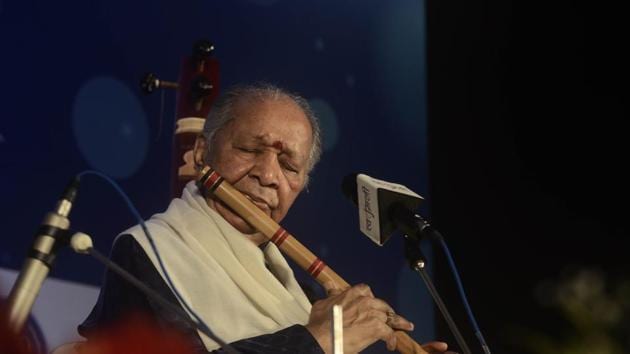
This is the third biography on Pandit Hariprasad Chaurasia and he says that he agreed to it because he felt this would be different from the others. “This book had to say something different. It had to tell stories that people do not know. It is a very difficult task for Sathya. I acknowledge the fact that she’s got guts,” he says.
The book chronicles his musical journey, but at the same time, conveys the philosophies that he has followed. “This book I felt tried to steer clear of details of personal relationships. And I felt that is good because that becomes the peg of the sales then. That, everyone does. But what about the struggles? What about the sweat and tears? That’s where she comes in. That’s why this book is different,” says the legendary artiste.
The flautist was being trained to become a wrestler by his strict father, when he realised that his interests lied somewhere else. The Padma Vibushan winner lost his mother when he was five. “My father did not remarry. He was a pehelwan. He thought there was no need for him to remarry. He said he is strong and capable enough to raise his children,” he laughs.
The book goes on to cover a period of time. From the days a young reluctant wrestler waited on the sidelines of an akhada, waiting to get pinned, to the time he discovered the instrument that’ll change his life, to the rise of Indian classical music around the world. Saran says the artiste was excited to contribute to this project of her’s. “Actually, it was his family who first decided of have a book on him. That’s when they got in touch with me, and then they told him. When I wrote to him, he wrote back saying that he’ll be very happy to do this book.”
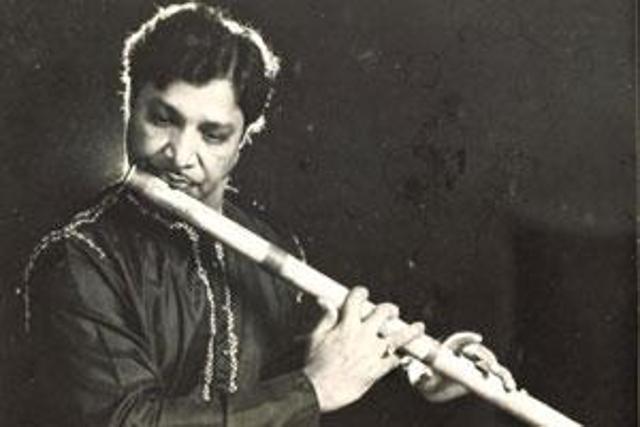
“I have to say, he was not impressed, initially,” says Padma Vibhushan, Hariprasad Chaurasia, reminiscing about the time when he landed a job at All India Radio in Cuttack. The ‘he’ here, is his father, a strict disciplinarian, who wanted his son to become a pehelwan.
But the day his father got to know of his son’s exploits, he presented a completely different side of himself. “He was crying. It was the first time I’d seen him cry. A pehelwan, who always looked intimidating, who I’ve seen pin down the finest of wrestlers, was crying for the first time in front of my eyes. I told him that I will have to go; otherwise someone else will get this job. This is the only way I’d be able to stay in this line of music,” he adds.
A life in pages
All of these stories and experiences make up the tell all biography, penned by Sathya Saran, as she covers an array of topics that have piqued the interest of many for decades. Titled Breath of Gold, the flautist’s formative years and the making of the legend comes alive through its pages. “When I write about somebody, I immerse myself fully in that character. I kept watching him. I think when you are a fiction writer, you grab some traits from people in your surrounding without even realising it,” says Saran about the process.
“My attempt has always been to write a biography that does not read like a biography. I wanted it to read like semi-fiction. I used the skills I would have used had I been writing a novel,” adds Saran on her process of undertaking this mammoth task.
An unlikely helping hand
The book covers numerous standout incidents from his life and of them it is impossible to snub the fact that the flautist found assistance in the form of the late Jehangir Ratanji Dadabhoy (JRD) Tata. So much so that, he says, “I feel, because my mother left me very early, she made sure that I got everything through him.”
It all started when JRD Tata, one day, heard Pandit’s music in his car, on radio. “He was very helpful. Fortunately, when I came to Mumbai, JRD Tata liked to listen to my music in his car on radio,” says the flautist. “JRD wanted me to perform in his theatres in Mumbai. I remember if there was anything, he’d say, ‘call Chaurasia’. Back then, Ratan was very young and I remember, he’d sit behind his father,” he laughs.
It was the Tatas, who helped him set up his gurukul in Mumbai. “When they came to know that I was thinking of making a Gurukul in Bombay (Mumbai), they came forward to support me,” he adds.
When the West came calling
And if there’s anything that a millennial knows of iconic ’70s, it’s the reckless and hippie trail escapades that were inspired by legendary bands such as Led Zepplin, Pink Floyd and Queen, who were very much in their prime. And amidst all this, birthed a fusion of Indian classical music and western sensibilities. The pioneers included — Pandit Ravi Shankar, Ustad Allarakha, Shivkumar Sharma and Pandit Hariprasad Chaurasia himself. “I miss them all. They were great artistes. They were good human beings and did so much for me. They were the ones who spread Indian classical music across the world,” recalls the flautist.
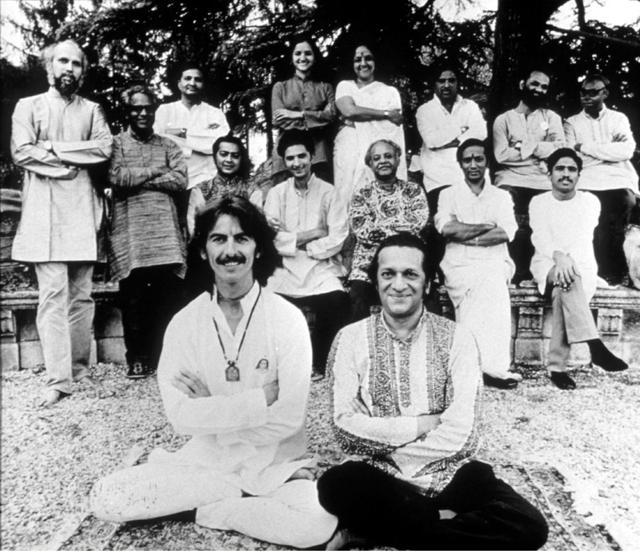
He also found himself an unlikely ally in George Harrison (from The Beatles). The artiste distinctly remembers the day Harrison walked into his home. “Somehow, he came to know about me. Perhaps, through Ravi Shankarji. One day, he came to my home. I remember, when he stepped in, I thought, who is this guy? His clothes are messy, his hair is uncut and his beard is not groomed at all. That’s when he told me – ‘Hi, I’m George Harrison and I love your music’,” he laughs recalling the incident. This was when Pandit Ravi Shankar walked in and he told me that this is the lead guitarist of the biggest band in the world.”
Harrison would sit for hours with the flautist and talk about how fascinated he’s with the flute. “He told me that he loved the fact that flute is such a simple instrument, unlike his guitar. I remember, he sat with me for a long time and told me that every time he comes to India, he’ll definitely pay me a visit, which he did. He’d come with his girlfriend. He used to come every year and go to Vrindavan (Uttar Pradesh). Nobody knew this. He grew his beard and hair to hide himself. He used to live there for about a month and then he used to come to Bombay or Calcutta to work with us,” he recalls.


