
 E-Paper



Manjula Narayan picks her favourite reads of 2024
From a biography of a pioneering anthropologist to a book on the wonderful old trees of India, another on the history of travel and a prize winning novel on a lynching, there was much to read this year

 Prefer HTon Google


From books on pioneering Indian anthropologists, the history of tourism and India’s video cultures of the pre-digital era to ones that broaden the contemporary reader’s understanding of the Manusmriti, millennials and the middle class, there were lots of exciting reads this year.
Urmilla Deshpande and Thiago Pinto Barbosa’s Iru; The Remarkable Life of Irawati Karve and Reema Desai Gehi’s ‘The Catalyst; Rudolf Von Leyden and India’s Artistic Awakening broadened my understanding of the cross-cultural currents swirling around India and the world in the interwar years as well as the post-Independence period. While Karve did her PhD in Berlin under Eugin Fischer, scientifically disproving his theory of European racial superiority in the process, and returned to ask crucial questions about language, culture and religion in India, the Jewish cartoonist Rudolf von Leyden moved from Germany to India in the early 1930s, becoming an influential mentor and patron of the Progressive Artists Group.
Ishita Tiwary’s Video Culture in India; The Analog Era is a wonderfully nostalgic read that recalls the era of video libraries, Hiba films and news magazines like Newstrack that documented everything from Mandal and Masjid to the militarization of Kashmir. Then there is S Natesh’s Iconic Trees of India, which features the country’s many old and wonderful trees including the mother tree of the Dussehri mango in UP, the sacred rayan tree of Ranakpur, the coronation cypress of Norbugang in Sikkim, and the Mahabodhi tree in Bodhgaya under which Buddha attained enlightenment. “The oldest tree in the world is more than 5000 years old and the oldest tree in India is about 2031 years old. Trees grow continuously until they die. They are a lesson to all of us – that we need to keep ourselves intellectually and physically fit until we die or we will become obsolete and irrelevant,” author S Natesh told me on the Books & Authors podcast.

I picked up Arvind Sharma’s From Fire to Light; Rereading the Manusmrti with some trepidation. “Yes, there’s a lot in the Manusmriti about jatis and marriage and caste, which is not appealing to a modern mind. But at least 40 smrtis have been known to exist. The Manusmrti was just the one chosen by the British when they were looking at Hindu law. The smritis were a way of updating legislature, as it were, with changing times. It wasn’t set in stone and there’s an awareness within the tradition about this. In the end, we have to apply our judgement to both tradition and modernity,” said Sharma whose book successfully contextualizes the work.
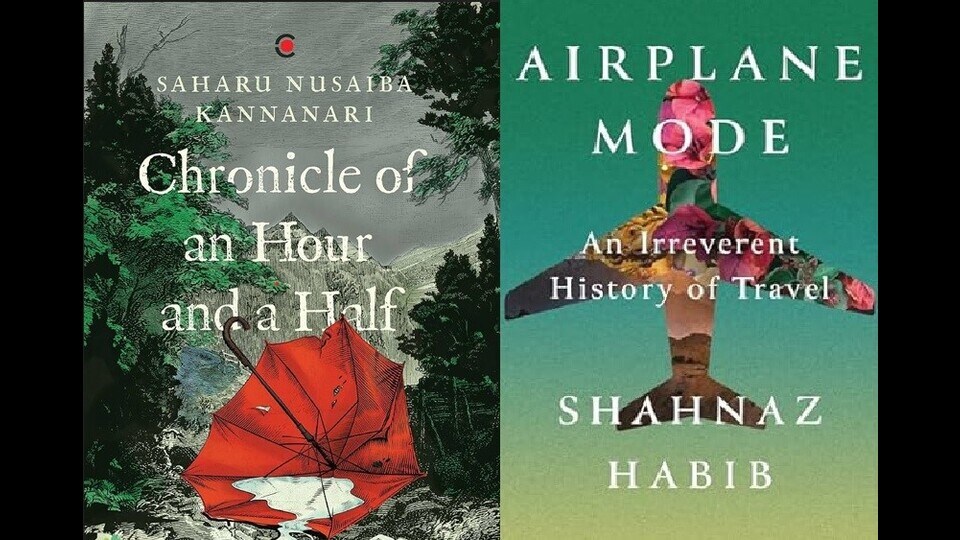
I generally gravitate towards non-fiction believing, mistakenly, surely, that it will help me understand the world better. This year, however, since I found myself on the jury of the Crossword Book Awards in the fiction category, I was forced to read plenty of novels. I enjoyed many of them but the one that struck me with its relentless pace and luminous writing was the winning title, Saharu Nusaiba Kannanari’s A Chronicle of an Hour and a Half about a lynching in a Kerala village. It called to mind Mikhail Sholokhov’s statement that “the novel is the genre that most predisposes one to a profound insight into the tremendous life around us…”
So, really, 2024 has been a year of excellent books, But since I have to pick my favourite read out of this embarrassment of riches, I’d point to Shahnaz Habib’s Airplane Mode; A Passive Aggressive History of Travel. It touches on everything from wanderlust as consumerism in another form to vacations and the history of work, and how travel in this age of social media is now about FOMO (the Fear of Missing Out). “The history of tourism is intricately connected to colonialism. Travel writing is a direct descendent of colonial exploratory writing and even today, modern tourism has that DNA. Modern tourism, in its internal logic, has a colonial gaze. This idea of “discovering” other places is built into the idea of why we travel” said Habib.
And suddenly, just like that, I see my own yearning for a week in the jungles of Angkor Wat in an entirely new light.


