
 E-Paper



Report: Apeejay Kolkata Literary Festival
The 17th edition of the event had sessions that discussed everything from pre-Harappan culture to the tyranny of the algorithm

 Prefer HTon Google


AKLF began with a welcome address from festival director Anjum Katyal before the event was officially inaugurated by singer Usha Uthup and actor Madhabi Mukherjee. A launch of the latter’s memoir Madhabi’s Garden and a discussion on it followed. Moderated by Oindrilla Dutt, the panel featured Uthup and Mukherjee in conversation with Arunava Sinha, who translated the book from the original Bangla. Mukherjee spoke about how she started acting from a young age with stalwarts like Chhabi Biswas. About her own journey Uthup said, “I’ve always been a people’s person and wanted my songs to leave an impact on the audience. Every day that I sing a song, it has a different meaning that I also want to convey to the listener.” Sinha spoke about being enthused at the prospect of translating a work by an artist he had always admired and about having learnt so much more about her during the process.

This was followed by a discussion on making history interesting with authors Norm Coady, Prateek Dasgupta, Sumanto Chattopadhyay and Amitabh Singh Baghel. “I’m a provocateur who wants to encourage discussions and have used objects to do that in my book,” said Coady, author, Props. “I believe that words are actually living, breathing museums that we carry with us,” Chattopadhyay, author, Stories of Words and Phrase, added as he explained the origins of the word “boycott”. He also revealed that he had a personal connection to the venue, the Alipore Museum, as it was where his grandmother was imprisoned by the British for being a part of the Women’s Self Defence Association. Dasgupta, author, Forgotten Footprints, said he wrote the book because several existing narratives are not based on historical facts. One of these was about Mehergarh, a pre-Harappan culture whose people were the first to domesticate cotton and even practice dentistry using stone age tools.
The next luminous panel on the sun god had Shalini Modi and Lopamudra Maitra in conversation with Oindrilla Dutt. Modi, author of The Eternal Sun shared her deep connection with the sun and how it had led her to write her book. Maitra spoke of how certain parts of history have been kept alive through folklore and through stories that can’t be found in books.
The day took a different turn when Mallika Dua, Karuna Ezara Parikh and Sandip Roy talked about the world of influencers. “Unlike what some people say, there’s no sure shot route to become an influencer,” said Parikh who added that algorithms have ruined creativity. “What is being pushed to you and what is being hidden is quite apparent. I observed that when I posted stories on Gaza, they were being hidden,” she said. “I started my journey in the pre-Jio era and was lucky to get approached by some interesting opportunities to which I said yes. I have a habit of saying what I feel which isn’t really a nice habit,” said Dua.

The first day ended with a discussion of The Elsewhereans that featured the book’s author Jeet Thayil and novelist Ruchir Joshi. The book is about a family – Thayil’s parents are characters in it – that moved around the world and realised, when they returned, that they didn’t really belong there anymore. Joshi said that though his first book also had his own parents as characters, he couldn’t have written it when they were alive. Thayil responded that while his father was okay with being a character, his mother had her reservations but finally allowed it.
The second day started with a session on historical fiction with Madhurima Vidyarthi, Tarana Husain Khan and Harshali Singh in conversation with Amita Prasad. Singh stated that the mansion in her Haveli series actually exists in Chandni Chowk and that she had wanted to write about it, even turn it into a character, since the first time she laid eyes on it. Khan spoke about what historical fiction entails: “The basic trajectory in historical fiction should be real and the gaps could be filled with narratives.”
A session titled Growing Pains: GenZ and Preparing for Tomorrow with Riri G Trivedi and educator Vijender Chauhan in conversation with Sujata Sen touched on the resilience of the generation being discussed. “GenZ were born into the internet and we need to understand that their agency doesn’t lie with parents or teachers but somewhere else. Algorithms are shaping children in ways we cannot imagine,” said Chauhan.
Next, Arundhati Ghosh and Marie Darrieussecq spoke to Ahona Palchoudhuri about alternate approaches to love and relationships. “There are many misconceptions regarding polyamory in our society. For example, jealousy in polyamory is not a deal breaker as you feel the same even in other relationships. Practising polyamory for me is being anti-one. One culture, one religion, one leader doesn’t work with me. You cannot be fascist and polyamorous,” said Ghosh, author, All Our Loves. Darrieussecq spoke about her own experiences: “At the age of 57, I am now focusing on my female friends. In France, I’m often stopped while walking on the street by men… They just see me as a piece of meat.”
The concluding session on mythology had authors Anand Neelakantan and Satyarth Nayak in conversation with Priyadarshinee Guha. Nayak spoke about the lens with which to approach epics like the Ramayana and the Mahabharata as many of their stories are metaphorical. Neelakantan pointed out that there is no sameness when it comes to Indian myths. “For civilization, it is important to move with science and logic. Elon and Trump are modern day asuras which they’re proving true with their actions,” he said.
The last day began with a session on crime thrillers featuring authors Rudraneil Sengupta and Amit Lodha, who is also an IPS officer, in conversation with Jashodhara Chakraborti. “I always wanted to be a writer but I didn’t know enough to write about crime and then my journalism career helped me. Following the dharma of journalism, I wrote about things as I saw it,” said Sengupta. It was the opposite for Lodha: “While all my books are somehow based on real life incidents, the story is fictional and because of that I get into trouble as well.”

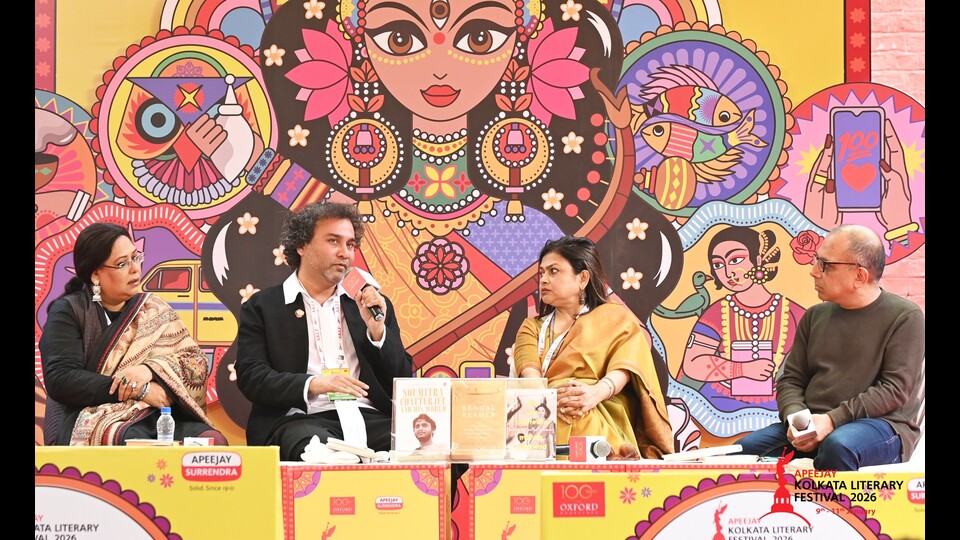
An intriguing session titled From Feluda to the Kothas had Sanghamitra Chakraborty, Manish Gaekwad and Poulami Chatterjee Bose in conversation with Arunava Sinha. While Gaekwad, author, Nautch Boy, spoke about his mother who was a courtesan, Chakraborty, who is the biographer of Soumitra Chatterjee, and Chatterjee Bose, who is his daughter, discussed the different aspects of the late actor’s life. Along with the main event, simultaneous sessions were also held at the Oxford Bookstore. Arunava Sinha, V Ramaswamy and Sayari Debnath along with the authors whose work they’ve translated like Sakyajit Bhattacharya, Adhir Biswas and Jayanta Dey sat down with Epsita Halder for an in-depth talk on the art of translation.
This was followed by Queer Tales where novelists Sudipto Pal, Rahul Singh and Sandip Roy discussed their books with Arundhati Ghosh. Many visitors also flocked to the poetry recitation stage.
All in all, the Apeejay Kolkata Literature Festival had some great sessions that provided much food for thought.
Chittajit Mitra (he/him) is a queer writer, translator and editor from Allahabad. He is co-founder of RAQS, an organization working on gender, sexuality and mental health.


