
 E-Paper



Report: The Mahindra Kabira Festival 2022
The sixth edition of the festival celebrated the 15th-century weaver-poet Kabir’s words and wisdom through music, puppetry, storytelling, and scholarly talks

 Prefer HTon Google


The sixth edition of the Mahindra Kabira Festival, held from November 18 to 20 on the banks of the river Ganga in Varanasi, was a magnificent celebration of the 15th-century weaver-poet Kabir’s words and wisdom. The city, also called Kashi and Benaras, was where Kabir spent much of his life. The festival was memorable not only because of the breathtaking sunrises and sunsets that could be witnessed from the venues – Guleria Ghat and Shivala Ghat – but also because the itinerary was packed with a broad range of offerings that included music, puppetry, storytelling, local cuisine, heritage walks, and scholarly talks.
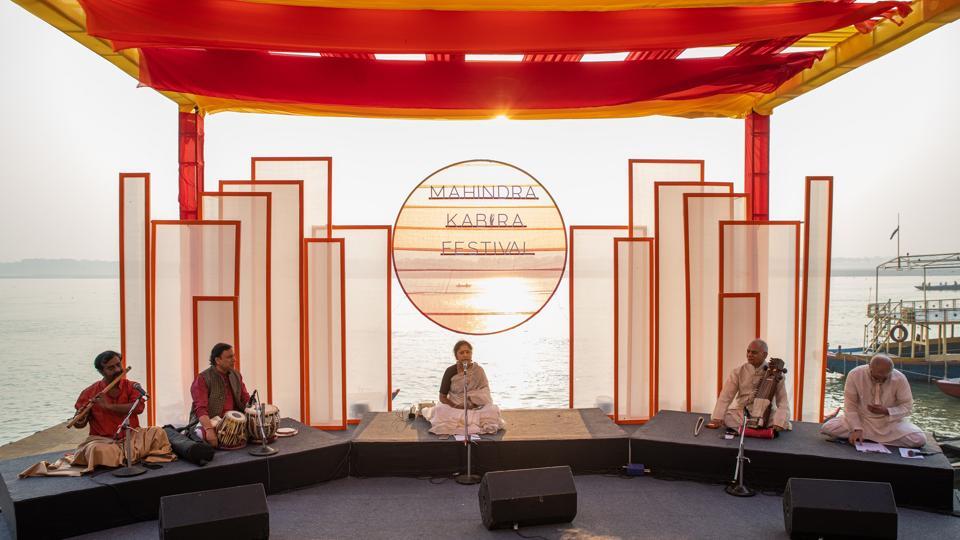
The Ganga aarti that opened the festival at Guleria Ghat was a mesmerizing display of colour and light. The first act, a santoor-tabla jugalbandi by two exponents of Hindustani classical music – Kumar Sarang and Pandit Lalit Kumar, set the right tone for an intense and joyful three-day immersion into the poetry and philosophy of Kabir whose voice resonates across centuries and speaks to us of love, self-awareness, humility, and the folly of clinging to narrow identities.
Vidushi Kamala Shankar, who invented and plays the Shankar slide guitar, accompanied by guitarist Nirmal Saini and tabla player Pandit Vinod Lele, enthralled listeners with Ud Jaayega Hans Akela, a Kabir bhajan popularized by Pandit Kumar Gandharva. The song points to the transience of life, the inevitability of death, and the need to be mindful of how we use the precious time we have before we run out of breath.
Vocalist Ashish Kumar Jaiswal and pakhawaj player Ankit Parikh presented Kabir in the Dhrupad style of Hindustani classical music, and spoke of music as upasana or worship. Umesh Kabir, an educator and researcher associated with the Kabir Chaura Math in Varanasi, spoke of Kabir’s opposition to bigotry and superstition. He added that Kabir’s poems always ask listeners to lend an ear – not follow – because a herd mentality is not conducive to inner exploration.
These musical sessions were followed by a dialogue between Roobina Karode, director of the Kiran Nadar Museum of Art, and Anubhav Nath, director of Ojas Art, who discussed three visual artists who have engaged deeply with Kabir – Haku Shah, Arpana Caur, and Gulam Mohammed Sheikh.
Karode noted that people who want to engage with Kabir “do not have to go to a mandir or masjid” because his poetry is “rooted in renunciation, in eliminating all that is unnecessary.” She added, “ He makes a distinction between need and greed. He is deeply philosophical but his wisdom is grounded in the everyday. He focuses on practice, which has a transformative energy.” She clarified that people mistakenly assume that Kabir was against scholarship; he was against “blowing one’s own trumpet and claiming knowledge and realizations that one does not have”.
Carnatic classical vocalist Sushma Soma, accompanied by Praveen Sparsh on percussion and Abhinandan R on the guitar, performed Naiharva – another Kabir bhajan popularised by Kumar Gandharva – along with songs from her album Home.
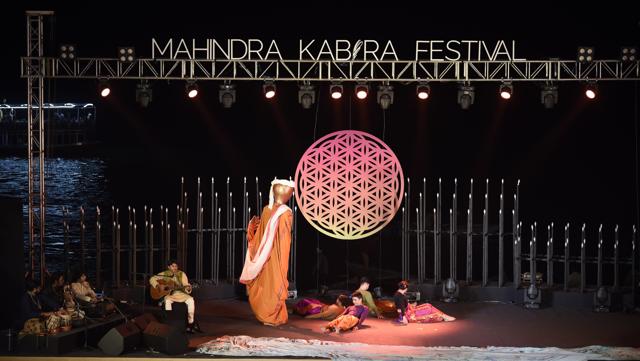
The Ishara Puppet Theatre, led by Dadi Pudumjee, collaborated with the Soulë Band, to come up with a spellbinding presentation combining puppetry, dance and music with Kabir’s couplets that articulate the most profound truths in the most accessible manner. Seeing Kabir as a giant puppet was a novel experience for most who have seen him only in paintings and posters.
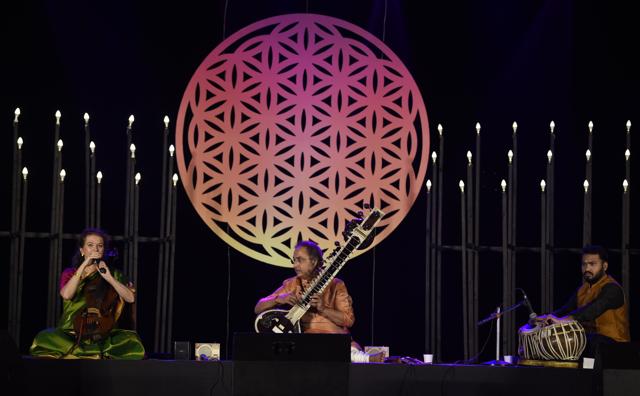
Sitar player Pandit Shubhendra Rao and cello player Saskia Rao-de Haas performed a jugalbandi based on a translation of Kabir by Rabindranath Tagore, which refers to the anahat naad or the unstruck sound – a mystical concept that appears frequently in Kabir’s poems.
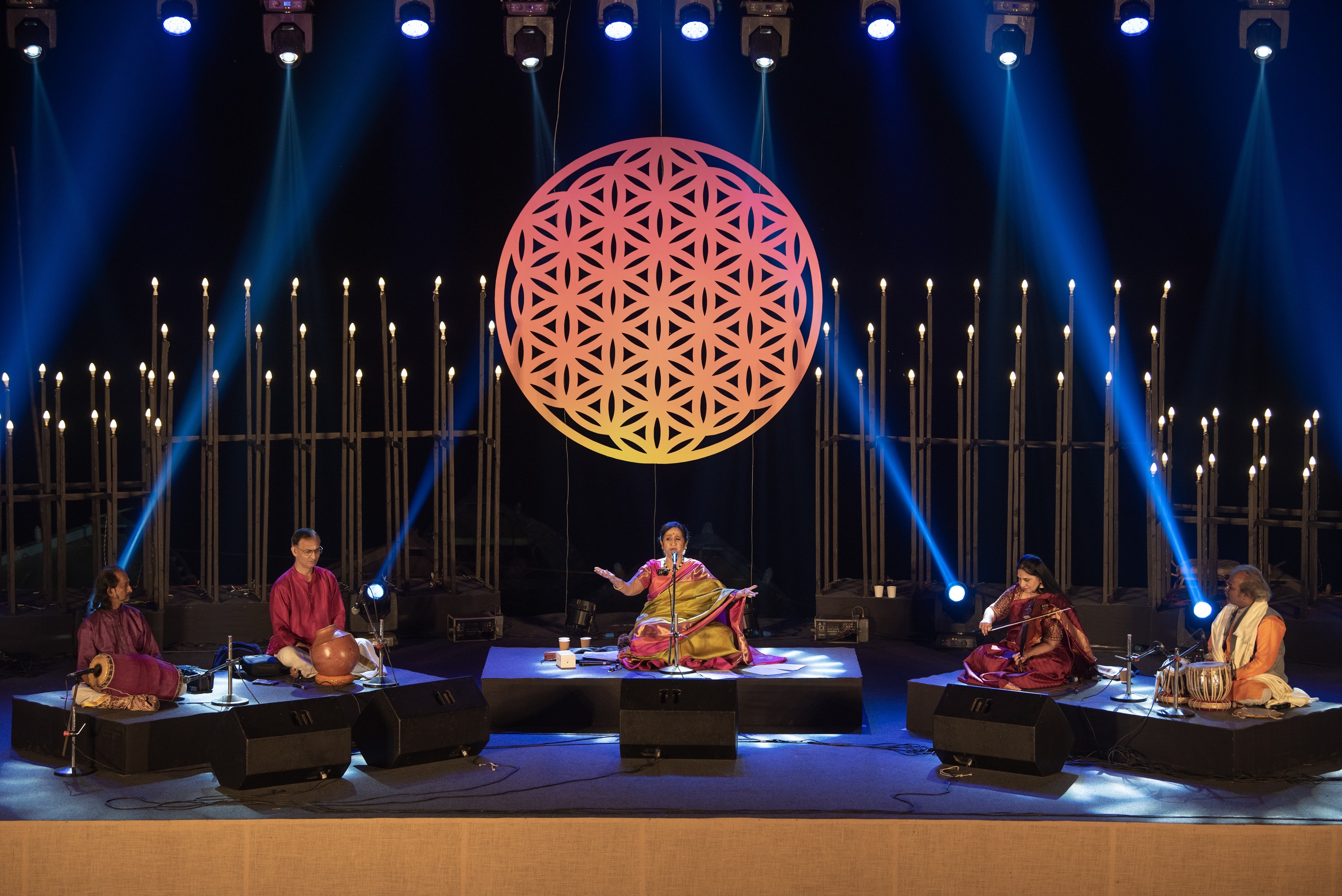
Words seem inadequate to capture what the listener experiences at such performances. As Carnatic classical singer Aruna Sairam said, “Sitting here with all of you, in the presence of Gangaji, I feel a sense of universal belonging. It seems as if every difference, parochial thought, and limited identity is getting dissolved.” In renditions drenched with bhakti, Sairam alternated between poetry celebrating the nirgun (formless) and sagun (form). Apart from sakhis (couplets) of Kabir set to music, she sang a Marathi song about Ganpati Bappa joining a procession of devotees and dancing with them. Her piece that combined Adi Shankara’s invocation to Meenakshi Amman with a Gregorian chant in praise of Mother Mary gave listeners gooseflesh. She also drew on her experience of participating in kirtan to get audiences to sing along with her.
What she loves about Kabir is that “he is absolutely traditional on the one hand and completely avant-garde on the other”. She said, “There is asceticism in his poetry, and also a deep love for the creatures of this world. These contradictions make me think about the amazing mind he must have had. His brevity of expression and his simplicity move me, and so many other people.”
Hindustani classical vocalist Rama Sundar Ranganathan, accompanied by tabla player Ustad Akhtar Hasan, sarangi player Pandit Bharat Bhushan Goswami, and moderator Nitin Vaidya, gave audiences a taste of various luminaries from the bhakti tradition that has flourished in the Indian subcontinent – Kabir, Meera, Guru Nanak, Tulsidas, and Swati Tirunal. Her rendition of Chalo Mann Ganga Jamuna Teer was poignant because of the physical setting – the mind, like the river, can be muddy or crystal clear. Sagun agun mein nahin kuchh bheda and Awwal Allah noor upaya qudrat ke sab bande were among the other songs that she sang.
The Maharaj trio, comprising Sarod maestro Pandit Vikash Maharaj and his sons Abhishek Maharaj on the sitar and Prabhash Maharaj on the tabla, brought in a local flavour. Their soothing music was accompanied by commentary on the Benaras Gharana. While everyone else spoke of Kabir’s influence on the city, the Maharaj trio spoke of the city’s influence on the poet.
Fouzia Dastango and Ritesh Yadav, who performed Dastan-e-Kabir written by Danish Iqbal, used the dastangoi form of storytelling to weave in Kabir’s couplets along with key instances from his life so listeners could imagine him as a living, breathing human being.
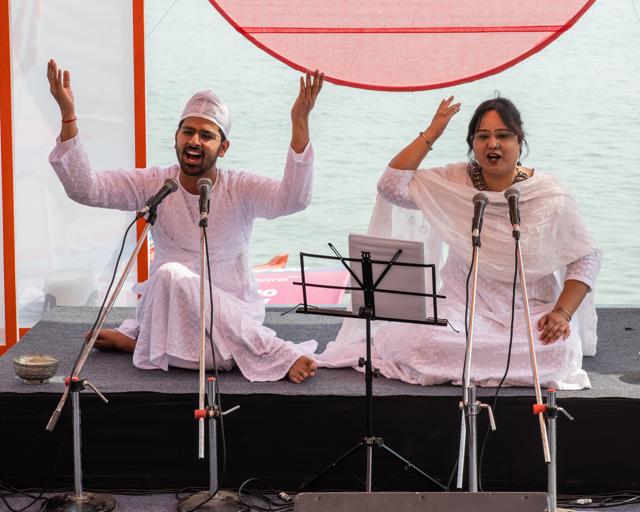
Purushottam Agrawal, author of Kabir, Kabir: The Life and Work of the Early Modern Poet-Philosopher (2021), teamed up with actor-singer Vipin Heero for a thought-provoking session titled Kabir Panguda Allah Ram ka (Kabir is the child of Allah and Ram). “We must stop treating Kabir like a hero of a Bambaiyya Hindi film. He is not a poet of Hindu-Muslim unity. If anything, he united Hindus and Muslims against him. He spoke about the hypocrisy of both,” Agarwal said.
Together Agarwal and Heero gave listeners a chance to experience the ulat bansi genre of Kabir poems that conjure absurd images to shake people out of their conventional, habitual ways of perceiving and meaning-making.
Yogendra Saniyawala, Swati Minaxi, Biju Nambiar, and Gaurav Kapadia, who make up the Tapi Project, are interested in Kabir’s journey. According to them, “Kabir speaks timeless words of wisdom, his words are a guiding light to every human being, at any age or time of his or her spiritual and philosophical growth. As musicians, for us, he acts as the path, the light illuminating the path and destination itself.” However, they write their own lyrics as they feel that their words should come from their own quest.
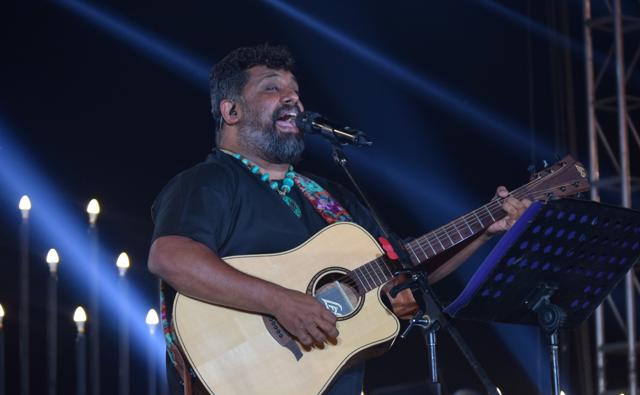
The closing act was by the Raghu Dixit Project, which presented the Kannada poetry of Sant Shishunala Sharifa alongside Kabir. “I hadn’t explored Kabir until a few years ago due to the language barrier. Thanks to filmmaker-singer Shabnam Virmani who started the Kabir Project and the Ajab Shahar archive, I have been able to understand Kabir,” Dixit said. The band, which plans to bring out a Kabir album, performed four of the eight Kabir songs they had recorded before the festival. These included Aag Lagi Hai Ghani Bhaari, Jhaad Chaddhanta Machhiya Dekhi, Mann Laago Mero Yaar Faqiri Mein, and Yeh Tan Thaat Tambure Ka.
“I am 48 now. I think a lot about who I am as a person, why I am the way I am, and how I can transform myself. The purpose of going on stage has changed. Now I want to make people happy, I want music to put faith in their hearts – the faith that they can cope with the worst that happens in their lives,” said Dixit who was excited to discover the multiple overlaps between the poetry of Sant Shishunala Sharifa, Kabir and Bulleh Shah. Jasleen Aulakh, who sings in Punjabi, and performed songs written by her mother Polly Saghera, joined Dixit on stage for one of the songs in his set.
Though the delegate rates would have been forbidding to many who were eager to experience the festival, it is worth noting that all the events at Shivala Ghat were free and open to the public at large. Sadly, this year’s line-up had a minuscule presence of performers from socio-economically marginalized communities that are known for preserving and transmitting the oral traditions of Kabir over successive generations. Hopefully, this will change in future editions of the festival.
Chintan Girish Modi is an independent writer, journalist and book reviewer
The views expressed are personal


