
 E-Paper



Report: Bhutan Echoes 2025; Drukyul’s Literature and Arts Festival
With interesting sessions on AI, imperialism, yoga, art and economics, stalls selling local ware, and a well-behaved audience, the festival held in Thimphu, Bhutan, was a wholesome experience

 Prefer HTon Google


Driving into Thimphu for Bhutan Echoes; Drukyul’s Literature and Arts Festival, it’s apparent that the city has grown quite a bit since you last visited in the pre-pandemic era. There are many more buildings and vehicles, and more people too in the streets. Thankfully, they are all still as nice as ever. For a traveller from gritty NCR, the politeness and good humour is almost as shocking and the dazzling white clouds rumbling in a deep blue sky. At the Royal Bhutan University campus where the three-day event that kicked off on 2 August was held, the traditional jester is wandering around getting up to mischief as he does ever year; only this time, there’s no sign of his regular prop, a large well carved wooden penis that in years gone by he waved cheerfully at all and sundry. These phallic objects that are believed to bring good energy and ward off the evil eye are connected to the teachings of “the Divine Madman”, a medieval master from the Drukpa Kagyu school of Tibetan Buddhism, who is the subject of Needrup Zangpo’s book, Drukpa Kunley; Sacred Tales of a Mad Monk, which was released at the festival. It’s tempting to give in to the lugubriousness that comes with the thought that the rest of the puritanical world has badgered the Bhutanese – a nation that has never been colonized – into hiding these fertility symbols but there’s just too many interesting sessions to attend for you to wallow.
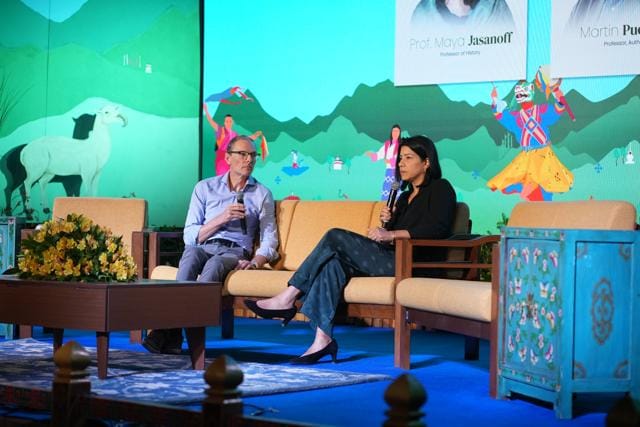
One of them is Forced and Inherited; Tracing the Roots of Imperialism and Their Lasting Impact on Identity and Power- which has literary critic and philosopher Martin Puchner in conversation with historian and fellow Harvard academic Maya R Jasanoff. “The language discussing imperialism is quite impoverished. About the empire-colony dichotomy, when you get down to brass tacks… we can see the US, Russia and China exercising imperial practices. Occupation and violence come with empires,” said Jasanoff.
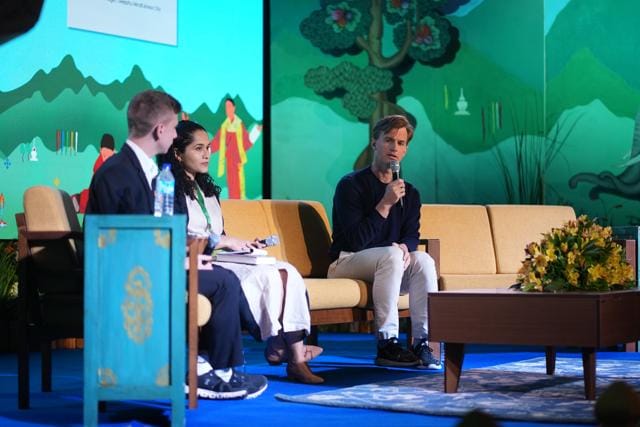
The conversation between Nicholas Thorne, co-author, Me, My Customer and AI, the novelist Amrita Mahale, who also works for a non-profit that uses AI for improving women and children’s health, and Gal Raz of Bhutan’s Gelephu Mindfulness City discussed the ways in which AI might falter when its trained on data from more homogenous societies and also the more optimistic side of Artificial Intelligence. “AI presents a tremendous opportunity for public health,” said Mahale while Thorne stated that entrepreneurship can be made easier with AI tools. “The definition of neighbourhood might be changing to include places across the world of people with shared community interests,” added Thorne, who is a startup incubator expert.
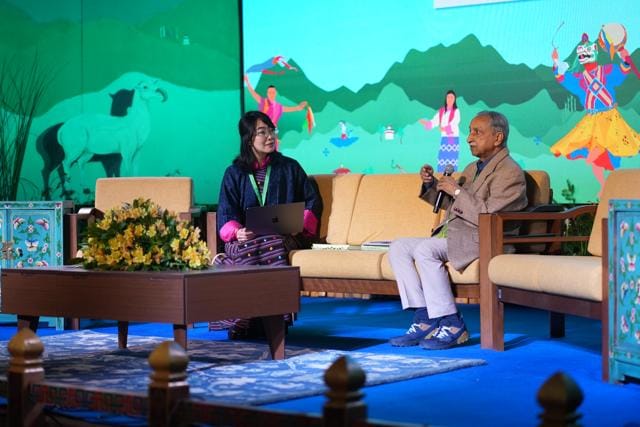
Unsurprisingly, AI also featured in the session titled Digital Transformation and New Narratives: The future of Indian and Bhutanese Cinema that had podcaster Tsewang Rigzin in conversation with Indian film maker Kiran Rao and Bhutanese documentary film maker Arun Bhattarai. “For an independent filmmaker, AI is like an assistant. We have to adapt,” said Bhattarai, maker of Agent of Happiness, who usually spends about three years with his protagonists while developing his stories. “Through my work, I like to understand what makes us human, and makes society what it is,” he said. Rao whose Lapata Ladies was screened at the festival believes cinema is facing a challenge from social media. “Our battle is for people’s attention. As a film maker I would encourage people to take a break from Social Media,” said Rao who believes that access to technology and to dopamine hits has not only changed human behaviour and emotions but also changed how we respond to images and stories.
Stories and poetry were part of the Voices of Heritage and Modernity session, which had Janice Pariat and Avinuo Kire, both accomplished authors from India’s north east, talking about writing, spirits, deities, hornbill ancestors and oral traditions. “The idea of an author is a Western concept; for us it is unknown. Our stories belong to everybody,” said Kire.
The session on Combating Childhood Poverty through Research Policy and Narrative had Nobel laureate Esther Duflo and illustrator Cheyenne Olivier in conversation with Sanjeev Mehta about writing for children. “The writing on poverty shouldn’t be poor writing; It should be rich writing,” said Duflo, who collaborated with Olivier on Poor Economics for Kids. “I needed someone whose work had a lot of beauty and joy; Chayenne’s illustrations are full of joy,” she added.
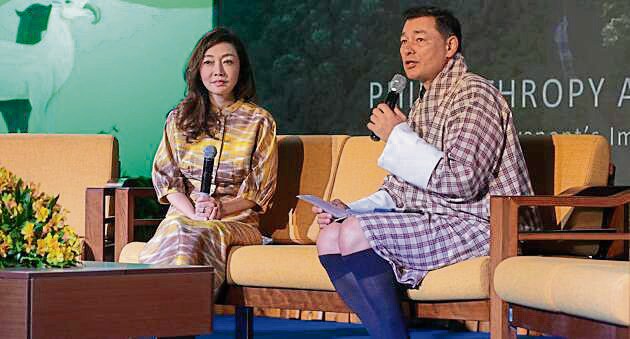
The joy of giving especially came through in art collector Marisa Chearavanont’s conversation with festival co-director, Kalden Dorji, better known to Indian movie goers as Kelly Dorji. “Most of the time, we are living virtually and indoors but I want people to go out in nature,” said the philanthropist who spoke about setting up the Khao Yai art forest in Thailand, Japanese artist Fujiko Nakaya’s Fog Forest that rejuvenated the originally tortured landscape of Khao Yai by drawing water from air, and about using art as a medium of healing.
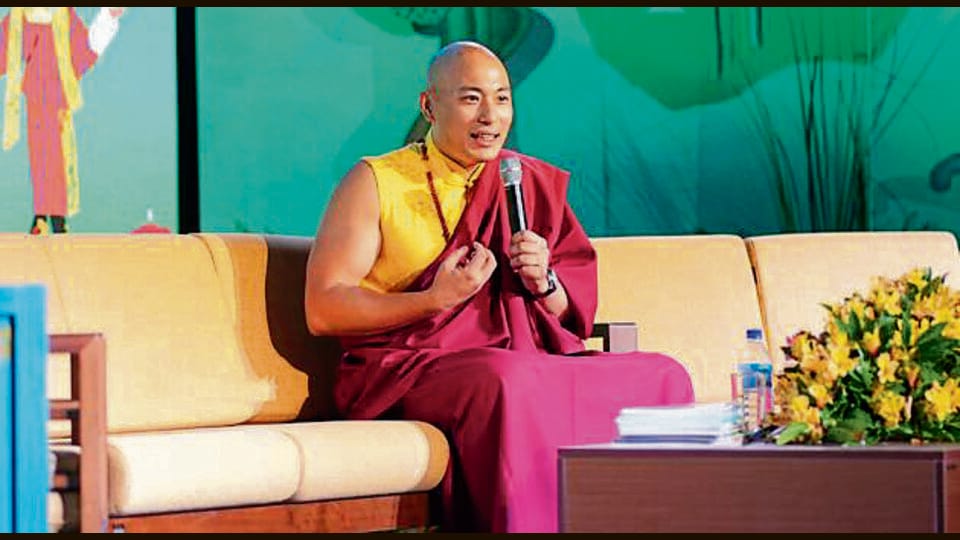
All of this was enlightening and interesting but it was Kalu Rinpoche’s talk about his forthcoming book, The Yoga of Niguma: Vajrayana Practices for a Luminous Mind that electrified the audience. Charismatic and imbued with the aura of a yogic rockstar, Rinpoche spoke about the extreme austerities of his early training that included consuming just a bowl of cabbage and a glass of water every day for two years and about logic and reasoning in Buddhism, which is “no blind faith’. Incidentally, years ago Rinpoche called out some monks for abusing him as a child. “There’s far more politics in religion than I expected as religion is run by humans but not the Buddha,” he said adding “I thought being good and compassionate solves all the problems; it doesn’t work.” What definitely seems to work are his energetic Niguma yoga exercises seen on a video that leaves the audience astounded. Next, British-Indian photographer Max Vadakul, known for working in black and white, presented a series of riveting images of Kalu Rinpoche and of people across Bhutan. “This is the most important work I’ve ever done in my life,” he said.

His use of superlatives is understandable. Bhutan, the land of the thunder dragon does that to the wretched from less cheerful places. With its helpful volunteers, excellent sessions, stalls selling local ware, well-behaved audience and freaky jester, Bhutan Echoes 2025 too was enveloped in a wholesome glow. And when the curtain fell on the event, as always, it was a wrench to leave.


