
 E-Paper



Review: Operation Silkyara by Saurabh Sharma
A vivid account of one of the longest rescue operations in India, this is also an indictment of our treatment of the environment and of migrant workers

 Prefer HTon Google


On November 12, 2023, a tunnel that was under construction at Silkyara in Uttarakhand’s Uttarkashi district collapsed, trapping 41 labourers. For 17 days, the anxious men survived in the darkness with one hope – that they would see their families once again. Like all survival stories in which people come face to face with death, this too is an extraordinary one of grit and tenacity with the workers finally emerging out into the world on November 28.
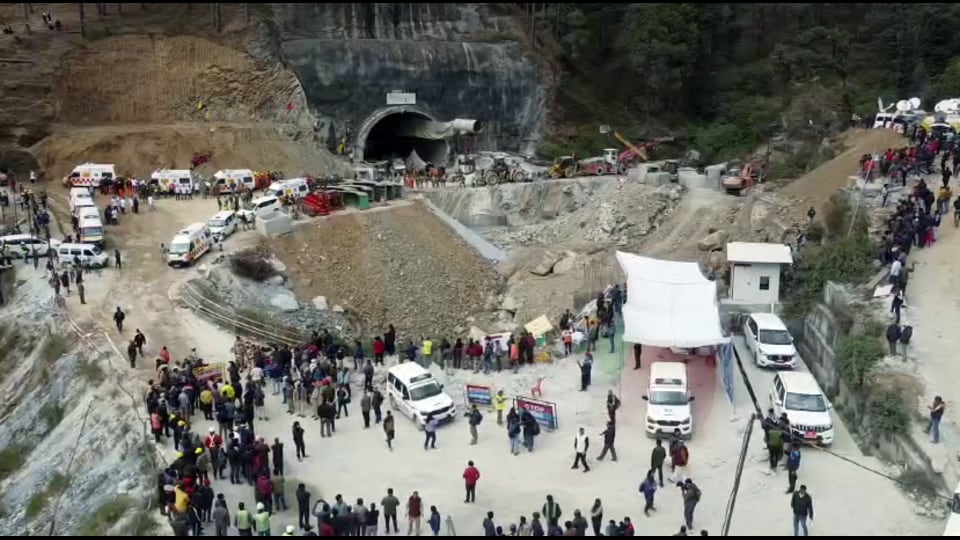

The Ramnath Goenka Award-winning journalist Sourabh Sharma vividly recounts the story of one of the longest rescue operations in India in his first book, Operation Silkyara. Full of interesting details, readers are taken into the world of each character: of Colonel Deepak Patil, who played a key role in the rescue operation; of Gabbar Singh Negi, the leader of the workers, who kept them calm throughout the ordeal; and Rajni, wife of labourer Virendra Kiskoo, who fights despair. Divided into nine chapters, this tautly written page-turner keeps readers hooked throughout. Devoted watchers of Indian news television will recall the 2006 rescue of Prince Kumar from a borewell that had grabbed the nation’s attention. This book attempts to recreate that same thrill, and succeeds.
The reader is taken along as workers discover a drainage pipe and establish communication, making it possible to inform the outside world that they were still alive. Confined for what must have seemed like an eternity, fights break out in the tunnel and frustrated workers demand bidis. Sharma describes how bidis and food reached the labourers, and how they were counselled by the doctor. We learn too of their sleepless nights, and how hope was kept alive, the worry and panic that had gripped their loved ones, and how many families camped at the site hoping for a miracle.
Operation Silkyara shows how people cling to faith in times of calamity and how it is often the only thing that keeps them tethered to sanity. It also explores how long buried folk beliefs re-emerge at times of great stress. Many saw the incident as a curse of serpent deity Baba Bhokh Nath, who is also known as the protector of the mountains of Uttarakhand. The striking metaphor, of course, points to the fragility of the local ecology and the disastrous consequences of upsetting the delicate balance of nature. Designed to connect Barkot and Silkyara, several environmental organisations had flagged the Silkyara Tunnel for harming ecology. These concerns eventually reached the National Green Tribunal and the Supreme Court. Sharma also raises some more concerns. “An off-the-record conversation with the state geology department revealed that work was done at a pace faster than was prudent,” he writes citing a statement from Bernard Gruppe, the German-Austrian engineering firm working on the tunnel’s design: “The geological conditions have proved to be more challenging than predicted in the tender document.” The author is certain that the Silkyara tunnel was “destruction in making,” because those in authority gave it the go-ahead without “any concern for those who actually built it.”
An excellent work of ground reportage, it is clear that Sharma did much legwork, camping for days on site and having extensive conversations with anxious friends and families of the trapped. But what of those who had no friends and family nearby? Indeed, the experience was even more traumatic for migrant workers. Many have decided never to return to the Himalayas. “I cannot step inside another tunnel ever again. The very thought makes me shudder as visions of being buried alive flash before my eyes,” says Manjeet, a migrant worker who has resolved to never venture out of his rural hamlet again. “I will take manual labour like my father in my village, but no more tunnel jobs for me,” he says.

It is true that migrant workers building the nation’s roads in remote and inhospitable terrain have “no mechanisms for rehabilitation or compensation”. Since they are hired informally, they are affected by the persistence of “structural vulnerability”. The author hopes “this tragedy will nudge a rethink on better safeguards for migrant labourers, who are literally building the nation’s backbone in harsh conditions.”
At one level a story of hope and of overcoming odds, Operation Silkyara is also an indictment of our treatment of the environment and of itinerant workers on large infrastructure projects.
Mayank Jain Parichha is an independent bilingual journalist. He writes about the environment, wildlife, culture, literature, and politics. He is the author of Nietzsche ki Kutai.


