The history is the present in India today. Everyday life is replete with references, shouted down from pulpits or by six talking heads boxed inside a television screen, of the glory of past civilizations of one faith that were ravaged by marauding invaders of an opposing faith – all stories with neat edges, reasons and justifications for what happens in India today.
The history of the Deccan, for example, is often fodder to push the idea of a crusade fuelled by religious passion, and the popular narrative often rests on the shoulder of Shivaji, the 17th century Maratha king recast as a Hindu conqueror, whose ancestry is sensitive enough for a large public library to be ransacked at the faintest possibility of a slight.
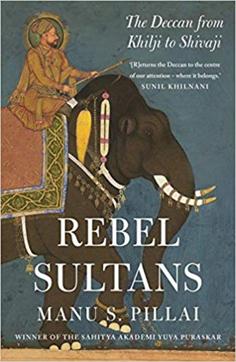
But in Rebel Sultans, Manu Pillai takes great pains to paint a picture of this fascinating region that is far messier – one that doesn’t give itself to easy generalizations, or narrative building. Through engaging prose and extensive footnoting (the annotation and bibliography take up almost 100 pages), Pillai takes the reader through kings who sailed from alien lands and rose to great power in the Deccan, sultans who painted their nails red and wrote paeans in praise of the goddess Saraswati, and rulers who had “skin the colour of coal”— in the process establishing Deccan as a riveting place where the potential of upward social mobility was possibly far more than today, albeit through gruesome bloodshed and fratricide.
By far my favourite bit of the book is the epilogue that lays out the story of the seminal 17TH century Telugu text Rayavacakamu (Tidings of the King) that chronicles the rule of the Vijayanagar king Krishadeva Raya that ostensibly outlines Muslim princes in the region as vile and barbaric, and Pillai argues, underlines the beginning of a crystallization of a common Hindu elite in opposition to the Muslim rulers nearby -- but doesn’t flinch from painting the contemporary Mughal rulers in the north as gods blessed by the shrine at Varanasi. The local Deccan Muslim rulers are asuras, but the Mughals are gods, reflecting the complex understanding of faith, region and allegiances.
{{/usCountry}}By far my favourite bit of the book is the epilogue that lays out the story of the seminal 17TH century Telugu text Rayavacakamu (Tidings of the King) that chronicles the rule of the Vijayanagar king Krishadeva Raya that ostensibly outlines Muslim princes in the region as vile and barbaric, and Pillai argues, underlines the beginning of a crystallization of a common Hindu elite in opposition to the Muslim rulers nearby -- but doesn’t flinch from painting the contemporary Mughal rulers in the north as gods blessed by the shrine at Varanasi. The local Deccan Muslim rulers are asuras, but the Mughals are gods, reflecting the complex understanding of faith, region and allegiances.
{{/usCountry}}This theme resonates throughout the book. Pillai stays away from easy conclusions and repeatedly points out how Muslim rulers would often have Hindu ministers, and vice-versa, and how the central tension in a kingdom would have been between those indigenous to the land and those who came from erstwhile Persia. In several cases, he points out instances of local Muslim nobleman (Dakhnis) allying with Hindus to stave off the Westerners (Persia born).
The strongest section of the book is the opening three chapters that chronicle the Bahmani and Vijayanagar kingdoms – which has in popular lore been recast as India’s holy crusade between Hinduism and Islam. Apart from the fluid prose, there were three major takeaways in those chapters. The first is that what we today call Hindu was often recorded and recognised as “Brahmin” in those times (a fact true even of the Rayavacakamu) – reflecting not just the near-hegemony of a community with control over textual records but also how underlining which communities we subconsciously refer to when we use the composite category of Hindu today.
Read more: Book review: A riveting read on palace intrigue and social change
The second is embedded in the nature of Hindu-Muslim conflict. Pillai narrates several instances where there was no so-called Hindu unity in favour of Vijayanagar, or when the Muslim rulers of Bahmani allied with Hindu kings in Andhra and Odisha. But the book also admits some Muslim rulers did desecrate temples, and the barbarism of Hindu kings triggered wars with Muslim rulers, inadvertently acknowledging the possibility that it is possible to cherry pick these incidents to retrofit a narrative of religious crusade.
The third lies in the choice of the kingdom we use to represent Hinduism today. Why does the modern right-wing use the Vijayanagar kingdom, where Brahmins had near-outright grip on power, as a example of Hindu power, but not the older and equally remarkable Kakatiya kingdom that drew its rulers from diverse communities, many of whom hailed from lower castes and called themselves sons of the soil? How different would Hinduism look today if the Kakatiyas became the model instead of the Brahmin power? For provoking these questions, and not attempting easy answers, Rebel Sultans is a remarkable, daring book.