
 E-Paper



Review: Ghost-eye by Amitav Ghosh
Strange, sometimes eerie, but oddly believable, Amitav Ghosh’s new novel lives in the friction between rationalist Westernized modernity and Indian traditional ecological knowledge

 Prefer HTon Google


Amitav Ghosh’s new novel Ghost Eye is foremost a love letter to fish — first celebrated in the deepest Bengali sense, culinarily, before being mourned ecologically.
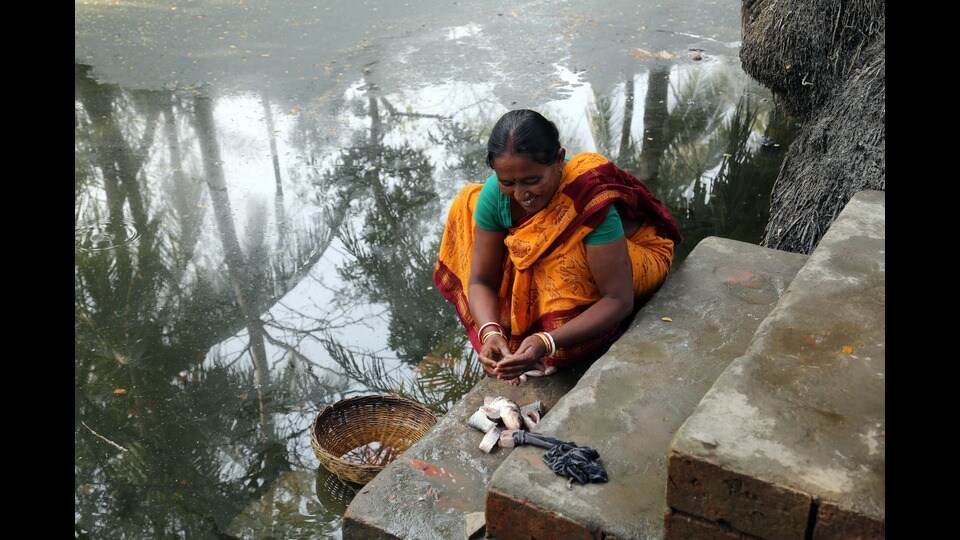
In a wealthy strictly vegetarian Marwari family home, three-year-old Varsha Gupta, over lunch, demands fish and rice: Ami machh-bhat khabo. Machh dao, she declares, refusing to eat anything else. The family, part Jain, fully alarmed, summon a psychologist. Shoma specializes in “cases of the reincarnation type” — she had been helping an American professor, one of the world’s leading experts in the field.

And so begins this vivid, visceral, deeply satisfying novel.
Varsha claims to be in her past life the daughter of a poor fishing family in the Sundarbans, and seems to have an unusually vast knowledge of fish. Shoma devises a plan. She begins poring over books on the aquatic fauna of Bengal, and with her cook, carefully selects different varieties from the fish market to quiz the child.
She carefully prepares a lunch menu with three varieties — Labeo rohita, Cyprinus carpio, Oreochromis niloticus. And Varsha, as Shoma had suspected, turns out is also a fish prodigy.
The fried fish with spices, Varsha recognizes is rui and not catla, a difference that even seasoned ichthyologists often can’t spot. She is also able to tell that the doi machh is made with karfu instead of the more commonly used catla. She cannot identify the tilapia, an African variety cultivated in fish farms and newly introduced in Calcutta. It was cooked in a spicy gravy of tomatoes and onions in the hope of passing it off as the Bengali koyi. But Varsha knew the unfamiliar fish wasn’t a koyi. She also knew that the koyi could climb trees — she remembered it climbing the tree next to the pond near her past life house where it would climb on to the branches and fall back into the water like ripe fruit.
Half a century later, during the pandemic, Shoma’s nephew Dinu, a middle-aged antiquarian in Brooklyn, gets a phone call. Tipu, a feckless young firebrand — the semi-adopted son of a friend he knows well — is now a climate activist in the Sundarbans where he was originally from. To survive the climate apocalypse, he says, “you’ve gotta be in a place you know well, and if that place knows you too, it’ll help you. I mean isn’t that what forests and deserts and oceans have always done? Haven’t they always taught people who are willing to learn how to survive even when the going got rough?”
A snakebite has turned him into a ghost-eye. One of his eyes changed colour, marking him as a kind of seer — part of a network of ghost-eyes who can see both in the ordinary world and a deeper world.
A cyclone is coming.
Natural disasters have a history of making themselves known via premonitions. And Shoma, seemingly delirious in her old age, saw Cyclone Amphan coming. The devastating super cyclone hit the Bay of Bengal in 2020 leaving millions destitute. Tipu needs Dinu to find out what happened to Varsha who disappeared shortly after she remembered her past life and had premonitions. Her memories are their key to saving the Sundarbans.
Preferring to write instead of having to talk to Tipu (who is, even on the page, quite annoying), Dinu starts to write.
But, “would this omnium-gatherum of apparitionists and spirit-whisperers ever be able to accomplish anything practical?” he wonders. His scepticism tethers the novel’s material world to its woowoo.
Ghost-Eye plays out in the sweet spot between the real and the magical — like its predecessors, but perhaps most successfully.
This is the third novel in the world Ghosh has been building since The Hungry Tide (2004) and Gun Island (2019). Dinu is Deen from Gun Island and Tipu, still a propulsive force. The legend of Manasa Devi, the goddess of snakes, threads through again. Piya, the dolphin biologist protagonist of Hungry Tide, has a cameo. Like its predecessors, Ghost-Eye lives in the friction between rationalist Westernized modernity and Indian traditional ecological knowledge.
Ghosh’s 2016 nonfiction book, The Great Derangement, was about literary fiction’s failure to grapple with climate change. He had argued that the conventional realist novel was unequipped to deal with climate change, while magical realism would undermine the terror of it — that it is “actually happening on this earth, at this time”.
Ghost-Eye’s subversive move is to expose the limits of Western knowledge itself. Ghosh decolonizes psychiatry by refusing to pathologize. Past life memory is not psychosis, premonitions are not anxiety, but simply alternate, deeper — spiritual but no less legitimate — realities. To make sense of what is happening to the planet requires looking for what modernity has spent centuries dismissing.
The numinosity seems to belong quite naturally in the sepia-toned Calcutta of the 1960s and 70s — a city then in the shadow of displacement and exile — incarnated particularly in Dev, the Burmese household factotum at Shoma’s home. And it’s only heightened in the pandemic sections — when inexplicably, drones as big as buses appear in the sky. Or even when at a Chinese fish shop, a snakehead at the sight of Dinu, flailed and thrashed about in its tank with such force that it fell on the floor.

It’s all strange, sometimes eerie, but oddly believable — as is Ghosh’s optimism, despite all good reason. Dinu, gathering family stories, history and memory, is able to build a convincing case through his writing and effect change. And Tipu, annoying Tipu, embodies future generations: the kids are weird, but the kids are alright.
And then there is the food. There’s a particularly vivid scene:
Dinu, to recreate dishes of his childhood to evoke once again memory across time and space, watches cooking videos online of rural Bengali women. To make mustard oil, not easily available in the US, he orders mustard seeds and gets to work, “heating, grinding and wrapping the oily slurry in cheesecloth before squeezing with all my might. The final extraction occurred in my bathroom, with me stomping barefoot on a colanderful of mustard-seed pulp.”
Food writing so fine and so viscerally alive that even a reader as vegetarian as the Guptas in the novel, I found myself embarrassingly hungry.
Saudamini Jain is an independent journalist. She lives in New Delhi.


