
 E-Paper



Review: Persian Nights by Alaka Rajan Skinner
Set in 1970s Iran and depicting the life of an Indian family there, this graphic novel shows the impact of conflict on everyday life

 Prefer HTon Google


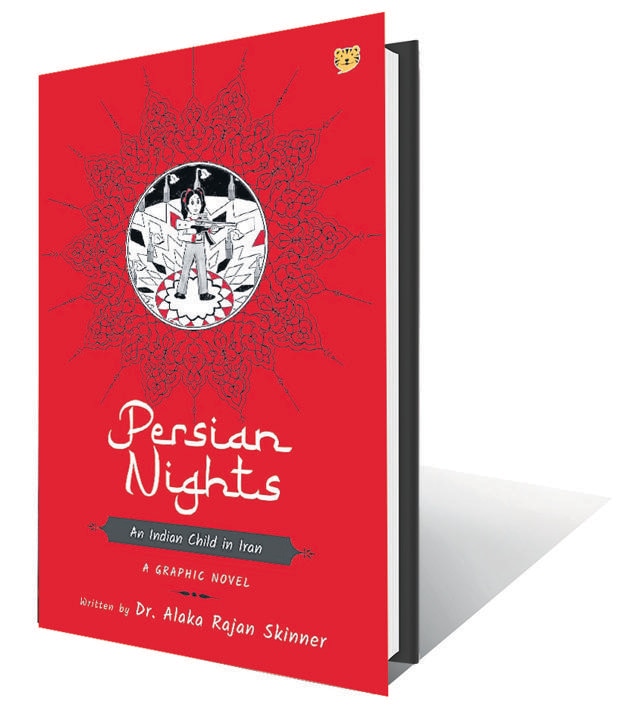
Alaka Rajan Skinner’s Persian Nights: An Indian Child in Iran, a graphic novel, is about the author’s experience of living in that country during the 1970s, when her father got a teaching job at Tehran University. “This incredible country with its rich culture and heritage was home to us for 10 years and an extremely important part of my growing up years,” Rajan Skinner writes in her author’s note.
As a child, she noticed that many of the herbs and spices like saffron, dill, turmeric, cinnamon, coriander, cumin, ginger and cardamom used in her mother’s Indian cooking were also part of Iranian cooking. “Iranian cuisine also used nuts and dried fruits like pistachios and dates as these were plentifully available in Iran,” she writes adding that she was surprised to learn that jalebis and gulab jamuns, which are assumed to be “traditional Indian desserts”, are likely to have originated in Iran. Woven seamlessly into the novel illustrated by Shweta Allam, Vishnu Jadhav and Chandrashekhar Aher, these details make the reader think about histories of culinary exchange simmering inside our kitchens. India absorbed several influences from the Persianate world through trade, conquest, the Mughal court, and migration. Indeed, the author’s father was one of the many Indian teachers, doctors, and engineers who went to Iran after Prime Minister Indira Gandhi’s official visit to the country in 1974. During that visit, undertaken during a severe global oil crisis, the Shah of Iran, Mohammad Reza Shah Pahlavi, agreed to contribute to India’s energy security in exchange for the supply of skilled professionals.
“... there was a large Indian community in Tehran and soon our social circle was wide,” writes Rajan Skinner. The expatriate experience is framed through a child’s lens, catching what adults might miss: “Birthday parties were especially memorable. 40 or more guests would come, which meant lots of presents. Mother would single-handedly cook for all of them.”
This observation about women’s labour on social and festive occasions is supplemented by an illustration of an outdoor picnic where men from the Indian expat community are busy eating while the women are feeding children or taking care of them. The subtle critical commentary on gender roles fits well in this tribute to Rajan Skinner’s deceased mother, who had urged her to document her childhood memories for those “who would want to know”.
Initially, the author’s father, who taught at the Central Institute of English and Foreign Languages (CIEFL; now called the English and Foreign Languages University) in Hyderabad, was reluctant to apply for the post in Tehran but gave in when a colleague nudged him to “just go and talk to” visiting recruiters. His wife, “always the more adventurous of the two”, convinced him of the benefits of international exposure for their family.
Their apartment in Tehran was small but had a gorgeous view of snow-capped mountains in the distance. The author contrasts this picturesque setting with the sibling squabbles that took place indoors. As the elder sister to her brother Kish, who was an infant when they moved to Tehran, she was often jealous of the attention showered upon him. But the book also shows moments of fun and play when she styled his curly hair, and treated him as a human doll.

At school, the curriculum included Farsi, English, Hindi and Punjabi, the canteen serving chana bhatura and samosas, and the principal sang Punjabi songs to celebrate student birthdays. The reader also learns about the neighbours: an Iranian man married to an Indian woman. Their love of music is evident from an illustration of the couple dancing away to Boney M’s Daddy Cool.
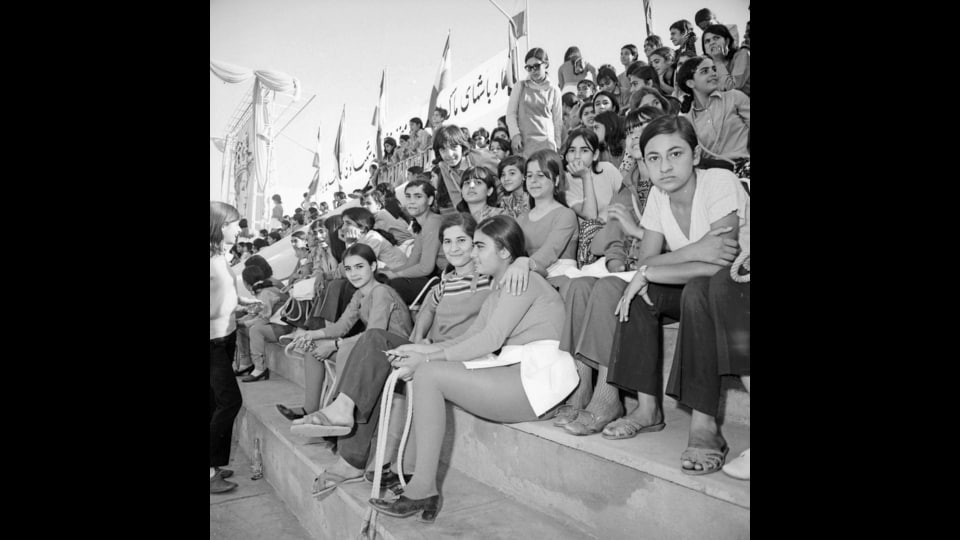
At this point, a wave of Westernization was sweeping through the country and American hits were played on the radio, in clubs, and at house parties. Things changed rapidly with the Islamic Revolution (1978-1979), which the author summarizes at the end of the book explaining that the “economic and technological progress” that took place under the Shah came at the cost of a widening gap between the rich and the poor, and the suppression of dissent. Religious leaders opposed the rapid modernization, especially with respect to women’s rights and eventually, the Shah fled Iran and Ayatollah Khomeini declared the nation an Islamic republic.
Rajan Skinner’s narrative documents the same history through personal anecdotes, often laced with humour. Before the Islamic Revolution, Iranians used to talk about the striking resemblance between her father and the Shah of Iran. The joke died a natural death afterwards.
In another incident, that probably elicited nervous laughter at the time but is hilarious in the book, the family car with the author’s father at the wheel is stopped by a group of armed Islamic guards. One of them, sporting a large beard and carrying a machine gun, tapped on the window. When it was rolled down, the guard said, “Salaam Ustaad! Do you remember me? I was your student at the University six years ago. You gave me a failing grade in English.”
The visual and psychological landscape of the era is vividly presented through illustrations of protestors chanting “Death to America. Death to the Shah” and revolutionaries stopping by the author’s home to warn the family of anticipated gunfire. Amidst this gloom, an unexpectedly light exchange occurs when chador-clad, weapon-wielding women ask the author’s father how many wives he has. That he has only one surprises them and he is told that he is still young and must get another one. He agrees to consider the suggestion.
Another truly comic moment has the author’s father asking her about the Farsi graffiti at the base of their staircase. He wonders if it is a warning to foreigners to go home. The child is amused because the text simply asks people not to leave their trash there.
The book, which pairs nostalgia with realism, never descends into sentimentalism. The revolution cost her father his job at the University of Tehran. He then found work at the University of Medical Sciences where departing American staff left behind vacancies. But after living in the country for a decade, the Iran-Iraq war compelled the family to return to India. The Persian carpet they had to leave behind becomes a painful symbol of separation.
A book that shows how violent political upheavals interrupt childhood, Persian Nights recalls Bapsi Sidhwa’s The Ice Candy Man, which looks at the Partition through a child’s perspective. Fans of Marjane Satrapi’s Persepolis, Zeina Abirached’s A Game for Swallows and Nicolas Wild’s Kabul Disco will also enjoy it for its intelligent and imaginative depiction of the humanitarian impact of conflict.
Chintan Girish Modi is a journalist, educator, fiction writer, and literary critic. He has a background in peacebuilding and has worked with the UNESCO Mahatma Gandhi Institute of Education for Peace and Sustainable Development and Women in Security, Conflict Management and Peace.


