
 E-Paper



Shantanu Naidu: “A dog’s default state is a good set of values”
Shantanu Naidu, on his memoir, Thinking of Winter, that chronicles his relationship with his beloved dog

 Prefer HTon Google


You call yourself a “single father”. How did you grow into this identity?
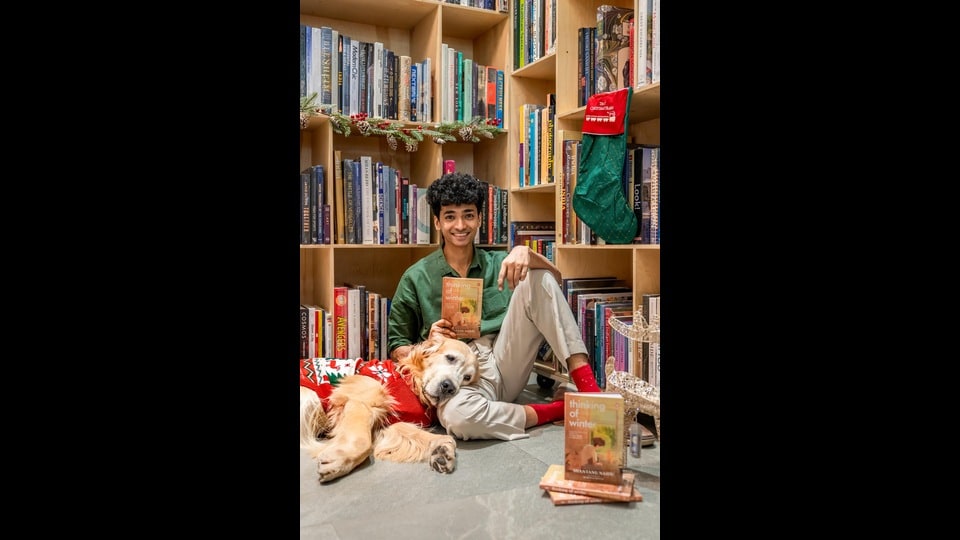
I came to this realisation in the small nitty-gritty nuances of daily life. I live as a bachelor in my house, along with Winter. Every day, when I leave for work, I take Winter with me and drop him off at a particular place where he stays for the day. That is one of my start-up offices. I carry a tiffin box for Winter, and a package with a ball that he likes to play with.
At some point, I noticed that this whole routine was eerily similar to how my dad used to drop me to school before going to the office himself. I used to have my backpack and he used to check if I had everything. There was a moment of euphoria when he used to pick me up in the evening. Similarly, Winter is excited to see me again when I pick him up. During the monsoon, I have to put a raincoat on him, bring him back carefully, wash his paws, and then dry him up.
These responsibilities, and the consistency they brought into my life, made me feel like I was in my dad’s shoes. Because I am not married yet, I think of myself as a single father.
You write about a time when you wondered if you were even capable of taking care of another life. When did that change, and how did it happen?
Winter has been part of my life since the last nine years. I adopted him when I was studying at Cornell University, and lived in Ithaca in the United States. I think the milestone after which I definitely felt ready was a bit delayed. It was two years after I adopted Winter.
Bringing Winter from Ithaca to Mumbai was such a harrowing journey in terms of paperwork, the risks involved, and all the regulations and precautions needed to ensure his safety and health. He travelled with me on a 16-hour flight. It required almost three months of preparation, and going back and forth with the animal husbandry department in India and the health department in the US. During that time, I just had to forcibly grow up so much and so quickly for Winter!
When we landed in Mumbai, and came out of the plane, I had this sudden realization, I told myself, “If I can do this, I can now take on anything to protect him, and bring him up the way he is meant to be brought up.” I became Winter’s dad when I was 24 years old. I am 33 now.
In India, one often comes across fathers who find responsibilities like toilet training and changing diapers yucky, so they don’t want to be involved in these. Why don’t people feel this discomfort and disgust when it comes to cleaning up after pets?
I might be the wrong person to ask this question because I can’t wait to be a father to a human baby. I am looking forward to that yuckiness and taking on what I see as gender neutral roles. What I am sharing with you is not coming from a place of performative progressiveness or being woke. I think that my parenting journey with Winter has actually helped build the foundation for what being a father to a child will look like for me. I am so grateful to him.
That said, I must acknowledge that a pet is a lot more independent than a human baby in certain aspects. You take your pet for a walk, and he does his business outside. It is quite simple. The other thing is that a pet is not crying all the time. That is a big difference. Also, you are not so worried about your pet’s cognitive development, and what his values and principles are.
You don’t have to pay school fees if you are a pet parent. Does that matter too?
Yes! That could be another reason why people prefer animal babies to human babies. When you are raising a child, you have to groom and mould him at every step to make sure that he has a solid value system. A dog’s default state is a good set of values. I think that people also prefer pets because it absolves them of a lot of emotional responsibilities that come with kids.
While reading your book, one feels that Winter has raised you instead of the other way round. You write, for instance, about how you had forgotten that Ithaca was so beautiful and Winter reminded you of that. What do you think of my interpretation?
We tend to frame our roles in a particular way. But are they really like that? Absolutely. not. Your question is very interesting because we tend to look at things from a human standpoint, and forget that dog years and human years are not the same. It is hard to say at what age they stop filling that role of a son or daughter. Winter is nine now. In human years, he is older than 60.
If you see our relationship from this perspective, he is significantly older in terms of his lifespan and his experience. It is true that he has raised me in many ways, not with intent but with his behaviour. He has made me realize my shortcomings. He has made me aware that I need to be more present, more forgiving, and more open in terms of who I share love and goodwill with.
When I look at Winter, I find him completely immersed in the moment. He is not worried about the past and the future. All he cares about is what is in front of him. That really is the key to joy. You cannot expect a human kid to give you this kind of wisdom. I learn from him all the time.
There have been news reports about people who adopted animals when they were going through a mental health crisis, and abandoned their pets once they felt better. This happened a lot during the COVID-19 pandemic. What would you tell them?
People experience a lot of things including euphoria, joy and companionship without having to invest a lot because a dog just keeps giving. Some take these pets for granted because there are no repercussions in terms of being held accountable by society or law. I would tell these people: “Don’t ruin another life! The dog is not going to ask you questions. So, the only thing left is your conscience. You must treat a dog like a family member or blood relative, not a trophy. If you are tempted to experience a dog’s company when you are lonely, there is a beautiful solution in the form of street dogs. You should definitely be friends with them and visit often.”
Unfortunately, the whole ecosystem of pet adoption and pet breeding is structured in such a way that there are hardly any regulatory checks. Whenever I rescue puppies or kittens, and put them up for adoption, I have a questionnaire for people to fill out even before they enter my house. Some of them get offended because they feel like they are doing an altruistic act and a favour.
I ask them things like: How many family members do you have? Are all of them enthusiastic about adopting the pet, or is it just you? How many hours do you spend outside the house? What kind of a house is it? Are you a local? Are you planning to move to another city? Will the pet move with you? If not, who will take care of the pet once you leave? When you are travelling for work, who is going to be with the pet? Have you had a pet before? If they say yes, I ask what happened to that pet? A pet’s life is precious, so it is important to know who is adopting him.
I tell people that if the adoption does not work out smoothly, they must bring pets back to me and not dump them anywhere. When pets come back, it hurts but at least they are safe with me.
What do you think of the Supreme Court’s directives about removal of community dogs from public places? What kind of sensitization is required for the judiciary so that courts can take animal welfare and animal rights into account?
At the core of our judicial system is a solid moral framework, which is progressive in terms of how it thinks about animals, and not just humans. Article 51A of the Indian Constitution talks about the duty of every citizen to have compassion for living creatures and come forward in support of another life. When we refuse to do this, we abandon our fundamental civic duty.
I hope that the judiciary will push for better implementation of the Animal Birth Control Rules, which already exist. Basically, you collect animals from the locality, sterilize them so that they don’t reproduce, and then release them back into the same locality so that their numbers don’t multiply to a level where dog overpopulation, dog aggression and dog bites become a serious concern. It is a beautifully designed system. All it needs is enforcement at all levels.
India has a large population, including street vendors and homeless people, feeding and looking after community dogs. But they don’t necessarily have the resources to give them veterinary care. What kind of policy changes would make that possible?
We need a law saying that, if anyone brings a stray animal for emergency care to a hospital or a clinic, whether it is private or public, the animal should be given free treatment. Otherwise, medical care should be subsidized to such an extent that the people you spoke about can afford it. It is not just the judiciary that we need to be concerned about. There is a section of society that has superstitions, myths and fears about street dogs that need to be addressed. Instead of fighting it out in court, we can try to understand each other as rational human beings.
Chintan Girish Modi is a journalist, educator, poet, fiction writer, and literary critic. His work has appeared in anthologies like 101 Indian Children’s Books We Love (2013), Borderlines: Volume 1 (2015), Clear Hold Build (2019), Fearless Love (2019), and Bent Book (2020).


