
 E-Paper



Tenzin Tsundue: “If you don’t protest, you become a coward”
The Tibetan refugee, poet, teacher, performer and activist on turning his life experiences into his new play, Standing on the Indus

 Prefer HTon Google


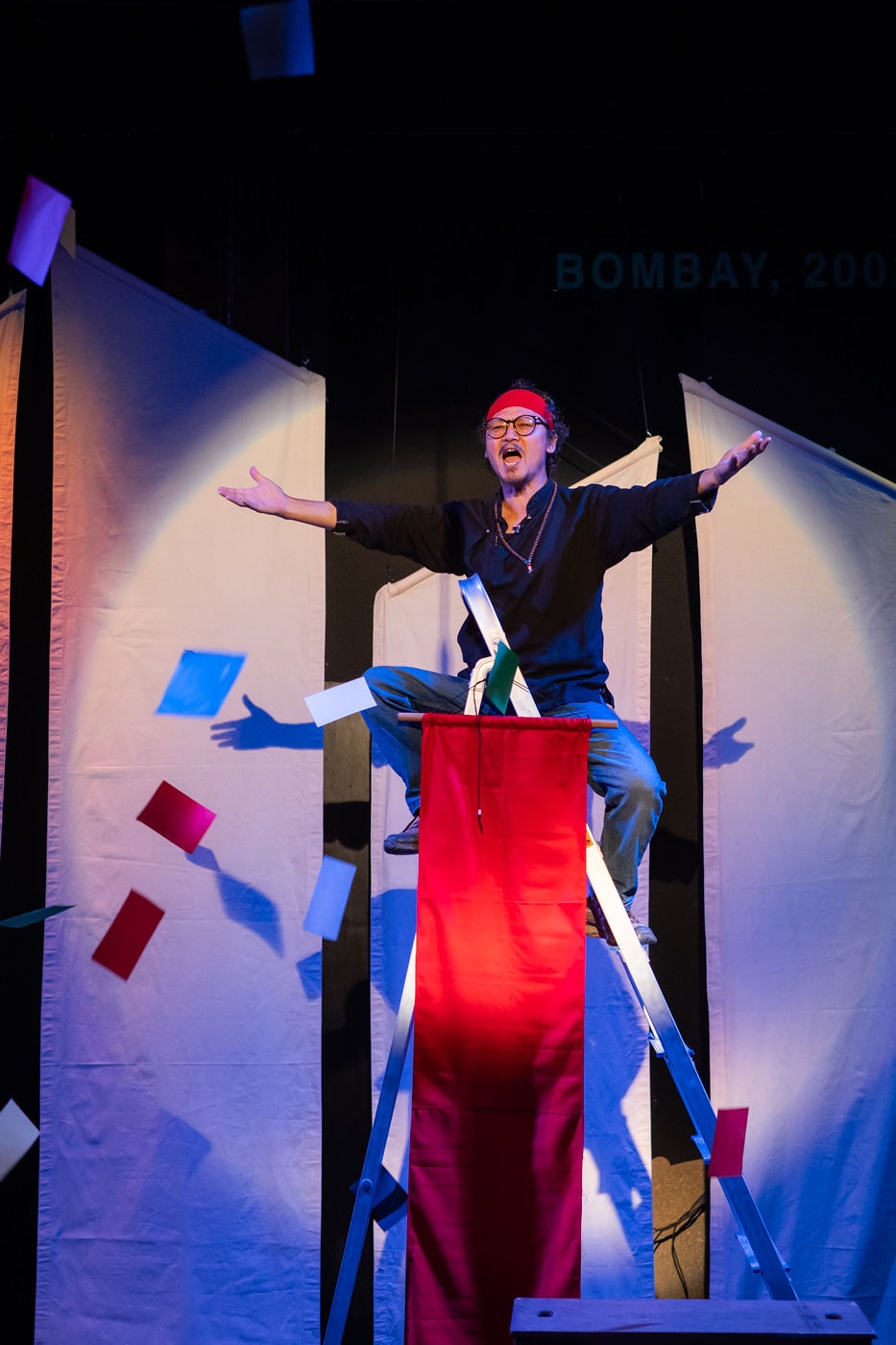
Standing on the Indus was performed at Harkat Studios in Mumbai on July 31.
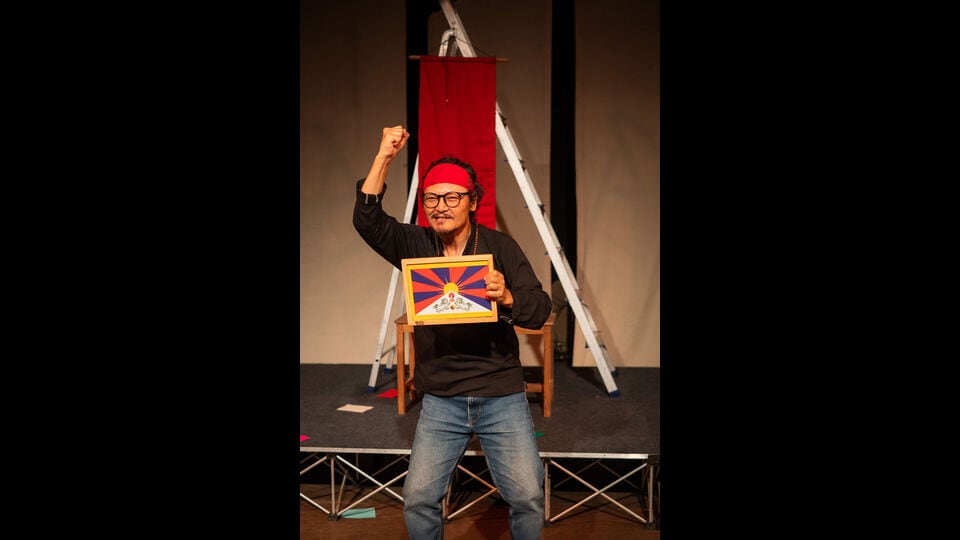
Standing on the Indus has this hard-hitting moment where you say, “Protest keeps you alive and your enemy awakened.” Please explain.
This statement really captures the goal of a protest. If you don’t protest, if you just suffer and submit, you become a coward. To protest is to say “No”. You may not have the power to fight back or overcome or win. But when you say that your conscience will not allow you to keep silent, and you start to protest, that brings you alive.
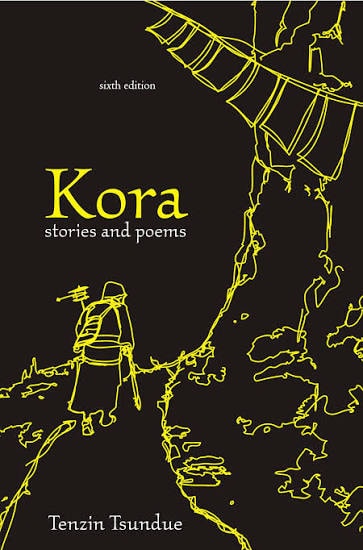
So Many Socks, Annie Zaidi’s play about the experiences of Tibetan refugees in India, drew inspiration from your book Kora. Abhishek Majumdar, who wrote the play Pah-Lak, has spoken about how your work deepened his understanding of the Tibetan struggle for independence. What was it like for you to work on your own play Standing on the Indus?
Two years ago, I met my friend Q, the man who directed So Many Socks, and told him that I had this wonderful idea of turning my 16 experiences in jail into a light comedy. I wanted to look at my own life in a slightly detached way, and create something human and humorous out of it. That sounded really exciting to me. But I also wanted Q’s opinion as a theatre person.
I was first jailed in Ngari, which is in western Tibet, close to the Ladakh border, and later in Lhasa. That was in 1997. In India, I have been in Bangalore Central Jail on Hosur Road, Goa Sada Jail, Tihar Jail in Delhi, Pithoragarh jail, Mandi District jail, and Madras Central Jail.
We kept discussing it for a while. And last year, he said, “It is doable, but you have to tell the story.” I replied, “No, I have never done a play. My biggest problem is to remember lines. I can write poems but I am not an actor.” Q was calm and reassuring. He said, “Don’t worry. Just tell the story in your own way. You don’t have to remember lines. Your co-actors (Charvi Ojha, Keith Antony Sequeira and Harshit Tank) will help as you go over the events from your life.” He made it sound possible. This is the story of how I ended up on stage. Q is a great director.
As an activist, you know how to project your voice when you address large audiences, and how to hold their attention using humour. How did these skills help you with your play?
My biggest advantage is my training in public speaking. It comes naturally to me because I have been doing it for so many years. You could say that I have done it my entire life. Similarly, going up on stage to communicate with people is not new to me. Though I have never acted before, I think that an activist giving a speech is also acting. And from my experience as a part-time teacher, I can say that a lot of acting is involved when you stand in front of a class of students. And, of course, there is so much acting involved in our everyday lives as human beings.
For you, creative work is not an end in itself. It is a vital part of non-violent resistance. As someone who is constantly innovating, using poetry and now theatre to draw attention to Chinese oppression, what motivates you to keep going? What role does Buddhism play?
As a Tibetan, Buddhism is not a religious badge to wear. It has been part of me since the time I was born. I have inherited the Buddhist heritage of Tibet, which goes back to almost 1200 years. Buddhist philosophy, religion and practice is deeply ingrained in us. Non-violent action guarantees that your mind is not disturbed. Through your very being, and your enunciation of words, you will not cause the kind of harm that non-violent action can and does. The principle of non-violence is non-negotiable for me. That comes first and foremost. Efficacy comes second.
If your resistance is not principally rooted in non-violence, you might do anything and everything to achieve your goal. The means that you use may not justify your goal. At the end of the, it is not democracy and freedom alone that you are fighting for. You want an inner victory.
In the play, you say that, whether your adversary is your girlfriend, the government, or a political party, freedom is to be found within. It is funny and deep. Why do you believe so?
As you go through life, there is always going to be a new adversary. If you embrace non-violence, you will never be disturbed. Of course, I know that this is easy to say and tough to practise. But the Buddhist path is anyway difficult. Therefore, it is the path of courageous warriors, and not of the faint-hearted. It is the path I have chosen and will continue to walk.
The play includes this anecdote about the time when you were caught hiding inside the Sabarmati Ashram just before Chinese President Xi Jinping’s visit to Ahmedabad in 2014. You chose a hiding place associated with Mahatma Gandhi. What does he mean to you at a time when many young people think of him as irrelevant and non-violence as ineffective?
I am familiar with this way of thinking but I do not subscribe to it. A lot of youth who might think so are probably overwhelmed by the force of violence or the power of money, or maybe they are just fed up with what militaries and weapons have been doing in the world. It is difficult for people to find their grounding in non-violence. They may think that doing something crazy or violent might get them media attention. But is this attention really worth it?
We used to think of the media as the fourth pillar of democracy. But it is also an industry. It has people who will make money out of your violence today, and find someone else tomorrow.
Although His Holiness the Dalai Lama and millions of Tibetans are using non-violent protest to be free from China, the second most powerful country in the world, we are not getting the kind of attention we need. But I am confident that, as long as our resistance is rooted in non-violence, we are winning every day by not becoming the new terrorists and adding to the wars going on.
We refuse to kill anyone for our freedom. Liberating yourself from anger and frustration is a victory in itself, and a demonstration of the power of non-violence. It fills you with courage.
Your poem My Tibetanness, which was read out during the play, says, “...no nation supports us./ Not a single bloody nation!” Why do you think this is so?
The People’s Republic of China is colonizing not only our land but also our history. It claims that Tibet has always been a part of China. But the truth is that, after Mao Zedong came to power, China occupied Tibet, East Turkestan, Southern Mongolia, and Manchuria. The Chinese are already controlling Aksai Chin, and sitting on the Shaksgam Valley. Now they are making claims over Arunachal Pradesh and Ladakh too. As Indian Prime Minister Narendra Modiji said, China is a “vistarvadi desh”, a country that believes in expansionism. India, on the other hand, is a “vikasvadi desh”. It is a development-oriented country. The international community is not willing to support Tibet because they trade with China, and depend on China’s supply chains. All the countries of the world are lying when they say that Tibet is an integral part of China.
What do you think of the Boycott Divestment and Sanctions movement launched by Palestinians? It is possible for Tibetans and their supporters to mobilize against Chinese occupation in a similar way?
Economic interests play a big role in international politics. Today, the entire world is divided between three major conflicts: Russia-Ukraine, Israel-Palestine, and USA-Iran. In the case of Tibet, we have a lot of individual sympathizers because their loyalty is not dictated by monetary benefits. But when we think of countries, most of them are dependent on China. The West has benefited at the cost of Tibet for far too long. China’s mining of lithium, gold and copper from Tibet’s 2.5 million square kilometres of land, and the electricity produced from over 100 dams on Tibet’s rivers, feed China’s industry. While Tibetans burn in self-immolation protests, the international community stays silent because of its nexus with colonial China.
Today, China is a major rival for the United States. If China continues to grow in the way it is growing today, the US will have to take extra measures to deal with China. They may use the issue of Tibet, East Turkestan, Southern Mongolia and Manchuria at that point. If the US takes on China, many of the European countries may also find it beneficial and useful to fight China. They would not want the Western world order to be replaced by one dominated by China.
You mentioned self-immolation as a form of resistance. In July 2026, Tibetan activist Lobga Rangzen set himself on fire in front of the United Nations Headquarters in New York City. He said that he was protesting against China’s new Ethnic Unity and Progress Law. How does this law harm Tibetans, and why is it being criticized by Tibetans living in exile?
The aim of this law is to erase the Tibetan language. It imposes the Chinese language on Tibetans, and forces millions of Tibetans in Chinese colonial boarding schools to learn it. In the play Standing on the Indus, I say, “Language is everything”. I mean it. The moment you change your language, it changes your culture, your identity and your religion. By claiming to bring all the minorities under the narrative of one unified China, it wants to rewrite history. This law also states that any breach of this narrative within China, or outside Chinese boundaries, will lead to legal action. This effectively means that China wants to prosecute people anywhere in the world, whether they are in Tibet, India, China, Japan, America, anywhere, if they challenge its narrative.
What are your thoughts on engaging with the United Nations to draw attention to this situation? Why is the term ‘genocide’ rarely used while speaking of Chinese atrocities?
Your faith in the UN seems misplaced. To believe that it is a champion of democracy and freedom is to lie to yourself. The UN is in China’s pocket because it is a veto power holder. Any kind of discussion about Tibet would be stopped from coming to the table because of China. Why do only five countries of the world have veto power? Why shouldn’t all countries be equal?
Isn’t the veto power a legacy of the UN charter drafted after the Second World War?
Yes, and that legacy continues to this date. As George Orwell famously wrote in his book Animal Farm, “All animals are equal, but some animals are more equal than others.”
Chintan Girish Modi is a journalist, educator and literary critic with a background in peacebuilding. He has worked with Insaaniyat, the Kabir Project, UNESCO Mahatma Gandhi Institute of Education for Peace and Sustainable Development, Prajnya Trust, HRI Institute for South Asian Research and Exchange, and Women in Security, Conflict Management, and Peace.


