
 E-Paper



Tata Motors inks Rs 900-crore deal with states for buses
As the commercial vehicles market recovers after four years of slowdown, Tata Motors, the largest manufacturer of buses and trucks in India, has signed deals worth Rs 900 crore with 25 state transport units (STUs) to sell 5,000 buses — grabbing 43% of the total demand floated by STUs.


As the commercial vehicles market recovers after four years of slowdown, Tata Motors, the largest manufacturer of buses and trucks in India, has signed deals worth Rs 900 crore with 25 state transport units (STUs) to sell 5,000 buses — grabbing 43% of the total demand floated by STUs.
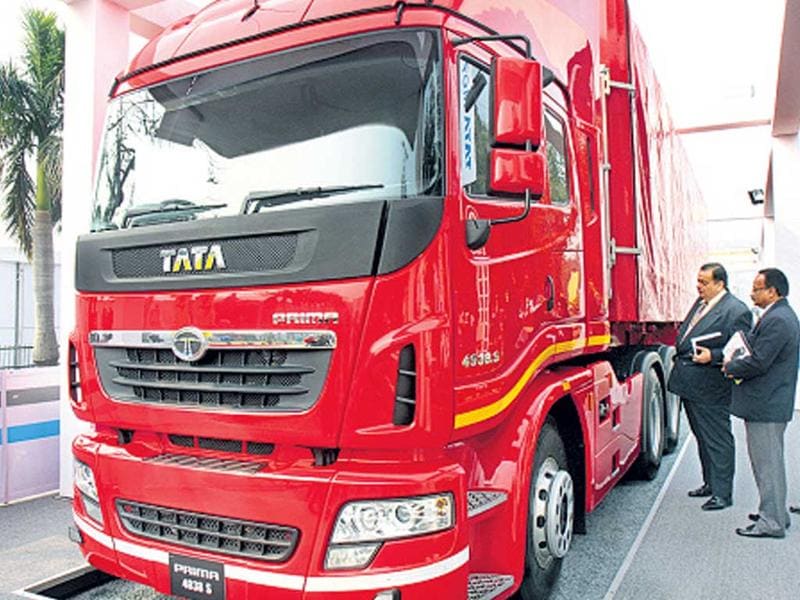
Reacting to the news, the company’s stock rose 7.19% on the BSE on Tuesday.
Ashok Leyland and Volvo Eicher Commercial Vehicles (VECV), too, had placed orders.
“We are seeing buoyancy after four to five years,” said Sandeep Kumar, head of commercial vehicles (passenger) at Tata Motors.
With the deal, Tata Motors has already seen an 80% rise in the order book of commercial vehicles in 2016-17, over 2015-16, when it received 2,808 orders.
Buses accounted for 5.6% of total commercial vehicle sales for Tata Motors during April-July. During the period, the company sold 95,287 units.
In 2010-11, when demand was at its peak, states procured 18,000-19,000 buses.
There has also been an increase in the prices of the buses, with the government procuring better, high-quality, more comfortable, hybrid and electric buses. “Some of the buses are fully loaded with high-end features… A regular bus without these features would cost Rs 12-13 lakh,” said Kumar.
The average price per bus according to the deal is Rs 18 lakh.
Till five years ago, the government bought only the chassis and fabricated the body. At present, a quarter of the total production is fully-made.
Karnataka and Delhi are looking at smart card solutions, Mumbai and Amritsar have ordered buses with automatic transmission, Mumbai also wants hybrid and electric vehicles, the Hubli-Dharwad Bus Rapid Transit System (BRTS) (Karnataka) has ordered articulated (two rigid bogies linked in train-like structure) buses, and smaller towns, including Bilaspur and Raipur, have ordered AC buses.
“There is a huge replacement demand coming up,” said Vinod Aggarwal, CEO of VECV. “The government is coming up with a 15-years scrappage policy.”
Kumar said that 25% to 30% of the fleet in the country has outlived its age of 8-10 years, and has run up to a million kilometres.


