E-Paper



Bhutan signs MoU with Adani Group for 5,000 MW hydropower projects
A company statement said the MoU builds on the ongoing partnership for the 570/900 MW Wangchhu Hydropower Project, in which DGPC will hold 51% stake

 Prefer HTon Google


Ahmedabad: Bhutan’s Druk Green Power Corporation (DGPC) and the Adani Group signed a Memorandum of Understanding (MoU) in Thimphu to jointly develop hydropower projects to the tune of 5,000 megawatts, a company statement said.
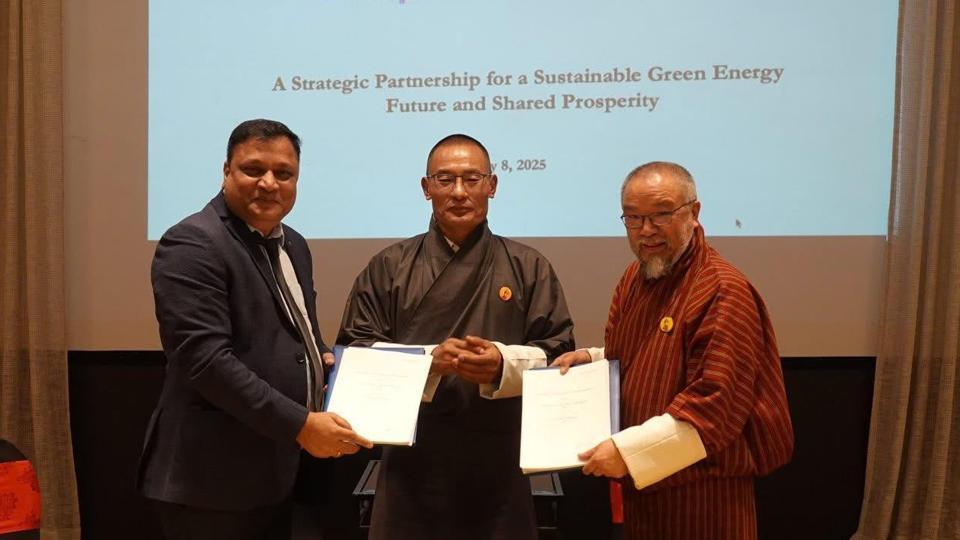
It said the MoU was signed by DGPC’s managing director Dasho Chhewang Rinzin and Adani Green Hydro Ltd’s chief operating officer(PSP & Hydro) Naresh Telgu in the presence of Bhutanese Prime Minister Dasho Tshering Tobgay, energy minister Lyonpo Gem Tshering.
This MoU builds on the ongoing partnership for the 570/900 MW Wangchhu Hydropower Project, in which DGPC will hold a majority 51% stake and Adani will hold 49%.
The broader 5,000 MW initiative will encompass additional hydropower and pumped storage projects to be identified, Detailed Project Reports (DPRs) prepared, and taken forward for implementation in phases, the statement said.
“This partnership reflects our deep commitment to developing clean energy infrastructure that enhances regional energy security,” said Naresh Telgu.
“Together with DGPC, we are enabling Bhutan to harness its hydropower potential and export reliable green energy to India. This is a powerful example of cross-border collaboration in pursuit of shared sustainable development goals,” he said.
“This strategic partnership with Adani will further strengthen our very strong engagement with the Government of India in harnessing Bhutan’s abundant hydropower resources, which is considered as the cornerstone of the exemplary and friendly relations between our two countries,” said Dasho Chhewang Rinzin, according to the statement.
DGPC, Bhutan’s premier hydropower developer, has decades of experience in managing the nation’s renewable energy resources. It plays a pivotal role in Bhutan’s clean energy journey, contributing to both domestic energy security and sustainable development. Through such partnerships, DGPC is also helping to strengthen Bhutan’s position in regional energy cooperation.
The Adani Group said it will support Bhutan in scaling up its hydropower capacity and facilitating access to Indian energy markets. As part of this collaboration, Adani will ensure reliable power offtake and integration with India’s commercial power markets, further reinforcing Bhutan’s role in the regional energy trade. The partnership is strongly backed by the Royal Government of Bhutan and the Government of India, underscoring a shared vision for clean energy growth and economic integration.
This initiative also aligns with Bhutan’s Renewable Energy Roadmap, which aims to achieve an additional 20,000 MW of generation capacity by 2040.