
 E-Paper



Overcoming the pandemic’s challenge requires an economic policy reset
A long-term look at this government’s economic policies suggests that for it to even consider a response the demand demand for a strong and equitable fiscal stimulus will require a reset of the existing economic policy framework

 Prefer HTon Google


There is now widespread consensus that the second wave of Covid-19 will worsen India’s demand side problem. Even though there is no official data to prove this, most experts and private estimates suggest a significant rise in poverty and inequality. As a corollary, demand for a strong and equitable fiscal stimulus is rising once again.
A long-term look at this government’s economic policies suggests that for it to even consider such a response will require a reset of the existing economic policy framework. This framework, from the evidence on hand, displays a bias towards the formal sector, capital (when seen in the context of the capital-labour binary) and centralisation.
This may have been initially based on the premise of trickle-down growth but the protracted slowdown in the Indian economy, even before the pandemic hit, had already nullified any such assumptions. If these policies did not help before the pandemic, they are definitely counter-productive at the current juncture. A brief recap is useful to understand the issues at hand.
Demonetisation and corporation tax cuts: two faces of direct tax policy
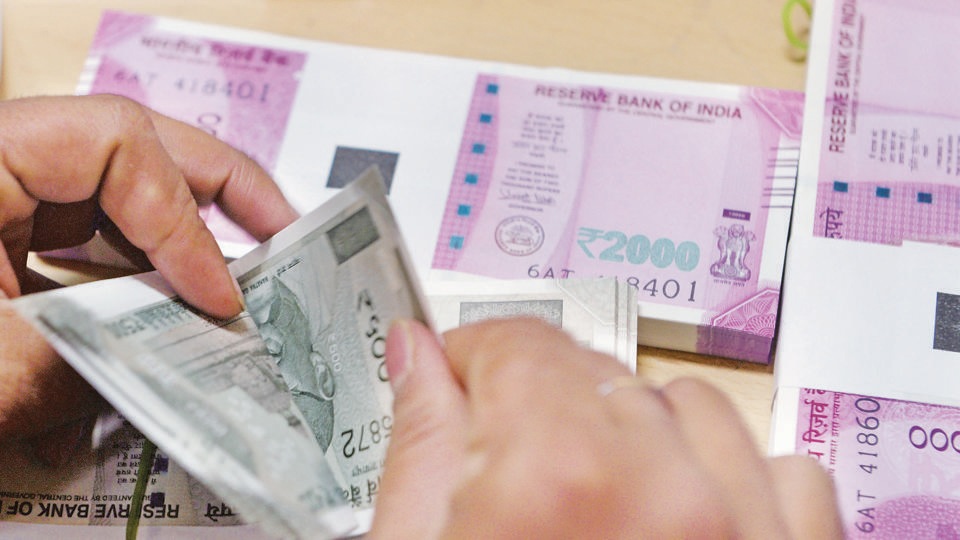
On November 8, 2016, the government scrapped high value currency notes of ₹500 and ₹1,000 as legal tender. These two denominations constituted almost 86% of the currency in circulation. Because liquidity restoration took time, economic activity was disrupted. The cash dependent informal sector suffered the most. The initial justification of demonetisation was that it would purge large amounts of unaccounted cash, thereby generating windfall gains for the government — but it resulted in collateral damage.
Also Read | India’s tax burden shifted from boardrooms to petrol pumps during Covid-19
Once it was clear that this was not happening, digitisation and better direct tax compliance were brought in as post-facto justifications. Four-and-a-half years after the policy, none of the objectives have been realised. Cash as a share of GDP is back to pre-demonetisation levels and income tax collections have only shown a marginal increase, clearly not worth the collateral damage which was inflicted on the economy.
Then, in an effort to boost business activity and competitiveness, the government announced a massive cut in corporation tax rates in September 2019. Tax data for 2019-20 and 2020-21 shows that fall in corporation tax collections have more than neutralised the purported marginal gains of demonetisation in income tax collections.
It is important to remember that the government resisted demands to announce any significant cuts in income taxes in the latest budget. This would have benefited the white collar workforce, increased disposable incomes of the (relatively) better-off and generated some tailwinds for demand. The direct tax policy, from demonetisation to corporation tax cuts to resisting income tax cuts after the pandemic, displays a clear policy bias.
The same government which announced major tax breaks for corporate profits thought that it was alright to disproportionately burden the informal sector via demonetisation to increase direct tax collections. As far as the formal sector is concerned, capital got a better deal than labour. It is an accepted fact that marginal propensity to consume out of profits is much smaller than that for wages. What the economy needs at the moment is demand, which requires incentivising consumption.
GST and increasing reliance on cesses have emaciated fiscal federalism
If demonetisation was a bolt from the blue, the rollout of Goods and Services Tax (GST) was the culmination of decades of efforts to harmonise India’s indirect tax regime. One of the biggest reasons why GST took so long to materialise was the difficult question of compensating states for surrendering their fiscal sovereignty. Finally, the Union assured guaranteed revenue growth of 14% for five years to get the states to agree to GST. This commitment is proving to be increasingly difficult to fulfill and has put a fiscal squeeze on the states at a time when they need resources the most. State governments have done most of the heavy lifting during the pandemic.
But GST, which remains good in concept, is not the only problem as far as fiscal federalism is concerned. The Centre has been increasingly moving its taxes away from what is called the divisible pool. Every rupee which accrues to the divisible pool of taxes must be shared with the states as per the finance commission’s formula. The 14th finance commission put this share at 42%. Its successor has revised it to 41%, largely on account of the erstwhile state of Jammu and Kashmir being bifurcated into two union territories. The provisional 2020-21 fiscal numbers show that the Centre only transferred 29.4% of its gross tax revenue (GTR) to the states.
Another comparison can make this clear. The Centre’s GTR increased between 2019-20 and 2020-21, but the states received a lower amount in transfers from the Centre. This is explained by the fact that most of the windfall gains from taxes on petrol-diesel were made via the cess route, which are not a part of the divisible pool. Everything else aside, a growing fiscal squeeze on states means that a crucial engine of fiscal stimulus is stalling. This will also have adverse consequences for health spending, which is crucial to preventing future waves of infections.
Skewed optimism confirms the policy bias
To be sure, not everyone is pessimistic about the economy. Stock markets did not suffer any losses during the second wave. They more than made up for reverses seen early in the first wave. The price-earnings (PE) multiple of the BSE Sensex is at 31.2 on June 1 , high in terms of both in terms of international and historical comparison. Because the PE multiple captures the extra premium on the share/index price with current earnings, it is in a way, a proxy for belief in future economic performance.
The trajectory of the PE multiple during the pandemic is at odds with that of future expectations in the RBI’s Consumer Confidence Survey (CCS). While the former fell sharply and then more than recovered, the latter stagnated and fell in the March round, the latest period for which data is available. In all likelihood, the CCS indicator will be lower in the May round, the results of which will be declared this week. This suggests an asymmetry about future economic prospects as seen by the rich and non-rich.
Optimism of rooted capital versus optimism of the footloose capital
To be sure, a pro-capital strategy could have been justified had it led to higher investment activity in the economy. That does not seem to be the case.
A survey by industry lobby group FICCI showed that business confidence index fell from 74.2 in February to 51.5 in May and 70% of businesses were citing weak demand conditions. This means that businesses will not invest, even if they have the capacity to. Latest data from RBI’s May 2021 bulletin shows that green-field investors (Direct Foreign Investment category) from outside India brought in lower investment in 2020-21 ($54.7 billion) than in 2019-20 ($56 billion). The net DFI figure went up marginally because outward DFI from India came down from by $1.7 billion. Net portfolio investment, largely invested in stock markets and speculative in nature, went up from $1.4 billion in 2019-20 to $36.8 billion in 2020-21.
Footloose financial capital, which is always on the look-out for speculative gains, can generate good looking stock market and foreign currency reserve numbers while it is around. These numbers, however, are no guarantee for a sustainable, even, incipient recovery in the real economy. In fact, there could be merit in pursuing some policies such as a pro-poor fiscal stimulus to help the real economy. More than anything else, these are functions of ideological proclivities of the incumbent regime.


