
 E-Paper



See How China Is Dominating the Global EV Market
Made-in-China electric vehicles can cost thousands of dollars less than U.S. or European models and now make up more than half of global sales.


 Prefer HTon Google


In the age of tariffs, Chinese automakers have been able to increase their share of global sales, now accounting for more than half of the electric-vehicles sold in the world.Companies such as BYD and Geely Automobile have been able to roll out models faster and more cheaply than established rivals, thanks to government subsidies and innovative manufacturing methods. That means a made-in-China EV often costs thousands of dollars less than one developed in the U.S. or Europe, while offering top-end features and long-range battery packs far cheaper than those of competitors.
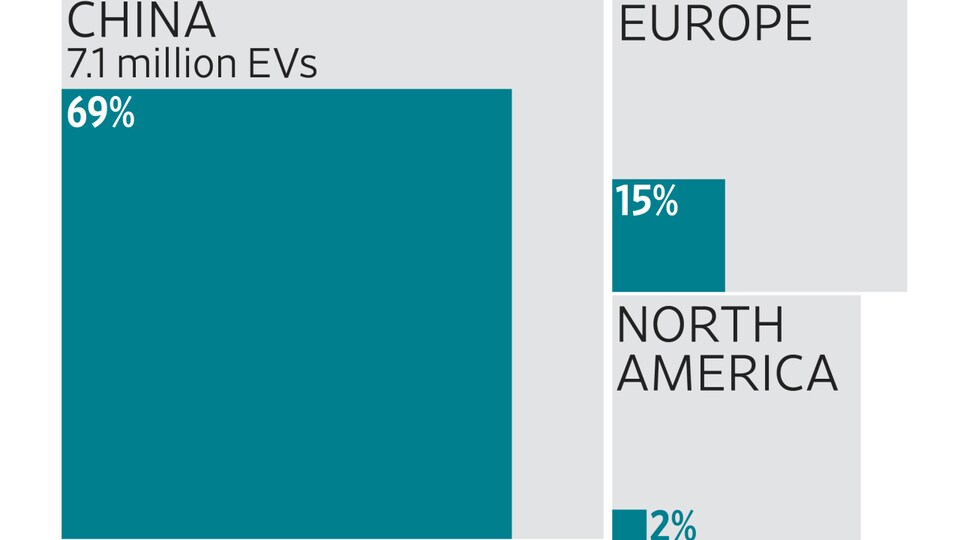
Tariffs have slowed the expansion of Chinese automakers in lucrative markets, including the U.S. and Europe, but their footprint is still growing. Here is what it looks like:
In China, sales of EVs and hybrids surpassed those of internal combustion engine cars for the first time last year. Local brands made up 75% of all EV sales in the first quarter of 2025.
China’s neighbors are also big buyers. In Thailand, where BYD recently opened a factory, Chinese EVs make up 93% of all sales. In Indonesia, that figure reached 78%.
Rising demand for Chinese EVs in Europe reached a plateau in 2024, when the European Union imposed tariffs on three Chinese car companies. Later that year, the EU announced tariffs of up to 45%, citing unfair competition from Chinese-government subsidies. Europe and China are in negotiations to lift the tariffs, with the EU seeking minimum price guarantees on Chinese vehicles to replace import taxes.
Despite the tariffs, some Chinese EV makers have continued to make gains in the region. BYD sold twice as many vehicles in Europe in April compared with a year earlier, outpacing Tesla for the first time. MG, the historically British brand now owned by the Chinese auto company SAIC, has also seen sales grow rapidly on the continent.
Chinese car companies have never had much presence in the U.S. and Canada, and steep tariffs imposed by both countries have made the entry of Chinese brands harder. President Trump’s trade war with China, plus waning U.S. consumer demand for EVs, makes the markets even less appealing. In Mexico and South America, Chinese automakers have had more success.
EV popularity has softened across the U.S. in recent months, including in California, by far the top state for EV sales.
Write to Max Rust at max.rust@wsj.com and Sean McLain at sean.mclain@wsj.com


