E-Paper



South Korea looks to upgrade CEPA without early harvest deal
South Korean trade minister Yeo Han-koo said in an interview that South Korea and India have great potential to forge stronger partnerships for the post-pandemic era in key areas

 Prefer HTon Google


NEW DELHI: South Korea is looking at concluding negotiations with India in 2022 to upgrade the bilateral Comprehensive Economic Partnership Agreement (CEPA) without going in for an early harvest package, South Korean trade minister Yeo Han-koo said on Wednesday.
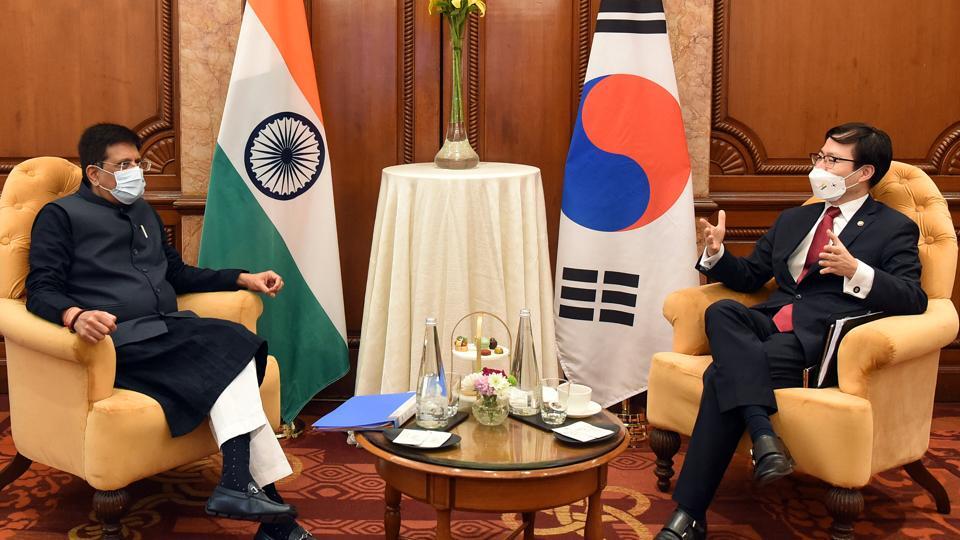
A day after holding talks in New Delhi with his Indian counterpart Piyush Goyal, Yeo said in an interview that South Korea and India have great potential to forge stronger partnerships for the post-pandemic era in key areas such as supply chains, emerging technologies, the climate crisis, digital, vaccines, and public health.
Goyal and Yeo agreed during their talks to expand trade by upgrading CEPA, which was finalised in 2009 and came into effect a year later, and by resolving industry-specific issues to achieve $50 billion in bilateral trade by 2030. Two-way trade crossed the $20 billion mark for three consecutive years since 2017 before being impacted by the Covid-19 crisis.
Noting that South Korea is eyeing the completion of negotiations for upgrading CEPA within 2022, Yeo said: “I think CEPA unleashed great potential [but] despite all this potential, I think CEPA could be sort of the framework to build on and then expand. CEPA took effect in 2010, which was forever ago, and now the world is completely changed.”
He added, “We need an upgrade to jump-start our bilateral cooperation. We launched these upgrade negotiations in 2016, but I think the progress has been sort of on and off. I think what we agreed on between the two ministers is that we really need to renew this momentum and then bring new spirit into this process, so that in 2022, we could really conclude a more upgraded and better CEPA.”
Though the Indian side raised the issue of an early harvest package that was decided in 2018, Yeo said there was “some misunderstanding on both sides” on this issue.
“I think we cleared that misunderstanding [on Tuesday]. I think what I understand is that India took it as, okay, we agreed on the early harvest package, and [it came] into effect right away, and then the rest of the negotiations will continue. But at that time, what Korea thought we got into was that, okay, this is an early harvest package that we agreed on and this is sort of a first stage, but [it has] not [taken] effect,” he said.
“In our system, the ratification process in the National Assembly is quite stringent and very, very intensive. We’ve never done [things] just partially, you know, partially concluded [an] early harvest [package], and then ratify it in the National Assembly and then continue on with the rest of it. We never did it, our system doesn’t allow that,” he added.
Yeo said the global trading environment is going through a big paradigm change, with the traditional scope of trade policy expanding to cope with issues such as supply chains, emerging technologies and digital. “In this sense, I think Korea and India have great potential to forge stronger partnerships in this rapidly changing era, for example, in supply chains,” he said.
The world was dependent on global supply chains developed decades ago, and now “we realise that disruptions or even small and unexpected hiccups along the value chain can really have serious implications for global trading”, he said. “Korea has its New Southern Policy, which puts Asean and India at the centre of our diplomatic, economic and industrial cooperation...We value India as an important partner for complementing our supply chains. And in this sense, the CEPA could really bolster supply chains, this connectivity and cooperation,” he added.
Yeo acknowledged that complaints from both Indian and South Korean businesses related to issues such as barriers to market access figured in his talks with Goyal. “I think in any healthy relationship, especially this trade relationship worth $20 billion, it’s natural that we have some sort of irritants, small or big on both sides. I think what matters is not those irritants, but how to bring this to attention and how to resolve them in a transparent, mutually trusted manner,” he said.
“We had a very intensive discussion on what Indian companies have issues with and also what Korean companies have issues with. I’m more confident that both authorities can keep the communication channels open and find a reasonable, win-win solution for those issues,” Yeo said.
It is understood that Goyal, during the talks, raised problems being faced by Indian firms to get market access in South Korea for commodities such as steel, bovine meat and agricultural products due to stringent regulations and practical barriers.