
 E-Paper



Paddy yield hits all-time high in Punjab, but raises concerns
Even as higher production means higher income for farmers, experts say it will hit diversification efforts, lead to more stubble burning and pose logistical issues

 Prefer HTon Google


As Punjab is heading towards an all-time high production of paddy this kharif season, experts welcomed the resultant higher income for farmers, but also raised concern over its long-term impact.

According to experts, increase in production means efforts for diversification will take a hit, as more farmers will shift back to growing paddy that offers an assured income by way of minimum support price.
As per the crop cutting experiments conducted by the state agriculture directorate, there’s an increase of 10.5% in the paddy yield. “It is expected to break the previous record of 2017, when a total of 199.65 lakh tonne paddy was produced (including basmati),” said director agriculture Rajesh Vashisht. Non-basmati varieties production in 2017 was 174.62 lakh tonne.
Crop cutting experiments are conducted in all blocks of the state and the trend could be assessed on basis of results of 60% of them.
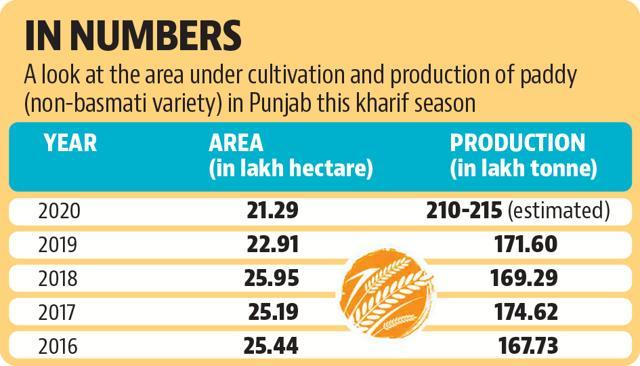
This kharif season, paddy was grown over 27.89 lakh hectare, including basmati over 6.6 lakh hectare.
The yield is expected to touch 210-215 lakh tonne, while paddy procurement by state agencies has already crossed 197 lakh tonne.
Vashisht said this season, crop delivered best results as all the conditions, such as weather, humidity and rainfall, were most conducive, there was no pest attack, and direct sowing rice (DSR) method was adopted over 5.5 lakh. Also, short-duration varieties were sown, which contributed to a higher yield.
“On one side, we are happy as the production has increased. However, more production will lead to a vicious cycle, wherein more farmers will turn towards the paddy crop with assured income in mind and our diversification plan will take a hit,” said Vashisht.
Stubble burning cases could rise
Moreover, the per-hectare productivity of paddy is also expected to touch an all-time high of 70 quintal.
“More productivity means higher stubble volume. When more stubble is burnt, it will emit more smoke,” said an official of the pollution control board.
At least 20-25 lakh tonne stubble is produced along with the grain. The number of stubble burning cases in the current season has touched an all-time high of 73,988, and due to this, air quality index remained over 300 (very poor) for many days before the Sunday’s rainfall.
‘Need alternatives for farmers’
Dr Sukhpal Singh principal economist, Punjab Agricultural University, Ludhiana, said assured income as well as environment protection are important.
“No doubt there is need to save subsoil water and ambient air. For that, we have to ensure an alternative to farmers, so that they can also get good remuneration. I think cotton and maize are good alternatives, if assured procurement could be ensured,” said Singh.
PAU vice-chancellor BS Dhillon said the challenge is to conserve water and sow short-duration varieties. “I am happy for the farmers, as increase in yield means higher income,” he said.
Storage to pose problem
According to sources in the food and civil supplies department, the storage of rice after shelling of the current paddy crop will pose a logistical problem.
Out of 205 lakh tone expected to be procured this season, 135 lakh tonne rice would come for storage.
Already 55 lakh tonne rice from the previous season besides 136 lakh tonne wheat is stored in state godowns. “More production is certainly a concern, if we look at the logistics, as the storage space is restricted,” said a food department official, who did not wish to be named.


