
 E-Paper



Stubble burning: 252 challans, ₹6.50 lakh fine imposed on farmers in Haryana
Other steps taken to stop crop residue burning include registration of 124 police complaints/first information reports (FIRs) in six districts till October 14, Haryana government informed the Supreme Court last Friday.


Amid concerns about the Air Quality Index (AQI) in Delhi-NCR reaching critical levels due to farm fires, the Haryana government has issued 252 challans and imposed ₹ 6.50 lakh fine on farmers of 11 districts for burning crop residue so far.
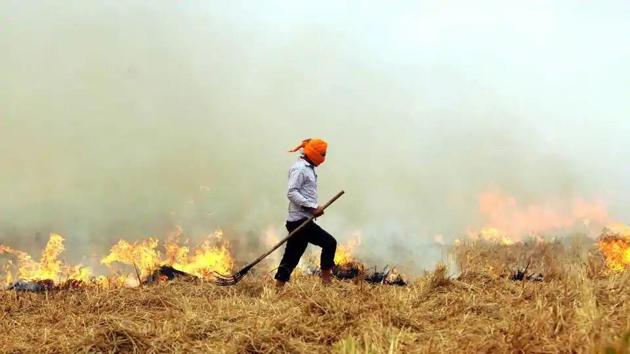
Other steps taken to stop crop residue burning include registration of 124 police complaints/first information reports (FIRs) in six districts till October 14, Haryana government informed the Supreme Court last Friday.
As per the official data, Fatehabad district tops the list with 44 complaints/FIRs registered for stubble burning followed by Jind 43, Sirsa and Kaithal 13 each, and Ambala 10. No FIR was registered in other paddy sowing districts like Karnal and Yamunanagar.
The apex court has appointed justice Madan B Lokur (retd) as a one-man committee to look into stubble burning in Punjab, Haryana and Uttar Pradesh. In his October 15 affidavit, while listing out eight different steps taken to reduce farm fires, Haryana chief secretary Vijai Vardhan assured the top court that the state government has been taking all necessary steps required to curb stubble burning and to prevent environmental pollution.
The affidavit was submitted in a case seeking urgent directions to Punjab and Haryana to ensure a complete ban on stubble burning so that the AQI in Delhi-NCR does not reach critical levels this year especially in view of the prevailing Covid-19 pandemic.
Till October 18, the Haryana Space Applications Centre (HARSAC) detected majority of active fire locations in Kurukshetra (521) and Karnal (562). Also, 57 challans were issued in Kurukshetra and 24 in Karnal till October 14.
The highest 63 challans were issued and ₹ 1.57 lakh fine was imposed in Kaithal district. In Kurukshetra, ₹ 1.35 lakh penalty was imposed.
Referring to the data (till Oct 14) received from Indian Council of Agricultural Research (lCAR), the chief secretary told the court that there was decline in active fire locations in Haryana in comparison to Punjab and UP.
As per the ICAR data quoted in the affidavit, there were 3,020 active fire locations in Punjab against 737 in Haryana and 249 in UP. During the same period last year, Haryana was ahead with 992 active fire locations, Punjab had 856 incidence of farm fires and UP 271.
The state government has stated that in order to follow a focused approach and micro-level planning, the districts were categorised into red, yellow and green zones in terms of incidences of crop residue burning based on the data provided by the HARSAC. As per the HARSAC, there were 2,676 cases of farm fires till October 18.
Decomposer technology
The state government has informed the Supreme Court that Agricultural and Finance Corporation Limited has developed the decomposer technology which requires validation before its implementation. The validation is being done by Chaudhary Charan Singh Haryana Agriculture University, Hisar, in collaboration with department of agriculture and farmers welfare. Trial/Microbial treatment on 21 identified locations in four districts of Hisar, Fatehabad, Kurukshetra and Ambala were conducted till November 15 after harvest of the paddy. The results will be declared by December 31 after laboratory analysis of samples. Thereafter, the technology could be adopted for actual implementation, the chief secretary has stated in the affidavit.
POINTER BOX: Steps taken to curb farm fires
Decomposer technology developed by agricultural and finance corporation
Incentives to farmers
Micro-level planning
Providing crop residue management machinery on subsidy
Creating awareness on ill effects of stubble burning
Crop diversification
Active role of panchayats in crop residue management
Enforcement measures
-kMNB-U1021018938041uE-250x250%40HT-Web.jpg)


