
 E-Paper



Karnataka: Caste census may impact political contours, say experts
Experts say caste census can impact state’s political equations after chief minister Siddaramaiah decided to accept caste census in the state


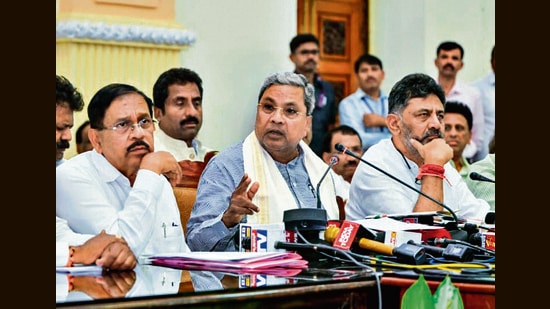
After the chief minister Siddaramaiah on Wednesday announced that the state government will adopt the 2015 socio-economic caste survey, commonly referred as the ‘caste census,’ and provide social benefits according to the survey findings, the experts believe that the revelations of the report will change the political landscape of the state.
The government also said the survey findings will have a bearing on “providing reservation and other benefits to various communities.”
“There will be political implications, considering the fact that the dominant communities in Karnataka will no longer hold numerical strength,” commented political analyst Sandeep Shastri. However, he cautioned that viewing Scheduled Castes (SCs) as a single entity may not be entirely accurate. He also raised the question of whether Muslims should be included in the caste equations. Nevertheless, he acknowledged that Muslims emerging as the second-largest group would hold significance due to their electoral impact.
The announcement comes in the backdrop of Congress leader Rahul Gandhi’s announcement in the recently conducted Karnataka assembly elections that the reservation to different sections should be based on a national census based on caste.
The findings of 2011 national caste census data could not be deciphered because of no clarity on different caste sub-groups.
The Karnataka caste census, which remained untouched since 2018, could challenge the perceived longstanding dominance of the Lingayat and Vokkaliga communities in Karnataka. These communities have traditionally held significant political influence, driven by the belief that they constituted a substantial portion of the state’s population.
During Siddaramaiah’s last term as chief minister, an extensive caste survey was commissioned at a cost of ₹162 crore in 2015, marking the first effort of its kind by any Indian state since 1931. The colossal task of surveying 16 million households in Karnataka, ordered in 2014, took over a year to complete. Bharat Electronics Limited (BEL) was entrusted with the responsibility of digitising the collected data.
In 2018, certain findings of the survey were leaked, which showed that Lingayats and Vokkaligas were lesser than their perceived proportion in the population. According to the leak, Scheduled Castes (SCs) accounted for 19.5% of the state’s total population, making them the largest caste group. Muslims followed closely, constituting 16% of the population. Lingayats and Vokkaligas represented 14% and 11% of the population, respectively.
Among the Other Backward Classes (OBCs), the Kuruba community alone accounted for 7% of the state’s population. Overall, the OBCs constituted 20% of Karnataka’s population. When considering SCs, STs, Muslims, and Kurubas collectively, they formed 47.5% of the total population, representing the most influential combination. Chief minister Siddaramaiah’s AHINDA (Minorities, Backward Classes, and Dalits) group is expected to be the most formidable force in the state, relegating Lingayats and Vokkaligas to secondary positions.
On Wednesday, the Karnataka government issued a statement saying the caste survey findings will be accepted by the government. “The caste-wise survey will provide the necessary data for making informed decisions regarding the provision of facilities and preferential treatment to various communities. The survey aimed to obtain scientific and accurate information crucial for providing reservations and other benefits,” he said.
However, the Lingayat community does not agree with the report’s findings. A senior office bearer of the Veerashaiva Mahasabha, who requested anonymity, referred to the justice Chinnappa Reddy Commission’s findings, which estimated the Lingayat population in the 1980s to be 6.9 million, accounting for 16.92% of the total population.
“How can the population of this community be merely 14% after a span of 30 years? If their population has indeed declined, it should have correspondingly affected the overall population of the state. But this is not the case,” said the official, who said the community conducted their own caste census, which revealed a population of approximately 1.2 crore, constituting around 20% of the state’s population.
Similarly, a leader of the Vokkaligara Sangha criticised the caste census as a futile exercise that attempts to divide society. A leader of the community questioned why resources were being spent on dividing society along caste lines instead of being utilised for infrastructure development, education, or even eradicating the caste system.
Former chief ministers HD Kumaraswamy, BS Yediyurappa, and Basavaraj Bommai’s lack of action regarding the census indicated that it may not politically benefit them. However, for Congress, the census could further AHINDA politics ahead of the Lok Sabha elections. “When the BJP aims to polarise voters along religious lines, the caste census could be the Congress’ response,” political analyst Sandeep Shastri. said.
CM Siddaramaiah’s decision has reignited demands for a caste census from various political parties, including JD(U), RJD, SP, DMK, NCP, and BJD. On the other hand, the BJP has expressed opposition to the caste census, allegedly due to concerns that it may challenge their Hindutva campaign leading up to the 2024 elections.
The BJP is yet to release a statement on the census. A senior leader said that the party will make its stand clear on the issue after consulting with the party leaders during the ongoing state-level meeting.


Stay updated Bengaluru Weather Live and with all the Breaking News and Latest News from Bengaluru. Click here for comprehensive coverage of top cities including Delhi, Mumbai, Hyderabad, and more across India . Stay informed on the latest happenings in World News.


