
High Court orders MP's 11th-century Bhojshala’s survey on Hindu group’s plea
Hindus consider Bhojshala to be a temple dedicated to Vagdevi (Goddess Saraswati) while the Muslims call it Kamal Maula Mosque
The Madhya Pradesh high court’s Indore bench on Monday asked the Archaeological Survey of India (ASI) to conduct a scientific survey of Bhojshala, a protected 11th-century monument, in Dhar within six weeks. Hindus consider Bhojshala to be a temple dedicated to Vagdevi (Goddess Saraswati) while the Muslims call it Kamal Maula Mosque.
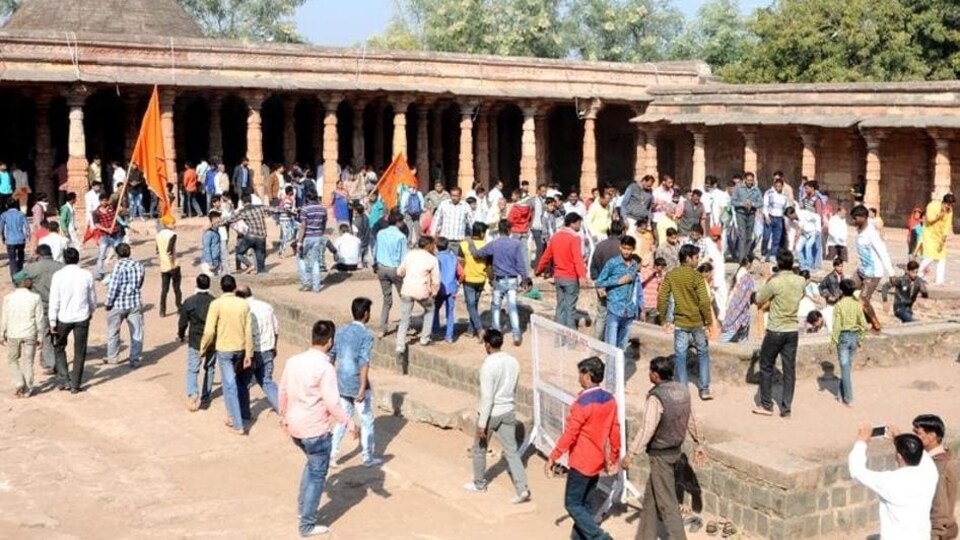
Hindu Front for Justice filed a petition in the high court in May 2022 against the offering of namaz at Bhojshala and sought a survey to determine the “real religious character” of Bhojshala.
The court allowed ASI to survey the monument based on evidence the petitioners presented in the form of coloured photographs of pillars where Sanskrit verses are written.
Read here: Bhojshala dispute: Madhya Pradesh HC issues notice to Centre, ASI and state govt
The ASI in April 2003 allowed Hindus to perform puja at Bhojshala every Tuesday. Muslims were given the go-ahead to offer namaz in the complex on Fridays.
In May 2022, the court called Hindu Front for Justice’s public interest litigation challenging the ASI move as comprehensive. It issued notices to the ASI, the Union, and the state government seeking responses to the plea.
The plea urged the court to direct the Union government to re-establish an idol of Goddess Saraswati within the Bhojshala complex. It said the then rulers of Dhar installed the statue at Bhojshala in 1034 AD and that the British took it to London in 1857.
ABOUT THE AUTHORShruti TomarI have spent over a decade chronicling Madhya Pradesh’s political and social landscape, covering politics, investigative journalism, crime, human interest, and government policy, blending sharp insight with ground‑level depth. I have closely tracked three assembly elections, three Lok Sabha elections, leadership transitions in MP while exposing governance lapses, tender irregularities, and flawed policy rollouts. My reports have revealed gaps in the Cheetah project, irregularities in medical education, rigging in recruitment exams, and loopholes in policy implementation. In crime reporting, I have moved beyond FIRs to map systemic patterns — from organised crime networks and gender‑based violence to custodial accountability — balancing urgency with sensitivity. My journalism is defined by a commitment to human interest. I have profiled the marginalised Bancchda community, documented atrocities against tribal groups, and highlighted efforts to preserve their culture through heritage liquor and revival of spiritual practices. I have reported on farmers struggling with failed MSP promises, giving voice to those often reduced to statistics in policy files. Passionate about field reporting, I have reported on rampant sand mining in Chambal and Narmada, pharmaceutical companies supplying medicines under altered names, the dire condition of schools and colleges, the plight of commercial sex workers, and skewed sex ratios in specific districts. Beyond deadlines, and as HT’s state correspondent and assistant editor in Madhya Pradesh, I engage with ministers, farmers, students, and activists, believing the best policy stories begin with a single human voice. A postgraduate in Journalism and Mass Communication, I also hold a diploma in sports journalism.Read More

E-Paper


