
 E-Paper



After Pathankot weaves a success story, Doaba belt set to take the silk route
In 2022, as part of a pilot project to check viability of sericulture, the state forest department had provided training and infrastructure to 116 villagers, most of them belonging to the Scheduled Caste community, having no or small landholdings, in the underdeveloped Dhar revenue block of Pathankot.


Buoyed by the success of the sericulture pilot project in Pathankot, Punjab is all set to expand silk production to the Doaba belt within a year.
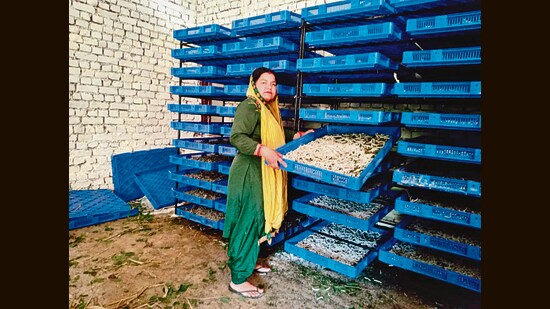
The state forest department has roped in 46 economically marginalised villagers from Hoshiarpur to produce silk cocoons.
In 2022, as part of a pilot project to check viability of sericulture, the state forest department had provided training and infrastructure to 116 villagers, most of them belonging to the Scheduled Caste community, having no or small landholdings, in the underdeveloped Dhar revenue block of Pathankot.
As part of the project, nearly 40,000 mulberry trees were planted in Pathankot, with its leaves – which are the only source of food for silkworms -- being provided to the sericulturists for free.
“In the last two years, about 6 tonnes of silk cocoon was produced in Pathankot. All support – sheds for silkworm cultivation, mulberry leaves, mandi to sell reared cocoons -- was provided to farmers under a Centre-funded project, supported by Bengaluru-based Central Silk Board,” said Sanjeev Tiwari, conservator of forests (north circle). He said the silkworms for the project were purchased from West Bengal, Karnataka and other places.
“At least, 12,000 saplings have already been planted in Hoshiarpur and another 10,000 will be sown in the next phase,” said Tiwari.
He added that in Pathankot, a factory to produce silk thread would also be set up in the next four to five months and it will become operational within a year.
Villagers in the sub-mountainous areas near the Shivalik foothills, known as kandi areas, where conventional farming is a challenge due to constrained natural resources, said that sericulture has the potential to improve their economic condition.
Manohar Lal, 60, of Pathankot’s Durang Khad village, who owns seven kanals of land, said, “We have small landholdings, and that too in the semi-hilly regions, which are not viable for wheat and maize cultivation. I have been in sericulture for almost a decade, but things improved since I got associated with the forest department’s project. We get all support from the department and are hoping for additional income.”
Sushila Devi, another sericulturist from the area, said that silkworm cocoons are produced twice in a year, with the March-April season being the most productive.
“We can produce a quintal cocoon from a single shed that may fetch ₹800 or more for a kilogram. But the cocoons reared before the onset of winter in September-October have very low production and rates are also not lucrative. Sericulture has potential to benefit the farmers, and the government should employ experienced sericulturists as master trainers to encourage others to adopt silkworm rearing,” said Devi, whose in-laws have been producing silkworm cocoons for the last almost 30 years.
Chatar Singh, a farmer from Bhadan village, said that last season was devastating as he was able to rear only 10 kg of cocoons.
“I own four acres of agriculture land, but it is hardly productive in the absence of sufficient irrigation facilities in the foothills. I have been working on sericulture since 2022 and got training in Jammu. I am convinced that it can bring a change in the rural areas. We hardly have any investment in projects of the forest department, but the fluctuating market rate is discouraging,” he added.


