
 E-Paper



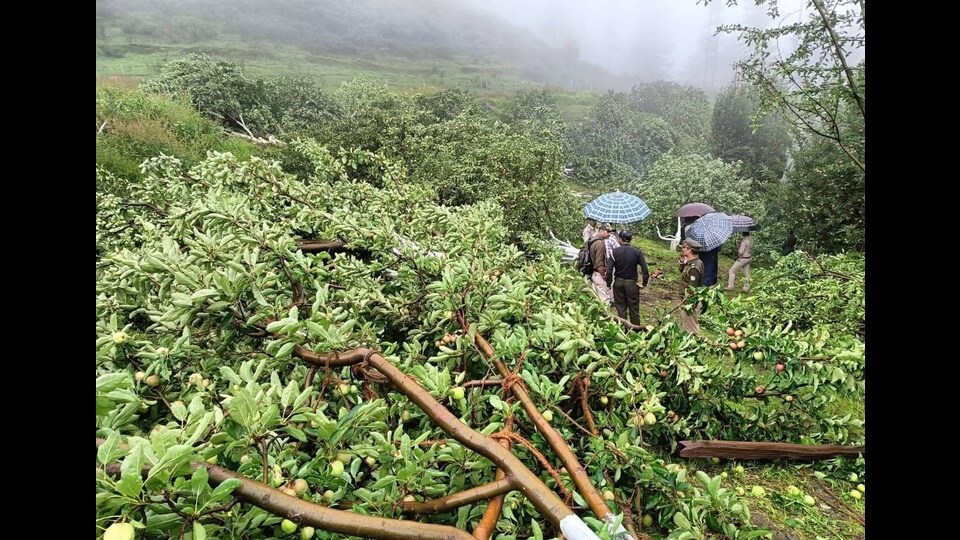
Axe effect: Decoding the furore over felling of apple trees in Himachal
Historically, the Himachal economy has heavily relied on agriculture and horticulture. Many individuals and communities have expanded their agricultural land or planted orchards on forest lands, often due to small land holdings, limited land availability and the desire to improve their livelihood.

 Prefer HTon Google


The ongoing felling of illegally grown apple trees on forest land in Himachal Pradesh has triggered a widespread outrage. While the high court has reiterated that all orchards grown on the encroached forest land shall be removed, apple growers have termed the move ‘anti-farmer’ stating that these orchards were planted decades ago and are a source of livelihood for thousands of families. HT takes a look at the genesis of the issue and its repercussions.
What is the issue
Historically, the Himachal economy has heavily relied on agriculture and horticulture. Many individuals and communities have expanded their agricultural land or planted orchards on forest lands, often due to small land holdings, limited land availability and the desire to improve their livelihood. The problem of encroachment stems from a confluence of factors, including historical land-use patterns, socio-economic pressures, legal complexities, and the challenges of enforcement and demarcation.
From 1950 to 1980, a vast tract of land in Himachal was mentioned as ‘shamlat’ in revenue records. During this period, the government gave portions of this land to the landless to cultivate. In 1980, after the Forest Conservation Act was enforced, this entire ‘shamlat’ land was declared as forest land. However, as there was no proper demarcation of forest land, a significant portion was encroached upon by growers, especially apple farmers.
The quantum of land encroached
State horticulture minister Jagat Singh Negi, during the budget session, had informed the House that according to the government data, over 5,700 hectares of forest land lies encroached across the state. Of the 80,000 cases of encroachment, 10,000 had been cleared. Also, the count of encroachers in the state stands at 1.63 lakh.
How the matter reached high court
In 2014, Jubbal resident Krishna Chand Sarta wrote a letter to the then chief justice of the Himachal Pradesh high court giving names of influential people in Upper Shimla who had cut down trees in thousands of acres of forest land and developed apple orchards. The names and addresses of the alleged encroachers were mentioned in the letter. Sarta had pointed out that 2,800 bighas of forest land had been converted into orchards. It was also that permanent structures had been erected on forest land with electricity and water connections.
What the high court said
Treating the letter as public interest litigation, justice Rajiv Sharma and justice Tarlok Singh Chauhan in April 2015 issued strict orders to the government to free every inch of the land from encroachers. Then chief secretary, principal secretary, forest, secretary revenue department, principal chief conservator of forests, state electricity board and other departments were told to remove all encroachments from government forest land within six months. Apart from this, orders were also given to cut off electricity and water supply to the structures built on the encroached land. Special orders were also given to recover the cost of cutting apple plants and crops from the encroachers.
On HC directives, the state government filed an affidavit in July 2015 in which it was pointed out most of the encroachments of the forest land was in Shimla district followed by Kullu. The report also revealed as many as 2,526 FIRs were registered in such cases. A 2018 report filed by the government stated that 2,522 encroachment cases were presented before judicial magistrates. Also, 1,811 cases were filed before different forest officers and eviction orders were passed in 1,416.
In subsequent hearings, strict orders were passed by the high court to remove encroachment but nothing moved on the ground. Upset over inaction, the high court in 2018 gave the responsibility to two female administrative officers to free more than 2,800 bighas of encroached land. Then the court issued orders to the registrar general to immediately contact the Indian Army (Commanding Officer of 133 Battalion in Kufri near Shimla) to remove illegal encroachment from government forest land. The court also ordered the then Shimla DC o to provide trained staff to the members of the special team and the Eco Task Force to ensure that encroachments are removed easily.
Policy to regularise illegal encroachments
When the HC initiated action to remove the forest land encroachments, protests started under the banner of Kisan Sabha in 2016. The then Congress government, led by Virbhadra Singh, initiated the process (2016) of bringing a policy to regularise the encroachment on government land up to 10 bighas. Prior to this, in 2002, PK Dhumal-led BJP government had initiated the process to regularise the encroachments up to five bighas. However, the things did not move further.
The Virbhadra government submitted before the HC that it was planning to bring a policy to regularise the encroachment on forest and government land up to five bighas on humanitarian ground. It had also submitted that the draft of the policy had been framed under a relevant Act, which said that the policy would cover beneficiaries prior to August 28, 2015.
On April 12, 2017, the HC gave approval to the state government for such a policy. However, the policy never saw the light of day.
After assuming power in 2017, the BJP government led by Jai Ram Thakur claimed it had removed ‘13 big encroachers’ from forest land. However, the growers came back and occupied the land again.
The HP govt stance
In June 2024, the high court asked the government to disclose the type of land that has been encroached upon. The current Congress government, led by Sukhvinder Singh Sukhu, told the high court on June 19, 2025, that it does not have any plan to bring a policy to regularise the illegal occupation of five or 10 bighas of government land. The high court then asked the state government to immediately clear the encroachments.
On July 2, the state government told court that the felling of apples trees on forest land has started.
What next
According to legal experts, the state government does not have many options. “As the order has been passed to clear the land of all encroachments, the government will have to get the land vacated,” said senior advocate Sanjeev Bhushan.
“The state government had filed an application in the high Court to temporarily halt the cutting of apple trees until the harvest is completed, but the court turned it down. So, the state has no choice but to comply with the court’s final directive,” said horticulture minister Negi.
“We had passed a resolution in the assembly after the 2023 flood damage, requesting the Centre to amend the Forest Conservation Act, 1980. Many families lost homes and land. These people have been living there for generations. They should be advised to explore their rights under the Forest Rights Act (FRA),” he added.
“The state government’s options are limited as it can’t make any policy with regards to forest land. Any amendment or relaxation has to be done by the central government,” said Anup Rattan, HP advocate general.
According to former Theog MLA and senior CPI (M) leader Rakeh Singha, the government should first ensure land demarcation. “We are not against forests. But forest conservation cannot come at the cost of destroying livelihoods. What we demand is justice, land demarcation and protection, and not bulldozers and axe-wielding forest officials,” he added.


