
 E-Paper



Consensus to confrontation: BBMB in deep waters over inter-state dispute
BBMB faces a water-sharing dispute between Punjab and Haryana, escalating political tensions over water allocations amid historical cooperation.

 Prefer HTon Google


Blurb: Former BBMB members say differences between states were resolved at meetings and never got escalated to level that politicians would cry hoarse in public.
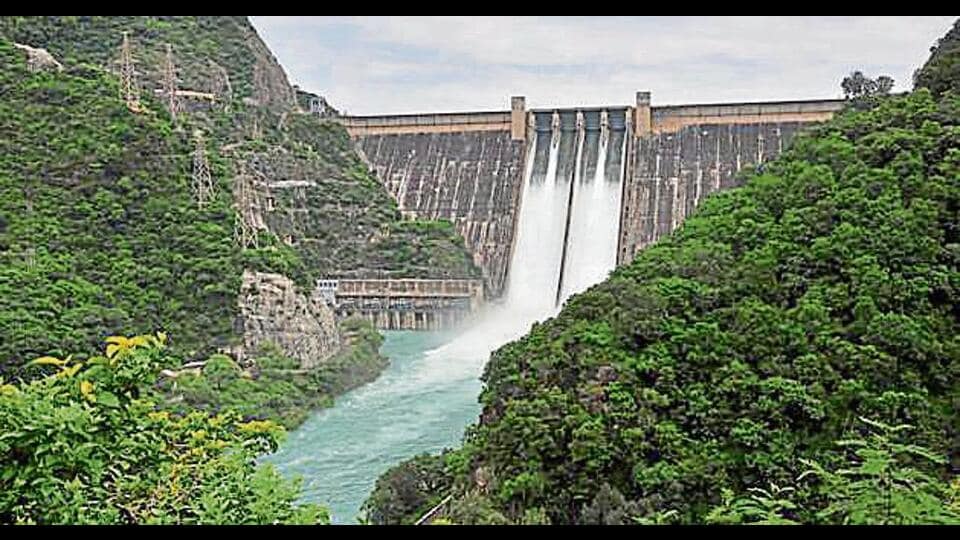
For the first time since its inception six decades ago, the Bhakra Beas Management Board (BBMB) finds itself in the crosshairs of an unseemly water-sharing dispute between partner states Punjab and Haryana, ruled by political rivals.
The controversy began on April 30 when the BBMB accepted Haryana’s request for the release of a surplus 4,500 cusecs of water daily from the Bhakra-Nangal dam to which Punjab objected, saying the neighbouring state had exhausted its allocated share. Three of the BBMB’s member states, BJP-ruled Haryana, Rajasthan and Delhi, voted in favour of releasing the surplus water, outnumbering AAP-ruled Punjab, while Congress-ruled Himachal Pradesh abstained.
A statutory body constituted under Sections 79 and 80 of the Punjab Reorganisation Act, 1966, the BBMB plays a central role in the distribution of water among partner states -- Punjab, Haryana, Rajasthan, Himachal Pradesh and Delhi. At the beginning of the accounting year in August-September, depending on the monsoon, the BBMB determines the amount of water to be allocated to each state. For this year, the board allocated 5.512 million acre-feet (MAF) to Punjab, 2.987 MAF to Haryana, and 3.318 MAF to Rajasthan. While Haryana sought the surplus water for drinking water purposes in Hisar, Sirsa and Fatehabad districts, Punjab called a special session of the assembly on May 5 after an all-party meeting and resolved it didn’t have a drop to spare for the neighbouring state that had already withdrawn 3.110 MAF or 104% of its share for the year.
Caught in the crossfire, BBMB chairman Manoj Tripathi, who had been asked by the Union ministry of home affairs on May 2 and the high court on May 5 to ensure that surplus water was released to Haryana, found himself confined to the guest house at Nangal dam for three hours on May 8 as Punjab education minister Harjot Singh Bains and Aam Aadmi Party supporters locked the gate to prevent him from releasing the surplus water to Haryana.
Tool to up political ante
Besides the chairman, the BBMB has two full-time members, designated as a member (irrigation), who as a precedent comes from Haryana, and a member (power) from Punjab. As on date, the board chairman officiates as member irrigation and a senior officer from the Punjab State Power Corporation Limited is the member, power. But on May 1, the BBMB struck a discordant note by relieving Punjab’s executive engineer, irrigation, of the key water-regulating charge.
“It needs deep understanding when different states have interests involved. The top man in the board should play a fair game and must have the power to convince top officials of partner states,” said a former BBMB chairman, requesting anonymity. “There were times when the then Punjab chief minister used to take my word as final,” he said.
According to a former BBMB member (power) Ashok Thapar, “Discord between states is not a good sign. There were differences between states earlier also but they were resolved in the confines of the office, and never got escalated to this level that politicians would cry hoarse in public. The BBMB, once a symbol of national pride, is being used as a tool to up the political ante.”
While Haryana chief minister Nayab Singh Saini has termed the need for surplus water a genuine demand to fulfil drinking water needs, his Punjab counterpart, Bhagwant Mann, has called it “an attempt to rob Punjab of its precious resource at the cost of farmers”. Between May 1 and 11, Mann reached Nangal dam to stop the flow of water to Haryana thrice. He even accused Union power minister and former Haryana CM Manohar Lal Khattar of acting behind the scenes to coerce the BBMB for releasing surplus water to Haryana.
Silt bigger challenge for board
The BBMB is expected to tide over the confrontation between Punjab and Haryana by May 21 when the filling season at Bhakra and Pong dams begins. “The dams start filling water with the snow melt and later with the monsoon from July to September 21, the states will get water according to the demand raised,” a BBMB official said. From September 22 when the filling season ends, water will be rationed and allocations made in proportion to the available water and individual share of the states.
A bigger challenge for the board, however, is silt accumulating in the reservoir of Bhakra dam. The dead storage level of the dam is 1,462 feet which, BBMB officials say, is set to increase due to the silt in the reservoir. “The total storage of Bhakra’s reservoir is 7.8 MAF of which 1.97 MAF is dead storage capacity. This is increasing because of the huge quantity of silt entering the reservoir due to urbanisation in the catchment area of the dam,” a retired BBMB engineer said. “Instead of political rhetoric, the partner states should focus on the dam’s safety and longevity,” he added.
The reservoir is spread over 168 sq km and silt coming in the reservoir is much more than expected when the dam was commissioned in 1963. Due to the silt, the dam fills and empties at a faster pace.


