
 E-Paper



Discoloured grain, high moisture leave Punjab paddy farmers in distress
A wave of frustration is sweeping through the mandis from Amritsar to Doaba. After waiting for months for their crops to reach maturity, farmers are now seeing their produce lose value because damage and discoloration have exceeded the acceptable 5% limit.

 Prefer HTon Google


For many farmers in Punjab, the recent paddy season has been marked by despair and an estimated ₹10,000-crore in financial losses. The crisis stems from a combination of prolonged procurement delays and extensive crop damage caused by floods, unseasonal rains, and poor yields.
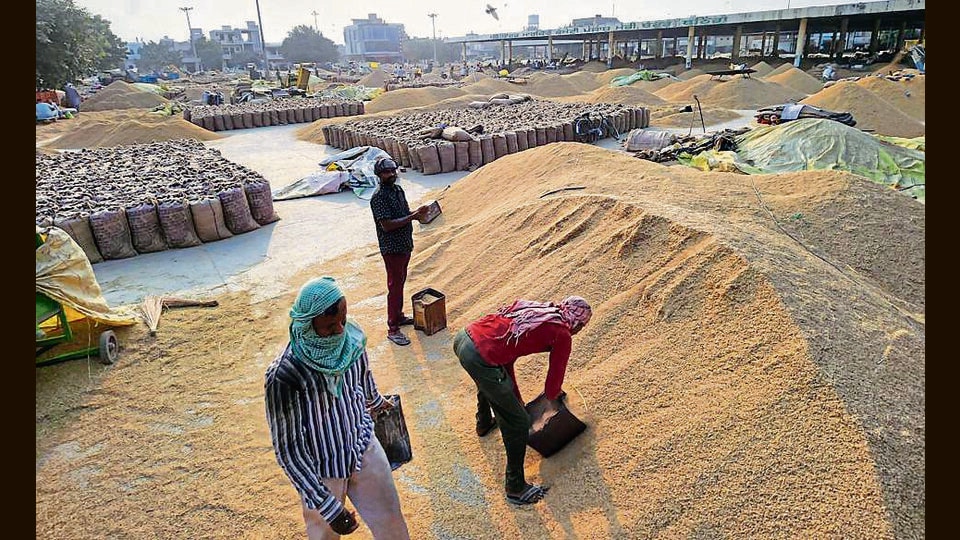
A wave of frustration is sweeping through the mandis from Amritsar to Doaba. After waiting for months for their crops to reach maturity, farmers are now seeing their produce lose value because damage and discoloration have exceeded the acceptable 5% limit.
“The grain of my produce had already discoloured by the time the crop was ready for harvest,” said Gurjit Singh, a farmer from Kapurthala. He said that due to the high moisture, he and other farmers had trouble selling their harvest on the minimum support price (MSP).
According to the state food and civil supplies department, total paddy arrivals are likely to touch 150 lakh tonnes, the lowest in nine years and nearly 20% less than the initial projection. The dip comes despite a larger sowing area — 32.49 lakh hectares this year — underlining how devastating the weather has been. Before floods the total procurement was pegged to ₹180-185 crore.
Floods and untimely rainfall in August and September have not only reduced yield but also delayed harvesting. By the time the procurement began in October moisture content was above permissible limits, and the Centre’s refusal to relax norms for discoloured grain has compounded distress.
Agriculture minister Gurmeet Singh Khudian said farmers have faced “a double blow” this season — weather damaged the crop and the entire season has been extended and the Centre has failed to give relief. In Amritsar, Gurdaspur, and Tarn Taran, where fields were inundated, even the recovered crop is being rejected at mandis. 5 lakh acres were damaged due to floods and crop over 2.97 lakh acres has suffered 100% damage.
Paddy procurement struggling to pick up pace
Amid the ongoing paddy procurement season, mandis across Ludhiana district have so far received nearly 8 lakh tonnes of paddy, significantly lower than last year’s arrivals of 16.5 lakh tonnes.
Of this, 48,000 tonnes arrived on Wednesday. In terms of purchase, 7.6 lakh tonnes have been procured till Thursday while 6.8 lakh tonnes have been lifted.
In its damage assessment report, the district agriculture department has noted significant crop losses following incessant rainfall in Ludhiana during the harvesting season.
Farmers in Ludhiana noted that they are facing financial distress prominently due to yield loss.
Jaspal Singh, a farmer from Rania village in Alamgir Sahib, said, “Initially, due to high moisture content in the crop, we had to trade an extra 5 to 10 kg of paddy with each standard 37.5 kg jute bag. However, with the improvement in weather, the moisture levels have now stabilised at the prescribed 17%, easing the situation.”
South Malwa farmers complain of loss of yield
Farmers of the south Malwa region complain of a loss of yield in non-basmati varieties as procurement of the key kharif crop has entered the last phase.
Stakeholders rue that paddy growers report a loss of production between 5-15% across the southwest region of the state.
Stakeholders said that despite a low yield, the foodgrains were of good quality and the moisture level was found within the required parameters.
Fazilka is the only exception where paddy harvest has reached 25% till Thursday.
Chief agriculture officer of Fazilka, Harpreet Pal Kaur said that crop cutting experiment results were yet to be analysed as harvesting in over 75% is still awaited.
Gurchet Singh, a farmer from Mansa, said that as harvesting was affected due to rains, this time the mandis did not have a glut-like situation.
Mansa chief agriculture officer Harvinder Sidhu said that untimely rains caused damage to the plants during the flowering stage.
“Fields where paddy was sown early and at the prescribed time faced damage due to the rains, however, areas where farmers switched to late sowing of paddy hardly witnessed damage as the crop had not attained the flowering stage when rains hit the district,” he said. Another farmer from Faridkot, Resham Singh, complained of a 10% loss in production in several areas.
Bathinda arhtiya association president Satish Kumar said that the procurement operations remained smooth this time, but a sizable section of farmers faced losses.
Bathinda district mandi officer (DMO) Gaurav Garg said that of the 7 lakh tonnes of paddy arrived till Wednesday, nearly 5 lakh tonnes have been lifted.
Muktsar DMO Ajaypal Brar said that the procurement operation would continue to run till November 15, but the paddy arrival is expected to be over by next weekend.
Doaba staring at losses
After facing high moisture content at the start of paddy procurement season, the farmers in Doaba region are staring at financial loss due to reduced paddy yield this season.
Hit by unfavourable weather conditions and crop diseases, the farmers have been reporting reduction of yield by 6-8 quintals per acre in many areas against the average yield between 32-34quintals per acre.
As per reports, the paddy harvesting is at its fag-end in Doaba region, with over 80% paddy area was harvested till date.
Manjit Singh, a farmer from Nagar village of Jalandhar district, said the entire paddy season has been marred by untimely rainfall and dwarf disease added to the woes of the farmers.
With inputs from Tarsem Singh Deogan (Ludhiana), Vishal Joshi (Bathinda), Navrajdeep Singh (Jalandhar) & Surjit Singh (Amritsar)


