
 E-Paper



Eye on 2027 polls: BSP kicks off outreach drive to reclaim space in Punjab
The BSP is launching 'Punjab Sambhalo Muhim' on May 3 to regain relevance, aiming to reconnect with voters ahead of the 2027 elections.


Seeking to revive its grassroots base and reassert its political relevance, the Bahujan Samaj Party (BSP) is set to intensify its statewide outreach campaign, ‘Punjab Sambhalo Muhim’, beginning from Ludhiana on May 3. The party plans to hold rallies across all 117 assembly constituencies, signalling an aggressive push ahead of the 2027 electoral battle.
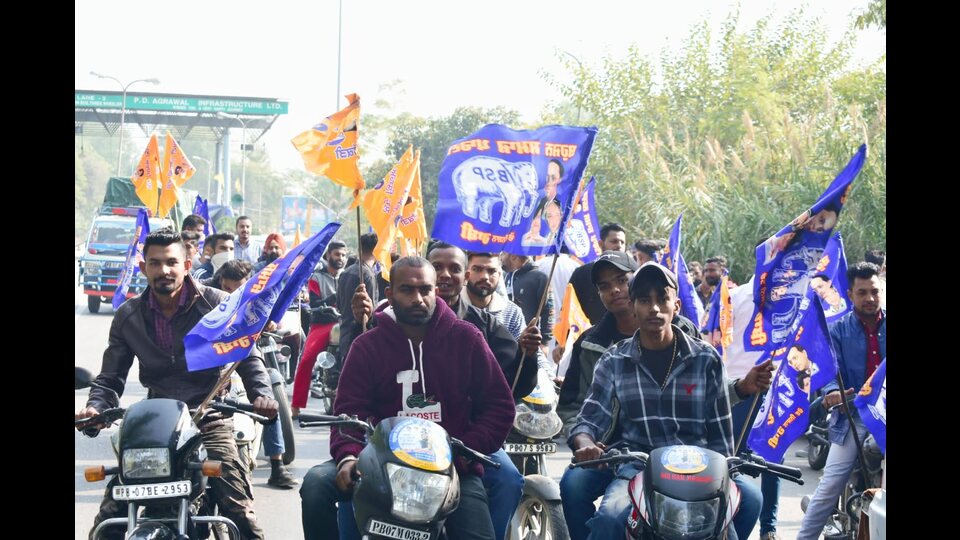
The renewed mobilisation comes in the backdrop of the party’s modest performance in the 2022 assembly elections, where it contested 20 seats in alliance with the Shiromani Akali Dal (SAD) but managed to secure just one seat—from Nawanshahr.
Despite the state having the country’s highest Scheduled Caste population, at around 32% and its founder, Kanshi Ram, hailing from the state, the BSP has steadily lost ground to mainstream players like the Congress and the Aam Aadmi Party (AAP), over the years.
From a nearly 16% vote share in 1992 and nine MLAs during the 1992–97 period, the BSP’s decline has been steady, and in the 2022 state polls, it managed just a 1.77% vote share.
Party insiders indicate that the BSP is reassessing its political strategy, with its alliance with the SAD (Badal) now appearing uncertain.
Punjab BSP president Avtar Singh Karimpuri said the campaign aims to reconnect with the masses and highlight what the party terms as the “failures” of successive governments. “We are intensifying our political campaign from May 3, starting in Ludhiana, and will cover all 117 constituencies. Our primary objective is to create awareness among people, as ruling parties have pushed the state into decline. We are committed to bringing Punjab from darkness to light,” he said.
Karimpuri said that no decision has been taken on continuing alliance with SAD. “Our focus, at present, is on strengthening the party independently across all constituencies,” he added.
Echoing similar sentiments, Nachhatar Pal, the lone BSP MLA elected in 2022, said the party is working to rebuild its organisational structure from the ground up. “We are reaching out to booth-level workers and attempting to revive the party. While a large section of Dalit voters continues to support BSP, we could not attract voters from OBC and other communities,” he admitted.
Steady decline
Traditionally, the BSP’s support base in Punjab has been concentrated among the Ravidassia/Adi-Dharmi community, particularly in the Doaba region.
Nearly 45% of the Dalit population is concentrated in the Doaba region, which sends 23 representatives to the 117-member assembly. Yet, despite this, the party has never gained traction among voters.”
The party’s electoral trajectory reflects a steady decline. From a vote share of nearly 16% in 1992 and having nine MLAs during the 1992–97 period, the BSP failed to win any assembly seat in the next two decades. Its vote share plummeted to 1.5% in 2017 and only marginally improved to 1.77% in 2022 — even after entering into an alliance with the SAD after a gap of 23 years. Notably, the party’s best electoral performance came in the 1996 Lok Sabha polls when it won three seats in alliance with the SAD.
Political analyst Ronki Ram, Professor Emeritus at the Institute for Development and Communication, Chandigarh, said the BSP’s decline is linked to shifting voter preferences within Dalit communities. “A significant section of Dalit voters has moved towards the Congress and, more recently, the AAP, which secured a substantial share of SC votes in 2022. Moreover, the Dalit community in Punjab is not homogeneous—it comprises multiple sub-castes with diverse political affiliations,” he explained.
He further noted that the BSP’s core ideological focus on caste discrimination has not resonated strongly in Punjab’s socio-religious landscape, shaped by Sikhism’s anti-caste ethos and syncretic traditions. “The party’s reliance on alliances and its inability to build a strong independent base have limited its long-term impact in the state,” he added.
A BSP leader, who didn’t wish to be named, said the party continues to lack a structured student wing or other campus-based unions— platforms that serve as pipelines for youth mobilisation and leadership grooming in other parties. “Absence of this has limited its ability to tap into the youth vote and nurture full-time grassroots leaders,” he added.


