Air pollution continues to remain a major concern in Haryana, with four cities figuring among the country’s 13 most polluted urban centres and seven others recording ‘poor’ air quality, even as restrictions under the graded response action plan (GRAP) remained in force across Delhi-NCR.
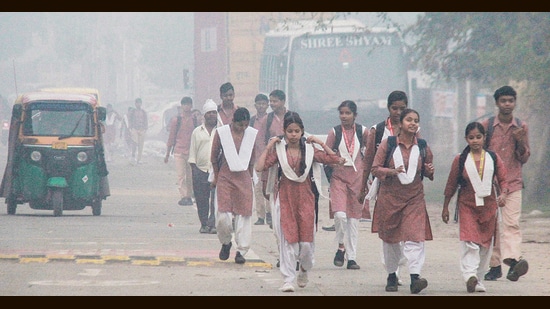
Ballabgarh emerged as the most polluted city in the country, recording an Air Quality Index (AQI) of 400. Gurugram reported an AQI of 324, Manesar,316, and Bahadurgarh, 308, placing all four in the ‘very poor’ category.
Among other Haryana cities Faridabad recorded an AQI of 298, followed by Jind, 261, Fatehabad, 247, Bhiwani, 245, Dharuhera, 229, Yamunanagar, 219, and Palwal, 210, all falling in the ‘poor’ category.
The deteriorating air quality comes despite the enforcement of stricter pollution-control measures under GRAP, including restrictions on older vehicles and curbs on construction activities across parts of the Delhi and districts falling in under the National Capital Region (NCR).
On the other hand farm fires remain a major concern with satellite monitoring data showing 229 stubble-burning incidents in Haryana between September 15 and November 13. According to the Consortium for Research on Agroecosystem Monitoring and Modeling from Space (CREAMS), a total of 11,342 residue-burning events were detected across seven states and Union Territories during this period. Punjab accounted for the highest 5,785 incidents, followed by Madhya Pradesh with 2,752, Rajasthan 1,439, Uttar Pradesh 919, Haryana 229, Uttarakhand 216 and Delhi two.
On November 13 alone, satellites detected 537 farm-fire events across the monitored regions, including 214 in Punjab, 246 in Madhya Pradesh, 33 each in Uttar Pradesh and Rajasthan and 11 in Haryana. No incidents were detected in Delhi and Uttarakhand on the day.
{{/usCountry}}On November 13 alone, satellites detected 537 farm-fire events across the monitored regions, including 214 in Punjab, 246 in Madhya Pradesh, 33 each in Uttar Pradesh and Rajasthan and 11 in Haryana. No incidents were detected in Delhi and Uttarakhand on the day.
{{/usCountry}}Box
Over 12,000 Panipat factories shut in protest
More than 12,000 industrial units in Panipat remained shut on Friday as industrialists staged a one-day strike and took out a protest march against pollution control norms and enforcement action by the Central Pollution Control Board (CPCB), causing an estimated business loss of ₹200 crore.
According to the reports, around 1.3 lakh workers stayed away from work as industrialists and hundreds of workers marched from Sanjay Chowk to the district secretariat, holding banners and raising slogans. The protest also led to traffic congestion on the GT Road.
During the protest industrial representatives said they were not opposed to pollution control regulations but were concerned about the manner of their implementation and the technical difficulties involved in complying with the norms. They also flagged the high cost and delays in the installation of pollution control equipment.
The industrialists later submitted a memorandum containing seven demands to the deputy commissioner at the district secretariat, following which the symbolic strike was called off.