E-Paper



Haryana air quality worsens as 9 cities record AQI above 300
The worst-hit was Ballabgarh, which recorded the highest AQI at 397, followed by Gurugram at 368, Bhiwani at 353, Hisar at 333, Manesar at 332, Bahadurgarh at 328, Faridabad at 313, Charkhi Dadri at 310, and Rohtak at 306

 Prefer HTon Google


Two days after air quality deteriorated in six Haryana cities, the regional pollution levels on Friday sharply worsened further across several districts, particularly in the National Capital Region (NCR), with nine cities recording an Air Quality Index (AQI) above 300.
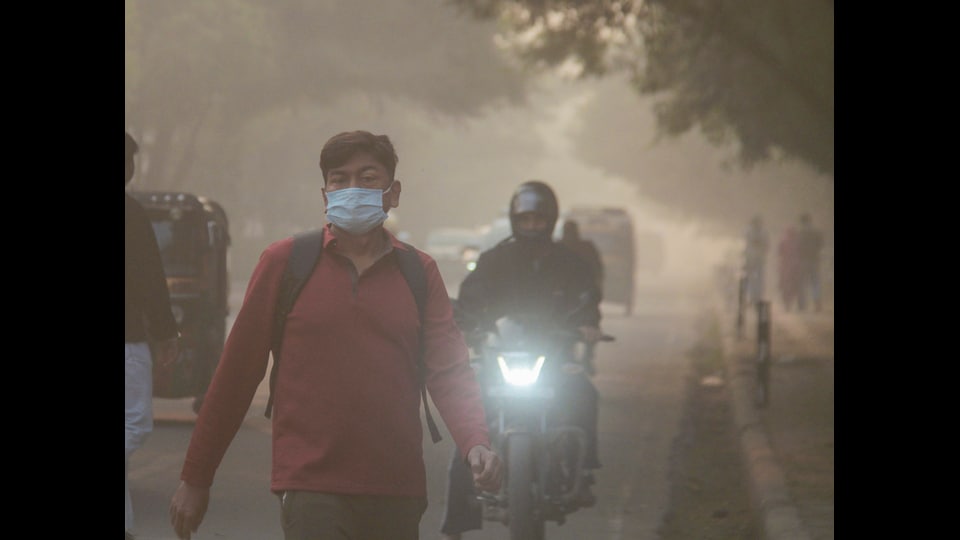
The worst-hit was Ballabgarh, which recorded the highest AQI at 397, followed by Gurugram at 368, Bhiwani at 353, Hisar at 333, Manesar at 332, Bahadurgarh at 328, Faridabad at 313, Charkhi Dadri at 310, and Rohtak at 306. The situation is also worrying in other parts of the state, with Sonepat and Ambala recording an AQI of 270 each, followed by Dharuhera (272), Jind (252), Kurukshetra (243), Kaithal (223), Panipat (214), Karnal (212), and Narnaul (209). These cities fall into the ‘poor’ category.
The worsening pollution levels prompted the Commission for Air Quality Management’s (CAQM) sub-committee on the Graded Response Action Plan (GRAP) to invoke Stage III restrictions in Delhi and the NCR as a precautionary measure. According to Central Pollution Control Board (CPCB) data, nine cities in Haryana have entered the “very poor” category.
Farm fires remain a major seasonal concern as the region approaches Diwali. According to the latest data from the Consortium for Research on Agroecosystem Monitoring and Modeling from Space (CREAMS), satellites detected 5,637 crop-residue burning incidents across seven states and Union territories between September 15 and November 5.
These included 2,787 in Punjab, 80 in Haryana, 456 in Uttar Pradesh, two in Delhi, 1,039 in Rajasthan, 192 in Uttarakhand and 1,081 in Madhya Pradesh. As many as 837 fresh incidents were detected on November 5 alone. Punjab accounted for 440 cases, followed by Madhya Pradesh (216), Rajasthan (90), Uttar Pradesh (64), Haryana (18) and Uttarakhand (nine). No incident was detected in Delhi on the day.
The CPCB classifies an AQI of 201-300 as “poor”, which can cause breathing discomfort to people exposed to polluted air for prolonged periods. An AQI of 301-400 falls in the “very poor” category and can cause respiratory illness on prolonged exposure, including among otherwise healthy people.
Under GRAP Stage III, stricter restrictions will apply to construction, transport and other activities that contribute to air pollution across Delhi-NCR. Dust-generating construction and demolition activities, including excavation, piling, demolition and open-trench work, face restrictions.
As per information the revised GRAP schedule also restricts the movement of BS-III petrol and BS-IV diesel or older light motor vehicles in Delhi and specified NCR districts, including Gurugram, Faridabad and Sonepat.