
 E-Paper



Haryana cabinet approves RRTS corridor till Karnal, DPR for metro rail till Kundli
The council approved the Delhi–Panipat–Karnal Namo Bharat (Regional Rapid Transit System–RRTS) corridor; the project marks a significant step towards strengthening fast, safe, and modern public transport infrastructure in the state

 Prefer HTon Google


The Haryana council of ministers on Tuesday approved two major urban mobility projects for the state aimed at improving regional connectivity and public transport infrastructure.
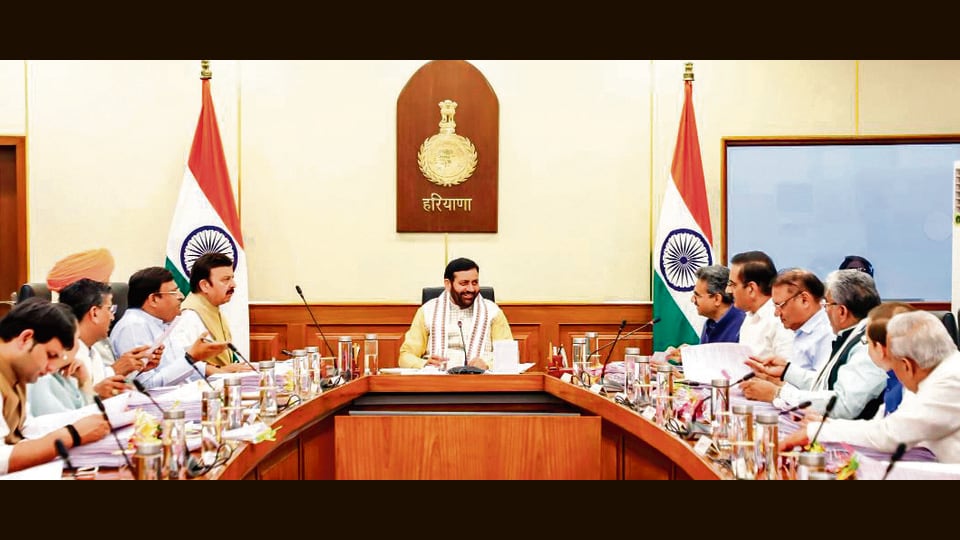
The council approved the Delhi–Panipat–Karnal Namo Bharat (Regional Rapid Transit System–RRTS) corridor. The project marks a significant step towards strengthening fast, safe, and modern public transport infrastructure in the state.
The council also gave its nod to the revised detailed project report (DPR) for the Rithala–Narela-Kundli (Phase-IV) metro rail corridor with regards to the Haryana portion of the project.
An official spokesperson said that as per the approved proposal, the Delhi–Panipat–Karnal Namo Bharat (RRTS) corridor will extend from Delhi to Panipat and up to Karnal, covering 136.30 km. The estimated total project cost is about ₹33,051 crore, out of which, the share of the Haryana government will be about ₹7,472 crore. The state’s contribution will be released in a phased manner.
The project will provide seamless connectivity between Haryana, Delhi, and Uttar Pradesh (Ghaziabad), improving regional mobility and reducing traffic congestion in the NCR region, the spokesperson said.
The RRTS project will have 11 stations in Haryana, which will provide seamless and high-speed connectivity between urban and semi-urban areas of the state and the National Capital Region (NCR). The corridor is expected to significantly reduce travel time, ease road congestion, and contribute to pollution control.
The council also approved that the depot infrastructure will be jointly planned by National Capital Region Transport Corporation (NCRTC) and the concerned land-owning agency. The depot will be developed at ground level, with provisions for commercial development above it, enabling additional revenue generation.
To strengthen the financial viability of the project, provisions have been made under the Transit Oriented Development (TOD) policy to allow higher Floor Area Ratio (FAR) in areas around RRTS stations. This will promote planned urban development and generate additional resources for the project.
The cabinet has designated the administrative secretary, town and country planning department, as the nodal officer for the project and authorised him to sign agreements and related documents with NCRTC. The chief minister has also been empowered to approve any changes or modifications required during implementation to address bottlenecks or difficulties.
The spokesperson said it was discussed by the council to extend this RRTS corridor beyond Karnal to Panchkula via Kurukshetra and Saha, and the matter be taken up with the Union ministry of housing and urban affairs (MoHUA) and NCRTC.
Metro rail corridor extension
The Rithala–Narela-Kundli (Phase-IV) metro rail corridor involves extension of the metro line from Narela to Kundli over a length of 2.726 km within Haryana, with two elevated stations at Kundli and Nathupur. The total completion cost of the Haryana portion has been approved at ₹545.77 crore.
Out of the total cost, the central government will contribute ₹97.30 crore, while the Haryana government will contribute ₹448.48 crore, including land costs. The project will be implemented with a funding pattern similar to other DMRC projects, with grants and subordinate debt components shared between the Centre and the State. The Council also approved the revised DPR incorporating updated financial and technical parameters. The project has already received approval from the Public Investment Board of the central government.
The Cabinet has authorised the ACS, town and country planning, Haryana, to execute agreements with Delhi Metro Rail Corporation (DMRC) and take necessary steps for timely implementation of the project. The CM has been empowered to approve any modifications required during execution in consultation with the government of India.


