E-Paper



Haryana unveils master plan for eco-friendly development around Sultanpur National Park in Gurugram
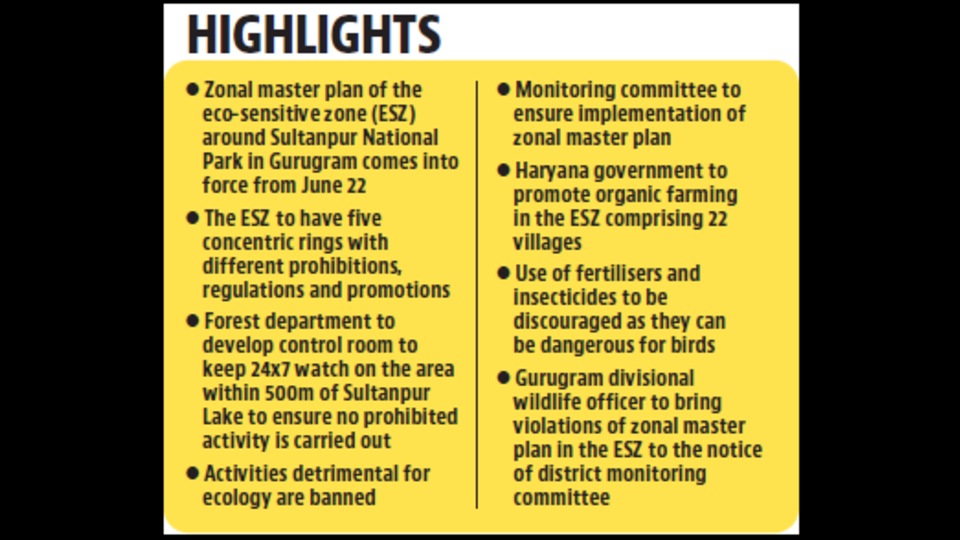
Twenty-two villages nestled in the salubrious environs of Sultanpur National Park have been included in the zonal master plan that the Haryana government rolled out for an eco-sensitive zone (ESZ) where numerous activities will be either prohibited or regulated

 Prefer HTon Google


Twenty-two villages nestled in the salubrious environs of Sultanpur National Park have been included in the zonal master plan that the Haryana government rolled out for an eco-sensitive zone (ESZ) where numerous activities will be either prohibited or regulated.
Sultanpur National Park, some 20km from Gurugram, is a bird watchers’ paradise. The ESZ of the national park is spread across 23,628 acre including Sultanpur lake on 350 acre.
Commercial mining, stone quarrying and crushing units will be prohibited up to 5km from the boundary of the national park, apart from burning of wheat and paddy stubble in the ESZ. New commercial construction within 3km from the boundary of the national park will be banned, setting up of new wood-based industries within 1km from the boundary will also be prohibited, according to June 22 notification of the Haryana government.
However, no restriction will be imposed on approved existing land use, infrastructure and activities unless specified in the zoning regulations of this zonal master plan.
“This comprehensive notification is a testament of the Haryana government’s sensitivity towards ecology,” said principal secretary (forest and wildlife ) G Anupama.
“The aim of this zonal master plan is to ensure measured and balanced developmental activities in the eco-sensitive zone,” added Anupama.
This zone will have five concentric rings with different prohibitions, regulations and promotions. The first ring will be up to 300m from the boundary of the national park. The second ring will be up to 500m, while the third up to 1km. The length of fourth ring will be 3km from the boundary and the fifth ring will be beyond 3km and up to the outer limit of the ESZ.
Mankraula, Jhanjraula, Mohammedpur, Patli, Dhanawas, Wazirpur, Ramnagar, Shikhawala, Garhi Harsaru, Tughlakpur, Kaliawas, Iqbalpur, Saidpur, Khaintawas, Hamarpur, Daya Bihar, Chandu, Omnagar, Budhera, Sultanpur, Harsinghwali Dhani, and Sadhrana Barmripur are the villages forming this eco-sensitive zone that also include revenue estates of 15 villages in addition to seven small settlements.
Official said for the purpose of this master plan, the boundary will be kept as the Gurugram-Pataudi railway line to the east which also forms the boundary of the urbanisable zone of the notified Gurgaon Manesar Urban Complex development plan.
To the south, Kundli-Manesar-Palwal Expressway provides a natural boundary for this master plan, though some part of the notified ESZ falls beyond the KMP Expressway.
All activities in the ESZ will be governed by the Wildlife (Protection) Act, 1972.
ACTIVITIES PROHIBITED
There will be ban on any kind of construction within 300m, except tubewell chambers of dimension not more than 1,000 cubic feet and on installing new high tension transmission wires up to 500m from the boundary of the national park.
Any polluting industry, established after the notification of ESZ, in the red and orange category as notified by the Central Pollution Control Board (CPCB) and brick kilns will be prohibited within 3km from the boundary of the national park.
As per the notification published in the Haryana government gazette, construction of any building with more than two storeys (30-ft) will not be allowed in the area falling between 300-500m from the boundary of the national park.
Local people will be permitted to undertake construction on their land for residential use. Commercial construction of not more than 100 sq-m area will be permitted within the ‘abadi deh’ of existing villages.
Single-use plastic will be prohibited in residential areas located within the notified ESZ up to the limits of the railway line on the eastern side and western peripheral expressway on the southern side.
“Discharge of untreated effluents and solid waste in natural water bodies or land area within the ESZ of the national park will be strictly prohibited,” states the order.
Also banned will be installation of new mobile towers within 3km from the national park’s boundary; and use of air pressure horn and public address system or loud speakers within 1km distance from the boundary.
Construction of glazed/glass facade buildings within 3km from the national park’s boundary will be prohibited and extraction of groundwater will be allowed for bona fide agricultural and local drinking water consumption.
Burning or incineration of solid wastes has been banned in the ESZ.