
 E-Paper



Hazardous grille work across Mohali derails road safety
With little to no barricading, caution signage or reflective warnings in place at many points, commuters said navigating these stretches, especially after dark, has become risky

 Prefer HTon Google


Even as authorities push ahead with installing road-dividing grilles to improve safety on major stretches in Mohali, the ongoing work itself has emerged as a serious hazard, with open trenches, toppled metal structures and scattered debris raising the risk of accidents and worsening traffic congestion.
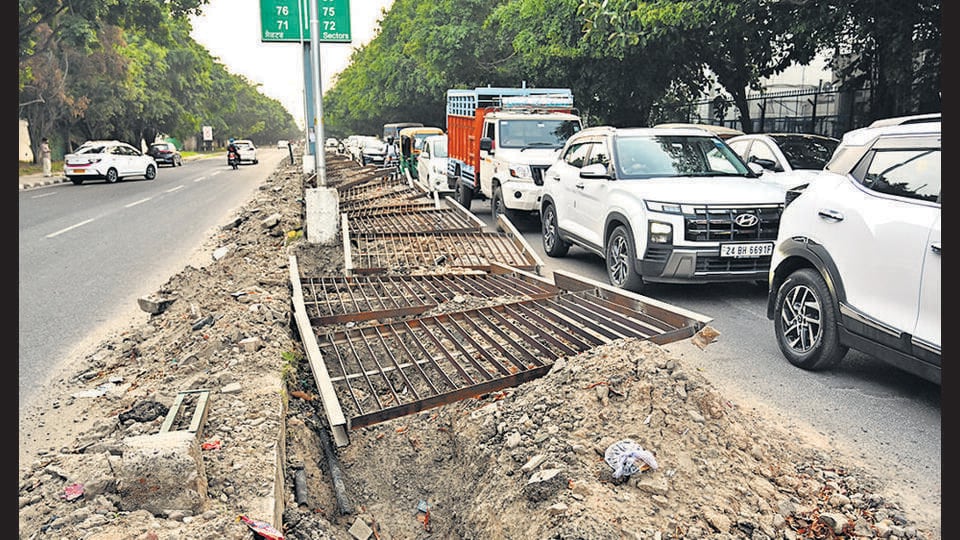
While the installation of grilles is intended to prevent head-on collisions, deter illegal pedestrian crossings, and curb wrong-side driving and illegal U-turns, the execution on ground is doing the opposite.
At several locations, including near Ivy Hospital in Sector 71 and Franco Chowk in Phase 2, deep trenches dug along the central verge remain uncovered, with heavy iron grilles lying dislodged or tilted precariously inside them. Mounds of rubble and construction waste spill onto the road, forcing vehicles to squeeze through reduced space, slowing traffic and increasing the likelihood of accidents.
With little to no barricading, caution signage or reflective warnings in place at many points, commuters said navigating these stretches, especially after dark, has become risky.
“The grilles are lying at odd angles inside open pits. One wrong move and a vehicle could get damaged or worse, cause injuries,” said a daily commuter.
Others pointed to frequent bottlenecks during peak hours, saying the ongoing work has compounded congestion on already busy routes.
Yogita Talish, a resident of Phase 5, Mohali, criticised the manner in which the work is being carried out. “These are high-traffic roads. Such projects should be properly cordoned off with clear markings and safety barriers. Right now, it’s chaotic and unsafe,” she said.
Experts say such road infrastructure upgrades demand strict adherence to safety protocols during execution. Shailender Singh, former chief engineer with the Chandigarh municipal corporation and currently with the Haryana public health department, said, “Proper signboards, continuous barricading and clearly visible reflector taping are essential, especially on high-speed corridors. Work zones must be adequately lit, and materials should be stacked in an organised manner away from moving traffic. Ignoring these basics significantly raises the risk of accidents, particularly at night.”
Responding to concerns, Mohali MC chief engineer Naresh Batta said directions had been issued to clear debris and restore radium taping. “The earlier taping may have been tampered with or stolen. We have asked workers to reinstall it. Street lighting has been ensured to maintain visibility, and the work is being carried out with safety precautions,” he said, adding that such projects typically take around three months and full road closure was not feasible.
Traffic police, meanwhile, cautioned that existing measures may not be adequate. DSP (Traffic) Karnail Singh said, “Large reflectors and proper warnings are necessary. Without these, the chances of accidents increase.”


