
 E-Paper



Himachal cabinet to amend Swaran Jayanti Energy Policy
The Himachal cabinet on Tuesday paid tributes to the people who lost their lives due to massive devastation caused by heavy rains, resulting in heavy loss. The revenue department gave a detailed presentation on disaster management and huge losses incurred to public and private properties.

 Prefer HTon Google


The Himachal cabinet on Tuesday paid tributes to the people who lost their lives due to massive devastation caused by heavy rains, resulting in heavy loss. The revenue department gave a detailed presentation on disaster management and huge losses incurred to public and private properties.
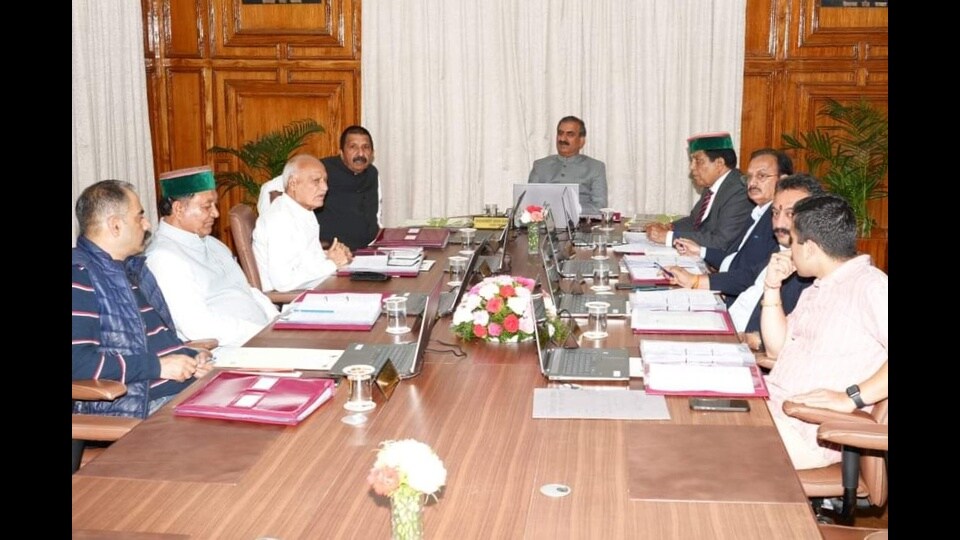
The cabinet decided to amend Swaran Jayanti Energy Policy, wherein MoU will be for a period of 40 years. The royalty will be as 15% for the first 12 years, 20 for the next 18 years and 30% for the remaining 10-year period. Thereafter, the project shall revert to the state government free of cost and free from all encumbrances and liabilities. However, the royalty payable to the state for an extended period will not be less than 50%.
It also decided to withdraw the relaxation given for staggered free power royalty in favour of SJVNL and NHPC for 210 MW Luhri Stage-I, 66 MW Dhaulasidh, 382 MW Sunni Dam and 500 MW Dugar Hydro Electric Projects with immediate effect.
The cabinet decided to rationalise the tariff of water cess to be charged from the hydel power projects.
It gave approval to enhance the financial assistance from ₹65,000 to ₹2 lakh under the Himachal Pradesh Widow Remarriage Scheme.
The cabinet gave its approval to enhance the support price of apple, mango and citrus fruits being procured under the Market Intervention Scheme for the year 2023-24 in the state. Henceforth, the support price of apple and mango will be ₹12 per kg instead of ₹10.50. Additionally, the support price of kinnow, malta and orange has been increased to ₹12 per kg from ₹9.50, whereas the support price of galgal and lemon has been enhanced to ₹10 from ₹8 per kg.
Consent was given to increase the honorarium of cook-cum-helper under the Mid-Day Meal Yojna from April 1, 2023, to ₹500 per month, i.e. they will get Rs. 4,000 instead of existing ₹3,500 per month, benefiting 21,431 individuals.
It also decided to enhance the wage rates under MGNREGS from ₹224 to ₹240 in non-tribal areas and ₹294 from ₹280 in tribal areas from August 15, 2023.
The cabinet gave its consent to include sanitary workers of the state under the Ayushman Bharat Scheme to provide them with health insurance.
It decided to select and train 874 candidates as patwaris and 16 chain-men to be deployed in the next five years in the state.
Nod was given to create and fill up 48 posts of different categories for newly set-up three traffic-cum-tourist police stations in Bilaspur, Mandi and Kullu districts in order to manage and control traffic and ensure road safety norms on the Kiratpur-Manali four-lane.
Furthermore, the cabinet also decided to fill up 35 posts of junior office assistant (IT) in the rural development department.
It gave its approval to regularise the services of part-time water carriers in the education department who have completed 11 years of combined daily wage and part-time services as on March 31, 2023, and September 30, 2023.
The cabinet gave its nod to standard operating procedure (SOP) for enumeration, marking, extraction and disposal of salvage trees from the forest land. This will ensure the availability of timber at the local level, reduction in transportation costs, boost in revenue, better and enhanced efficiency of field staff and conversion in raw forms.


