
 E-Paper



Ludhiana: Students protest PAU plan to axe trees for road work
The reaction from various students triggered after authorities marked the area that would be included in the road and footpath in the project


Students at Punjab Agricultural University (PAU) are protesting the university’s plan to cut trees for the proposed widening of the road in front of the university’s Mohinder Singh Randhawa Library. In a protest, students have taken to social media to highlight the dissonance between the university’s credentials as an agricultural university and cutting trees.
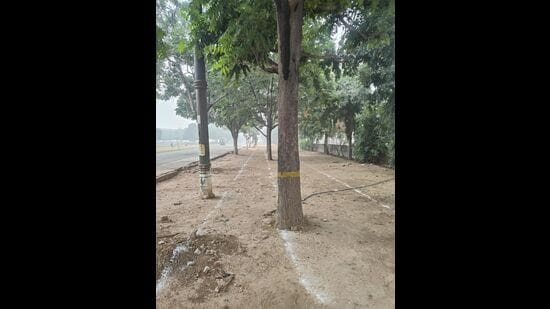
Writing on Instagram, university student Simranjeet Singh, said, “The decision to uproot nearly 100 trees for road widening in our university is deeply disappointing. An institution meant to protect agriculture and nature should be encouraging tree plantation, not destroying green cover. Such actions raise serious concerns about misplaced priorities and growing corporate influence within the university.” Singh said that development should not come at the cost of the environment-especially at a place which is supposed to stand for sustainability and ecological responsibility.
The reaction from various students triggered after authorities marked the area that would be included in the road and footpath in the project. Students charge that at a time when pollution and its dangerous effects on humans have captured the public consciousness, it was very insensitive to even think about cutting trees.
Highlighting his concerns, Angrej Mann, a member of the Punjab Agricultural Students Union said,”The whole stretch has around 100-150 trees along the road, which will be cut to make way for the widening of the road. We have seen how pollution has taken over North India for the last couple of months. The trees are lungs for the environment. Cutting so many trees defeats sense.”
Angrej added that it isn’t just about this stretch but a larger trend. He alleged that, in 2017, the university had chopped many old trees near Gate Number 2 to make a way for larger flower beds. “We protested the cutting of trees even then. The argument was the same. Development. Although, we were able to save some trees with our protest,” he said.
“We are not against development, but development at the cost of the environment and heritage is questionable. Why can’t they come up with ideas that cater to both the need for increased mobility and the environment,” he added.
Environment activist Kuldeep Singh Khaira while criticising varsity’s plan, alleged that this development is without any thought and driven by commercial motives. “The PAU itself is heritage. That includes everything in it. The courses haven’t increased in a decade. If anything, the veterinary college is now a separate university. That only lowers the footfall. There is no need for increased mobility. The university has, over the years become a top destination for public events like the recent Saras Mela, or the Diljit concert last New Year’s. It is only during those commercial events that there is an issue of traffic and parking,” he said. “Are commercial events the university’s priority? Is this just another venue?” he asked.
‘Campus designed in 60s considering cycles, now, we have cars in campus’
Responding to the allegations, PAU vice-chancellor, Satbir Singh Gosal said, “The campus layout was designed in the 60s. At that time, only parking for cycles and scooters was under consideration. But now we have four-wheelers, and the number of four-wheelers has been increasing in the university. Even students have cars now,” he said.
The VC added that it was important to update the road infrastructure to ensure smooth movement on the campus. He also dismissed the claims of a lack of environmental sensitivity. He said that the varsity conducted regular plantation drives on the campus and a thousand trees were planted every year. “We may have cut the trees that will come in the road, but those in the footpath will not be touched, and along that would be a green bed with trees,” he added.


