
 E-Paper



Merge national education portals for easy data management: V-Cs to UGC
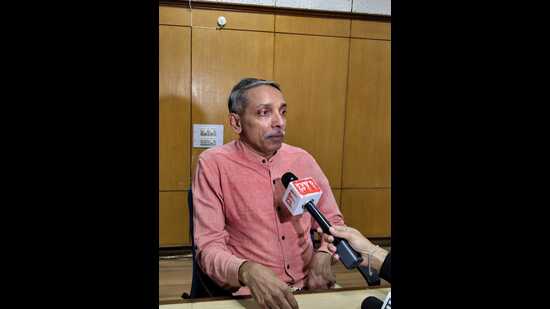
During the open house, UGC chairperson Mamidala Jagadesh Kumar said that universities should invite professors of practice who could help design courses as their input is vital


To make data management easy for the authorities, vice-chancellors (V-C) in the North Zone Vice-Chancellors meet, on the concluding day, recommended a centralised single portal for the comprehensive collection of data by merging all national education portals.
Merging of portals, including All India Survey on Higher Education (AISHE), Undertaking Transformative Strategies and Actions in Higher (UTSAH), National Institutional Ranking Framework (NIRF), National Assessment and Accreditation Council (NAAC), National Board of Accreditation (NBA), was recommended by the thematic group deliberating on accreditation and excellence.
There were a total of 10 groups considering various themes and presented their recommendations at the Law Auditorium.
For the governance and autonomy of universities, recommendations included adequate resource allocation, policy alignment and long-term vision.
For multidisciplinary and holistic education, reformation of pedagogical activities, empowering teachers and evaluating their capacity for improvement of education has been proposed.
For digital and online education, the need for quality content delivery especially in practical courses through simulation of experiments, virtual field visits, gamification and visualisation was focused upon.
For skill development and employability, alignment between demand and supply; collaboration with industry; start-up culture and embedding technology and professional practices are required.
During the open house, UGC chairperson Mamidala Jagadesh Kumar said that universities should invite professors of practice who could help design courses as their input is vital. Further, he said 5,000 skill hubs would be set up across the country for the students. He also highlighted that the development of e-content in regional languages is also important. Moreover, he emphasised the need for continuous feedback from students, which is essential for improvement in teachers.
A session on ‘Bharatiyabhashaayei’ was also organised. The recommendations regarding equipping teachers to use translation tools such as Anuvadini, Bhashiniand Udaan were made. It was also proposed that rather than translating curriculum books, the emphasis should be on creating original content in regional languages to retain the soul of the subject.
In another session, the UGC chairperson interacted with 33 student ambassadors (NEP Saarthis) from eight universities in the northern region. UGC joint secretary Avichal Kapurapplauded was also present and summarised various initiatives being taken at the UGC level.


