
 E-Paper



No respite in sight from raging forest fires in Himachal
The fire season in the hill state starts from April 15 to June 30. A prolonged dry spell coupled with soaring daytime temperatures has seemingly stretched the fire season. Himachal recorded 17.7% rain deficit in May while it increased to 45% in June.


With no respite in sight, 137 new forest fire incidents have been reported in the last four days in Himachal Pradesh, further exacerbating the environmental crisis.
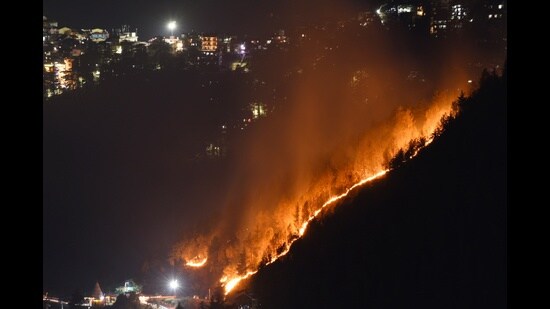
Since the onset of the fire season in April, the Himachal Pradesh fire department has recorded a staggering 1,640 forest fires in the state. The fires have so far destroyed at least 1,71,223.3 hectares of forestland, the total estimated loss is pegged at ₹6,01,00764 crore.
45% rain deficit in June
The fire season in the hill state starts from April 15 to June 30. A prolonged dry spell coupled with soaring daytime temperatures has seemingly stretched the fire season. Himachal recorded 17.7% rain deficit in May while it increased to 45% in June. “There has been rain in the isolated areas, but most parts of the state will remain dry in the coming days,“ said IMD regional office director Surendra Paul.
No loss of human life has been reported, however, it has affected wildlife. Mandi, Hamirpur, Sirmaur and Bilaspur were the worst-affected forest circles in Himachal. Soon after the elections were over, chief minister Sukhvinder Singh Sukhu directed forest department officials to take measures to curb the incidents of forest fires. Emphasising ensuring people’s participation in these efforts, he said that with people’s cooperation, the forest fire incidents are gradually decreasing.
“Forest department officials are working to protect the forests. There has been no loss of human life,” principal chief conservator of forests Rajiv Kumar said, adding that the forest department has sought operations from the villagers to help curb the fire incidents.
“We would like to appeal to the people of the state to cooperate with the department to save the forests from fire.
Pine leaves to blame
During the past two years, forest fires were not as frequent, but with a large accumulation of pine leaves, the incidents are increasing. Blazes are more frequent in the mid hills having highly combustible chir pines. Smoke billowing from the chir pines forest is almost a common sight in the state. But its ecological impacts are now becoming a cause for concern. The forest and state machinery are looking at firefighting management through fire lining. The rate and volume of the falling pine leaves are such that fire lines also get covered with fresh needles every few days. The alienation of the communities from forest-based livelihoods makes it more difficult. Earlier, litter raking from forests was a common practice for agriculture and cattle bed making. These practices are reducing with changing farm economies.
“Forest fire in Himachal and in mid-Himalaya and lower belts may directly be correlated with chir pine forests. Though pine is a native species, its commercial propagation as monocultures started in the colonial period and went on till the late 80s and even 90s. In many areas now chir pine is spreading onto grasslands and oak forests. The removal of inflammable pine needles through lighting fires has become a common practice - both to make forest paths walkable and also prompt grass growth,” says Manshi Asher of the Himdhara collective.
Himdhara collective continuously emphasises the government’s framing of a policy to replace the highly inflammable pine trees with broad-leafed trees. “Preventive measures require qualitative research and community dialogue to reestablish the links with forests. Changing the forest composition to broadleaf and such long-term measures cannot be taken without community-led micro-planning and resource allocation by the state government,” says Asher.


