
 E-Paper



Not a single Chandigarh area untouched by Covid’s second wave
According to municipal corporation figures, as of April 30 more than 4,000 houses in the city had active cases. Nearly 73% of these are in sectors and remaining in rehabilitation colonies

 Prefer HTon Google


The fast-spreading second wave of the Covid-19 pandemic has not spared any sector, village or rehabilitation colony in Chandigarh.
In contrast, during the first wave last year, the cases were concentrated in 75% of the city areas, with rehabilitation colonies, particularly Bapu Dham Colony, predominantly affected.
According to municipal corporation figures, as of April 30 more than 4,000 houses in the city had active cases. Nearly 73% of these are in sectors and remaining in rehabilitation colonies.
Sectors worst affected
Notably, almost half of the affected households are located in Sectors 21 to 50.
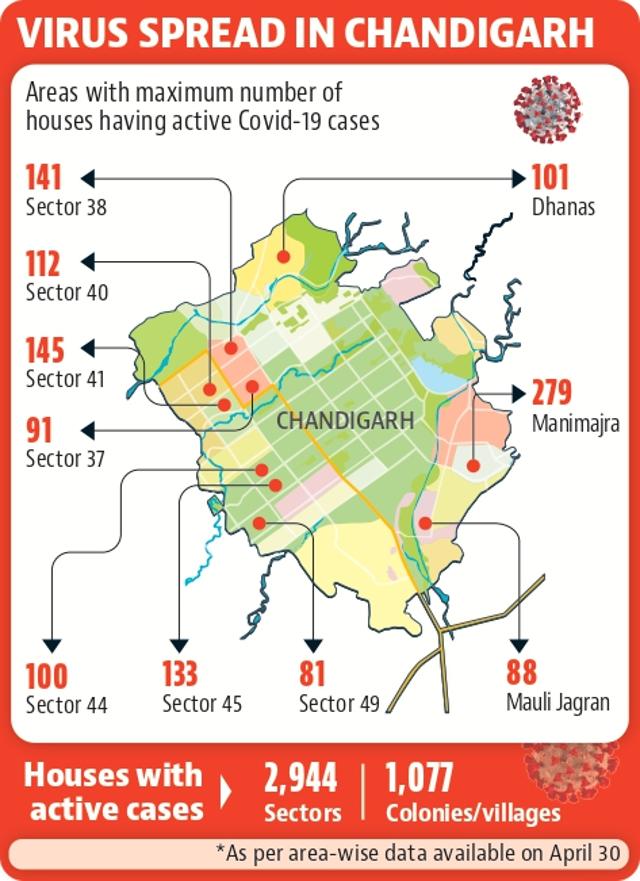
On the other hand, only three areas in colonies/villages – Manimajra, Dhanas and Mauli Jagran – are in the Top 10 areas in terms of number of houses with active cases (see box).
Manimajra tops the list with 280 households having more than 450 positive patients, followed by Sector 41 with 145 affected houses and Sector 38 with 141 houses.
While in the first wave, the northern sectors remained largely untouched by the pandemic, this time around, the virus has spread to the posh areas as well. In Sectors 1 to 12, 280 houses have over 430 active cases.
Absence of curbs to be blamed: Expert
The lack of lockdown or strict restrictions this year is being seen as one of the reasons for the wider spread of the disease in the city.
“Last year, the lockdown was enforced much before the pandemic peaked in September, limiting mobility across different locations of the city. This time around, the restrictions are coming when the infections have already spread widely, allowing the virus to spread to more areas,” said Dr Rajesh Ahuja, former head of the department of community medicine and public health, PGIMER.
The new variants of the virus, which are considered to be more infectious, are also to be blamed for the current scenario. “Last year, if one person tested positive, they further infected half or one-third of their family members. But, now, two-thirds or entire family members are testing positive,” said Dr Ahuja.


