
 E-Paper



Punjab farmers stare at ₹10,000-crore farm loss as paddy output dips
The food and civil supplies department has slashed procurement target from 185LMT to 150 LMT this season; this wil be the the lowest crop yield since 2016 when the paddy arrival was restricted to 140 lakh tonnes


With Punjab suffering from the worst floods in four decades, farmers are staring at losses of nearly ₹10,000 crore this kharif season. The deluge destroyed crops across 2.97 lakh acres, while a subsequent outbreak of loose smut disease has further hit paddy yield. The food and civil supplies department has slashed its procurement target to 150 lakh tonnes, estimating a 20% drop in grain output. This decline comes despite the area under paddy rising by 1.5 lakh hectares to 32.49 lakh hectares this season.
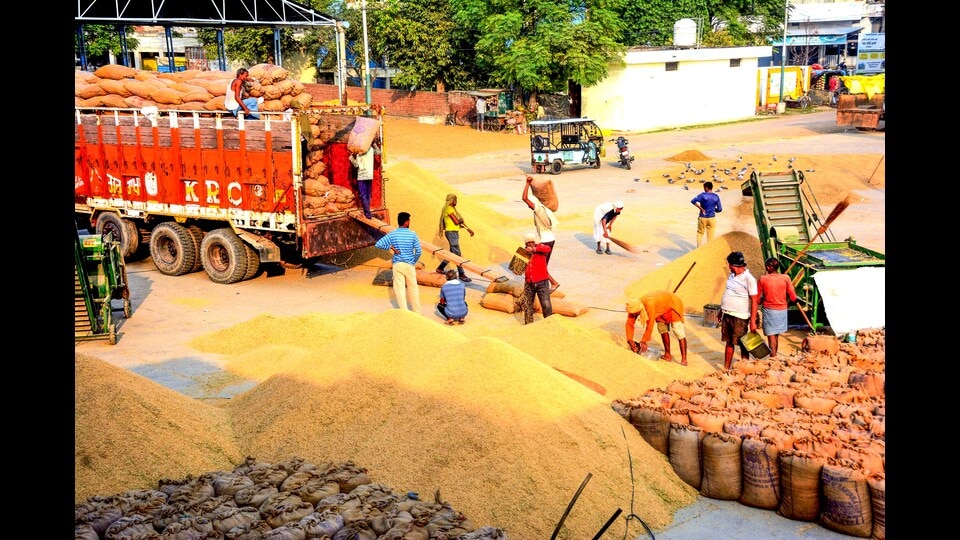
It is the lowest crop yield in the past nine years since 2016, when the paddy arrival was restricted to 140 lakh tonnes. In the previous five years — 2024, 2023, 2022, 2021, and 2020, total paddy procured stood at 175, 188, 183, 187, and 162 lakh tonnes.
At the onset of the season in July–August, the department has made arrangements for procuring 185 lakh tonnes of paddy and has also arranged a sanction of cash credit limit (CCL) of ₹45,000 crore.
“Now we think the crop procurement would not cost more than ₹35,000, which means a straight loss of ₹10,000 crore to the farmers,” said an official of the food and civil supplies department.
The commission for agricultural costs and prices (CACP) has fixed a minimum support price (MSP) of ₹2,389 per quintal on paddy purchased in the current season.
Punjab agriculture minister Gurmeet Singh Khudian accepted that less procurement will mean less cash in the hands of the farmers.
“In case of lesser crop for procurement, farmers are at direct loss,” Khudian said, adding that farmers have suffered double brunt this season.
“The floods and incessant rainfall have eaten into the crop, and diseases such as loose smut also left an adverse impact,” Khudian added.
As of Tuesday, total paddy arrivals in the mandis crossed 100 lakh tonnes, with 5 lakh tonnes of crop arriving in mandis.
“The peak arrivals will continue for the next few days, and then it will taper down,” said food and civil supplies minister Lal Chand Kataruchak.
According to Kataruchak, 50-55 lakh tonnes more is expected, and in the next ten days, the procurement will wind up.
“This season, due to late rains, the harvest and arrivals started at a very sluggish pace. Although the procurement started early on September 16 for the early varieties but rainfall acted as a damper,” the minister added.
He clarified that the relaxation sought by the state government for a higher quantity of discoloured and damaged grain is yet to be cleared by the Centre.
“It has been three weeks since the officials from the Centre took 100 samples from different mandis. As per norms. 5% discoloured and damaged grain is allowed in a sample of freshly harvested paddy, but due to delayed rainfall, the quantity has doubled. Nearly two-thirds crop has arrived in the state mandis, and almost all of it has been procured. We are yet to receive a word from the Centre on discoloured and damaged grain,” said Kataruchak, alleging that the state farmers have suffered on all accounts, and the delay by the Centre is contributing to their woes.


