
 E-Paper



Farm fires back in Punjab, over 7000 cases reported
The number of wheat stubble-burning incidents recorded in Punjab on Friday touched 7,529, in the current wheat harvest season, which is nearing its end.


The number of wheat stubble-burning incidents recorded in Punjab on Friday touched 7,529, in the current wheat harvest season, which is nearing its end, said the data provided by the state pollution control board. The state’s remote sensing centre at Ludhiana is recording the fires on behalf of the PPCB.
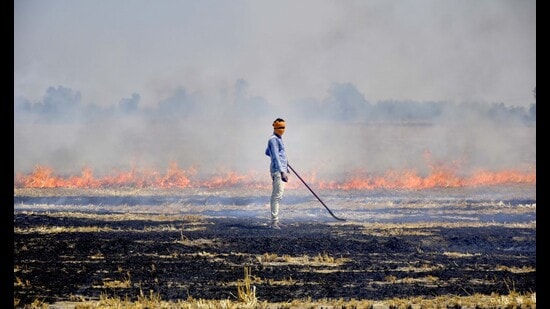
Over 40% of the cases (3,325) were reported in the last three days, the data added. The state reported 1,019 cases on May 10, 1,554 cases on May 11 and 752 on May 12.
The increasing incidents of farm fires in the rabi season have concerning for both the Punjab Pollution Control Board (PPCB) and the state agriculture department, as stubble burning is not only causing pollution but the wheat straw which can be used as fodder for milch animals is being wasted, said agricultural experts.
This year, however, the number of farm fires has seen a drop, as compared to last year’s data. In 2022, the number of farm fires reported by May 12 stood at 13,558. In 2021 on the same day, 7,501 cases were reported.
“The current season saw delayed harvesting due to late rainfall. The state government had not expected so many fires in the rabi season … We have been educating the farmers to desist from the practice as it leads to loss of soil nutrients,” said Gurvinder Singh, director, agriculture department.
The department has sent teams to Moga and Ferozepur districts (which have reported maximum cases of stubble burning) to assess how much area of land the fires have been set since as of now there is only information on the number of fires, added Singh.
An official of the state agriculture department said that the Punjab government is also contemplating action against the farmers who have set crop residue on fire in their farms. “The PPCB and state remote sensing centre is maintaining a record of farm owners where the fires have been reported,” said the official requesting not to be named.
The president of the Bhartiya Kisan Union (Rajewal) Balbir Singh urged the farmers to stop burning wheat stubble and contribute towards conserving the environment and soil fertility.
He, however, alleged that the Punjab Agricultural University (PAU) had pushed the farmers to adopt this practice. “Under ‘intensive agriculture development programme’ at the onset of Green Revolution, farmers were told to set fire to farm residue to clear their fields at the earliest … and as the cheapest alternative,” he said, adding that the cash incentives promised by the National Green Tribunal (NGT) to the farmers for not burning their stubble have not been disbursed, which has further discouraged farmers from adopting other techniques.
Moga reports maximum cases
As of now, Moga district has reported the maximum number of stubble-burning cases in the current rabi season at 761 farm fires, followed by Sangrur district at 592 cases. With seven cases, Ropar district recorded the least number of fires.
The other districts that reported farm fires this season are-- Ferozepur (544), Bathinda (535), Barnala (514), Gurdaspur (505), Amritsar (495), Ludhiana (485), Muktsar (465), Fazilka (386), Patiala (351), Mansa (316), Faridkot (313), Hoshiarpur (302), Tarn Taran (225) and Jalandhar (220), Malerkotla (151), Fatehgarh Sahib (64), Pathankot (48) and Mohali (16).
Wheat arrivals touch 124.36 lakh tonnes
On Friday wheat arrivals in mandis of Punjab touched 124.36 lakh tonnes. Today, 29,000 tonnes of wheat arrival was reported in the state. The food and civil supplies department is expecting the total arrivals in the season to touch 128 lakh tonnes.
GFX
Burning issue
Total farm fires (till May 12): 7,529
Fire incidents (on May 12): 752
Total wheat arrivals: 124.36 lakh tonnes
Top six dists reporting farm fires
Moga 761 cases
Sangrur 592
Ferozepur 544
Bathinda 535
Barnala 514
Gurdaspur 505


