
 E-Paper



Punjab: Five paddy straw pellet units to arrest stubble burning
Of the estimated production of 19 million tonnes of paddy stubble, the state targets to manage 16.27 million tonnes; experts in Punjab opine that the initiative can contribute significantly in getting rid of the environmentally-hazardous farm practice of burning stubble

 Prefer HTon Google


In a first, five paddy straw to pellets converting units — three in Mansa, one each in Patiala and Gurdaspur — are expected to process 1.26 million tonnes of the organic residue this kharif harvesting season in Punjab.
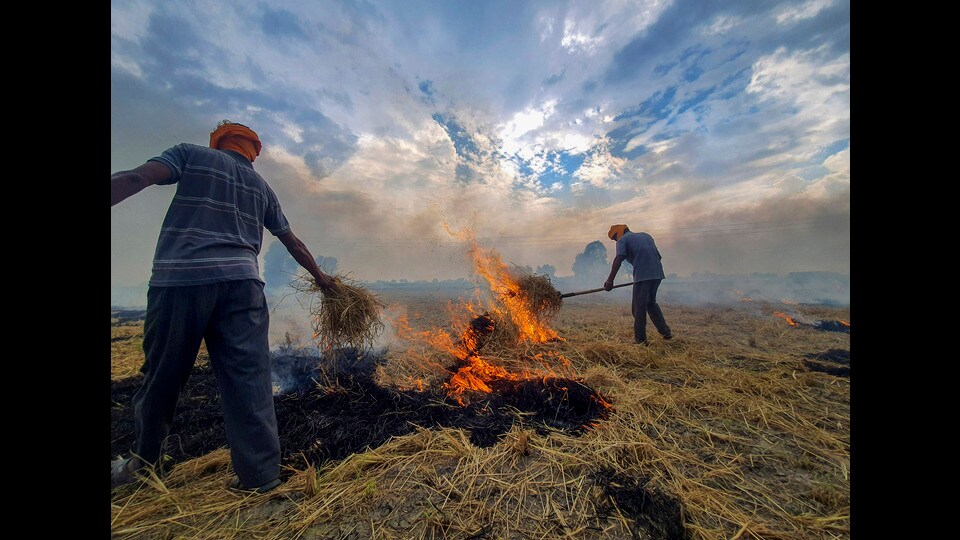
Paddy straw is converted into pellets using pelletisation process. These paddy straw-based biomass pellets can be used in thermal plants for co-firing and to promote utilisation of paddy stubble in thermal power plants and industries.
The Centre has also pushed a scheme under which an entrepreneur gets 40% financial grant, while he has to invest an equal amount from his resources and raise the rest 20% from any institute.
Experts in Punjab opine that the initiative can contribute significantly in getting rid of the environmentally-hazardous farm practice of burning stubble. They say the latest initiative has a potential of generating local employment opportunities and Punjab industries can reduce dependence on fossil fuel.
Punjab State Council for Science and Technology (PSCST) has tested and validated the viability of this ex-situ stubble management strategy and officials in the state government think that the technology is capable of mitigating the issue of crop residue burning in the long run.
In-situ management involves incorporating stubble into soil using crop residue management (CRM) machines, while ex-situ management involves lifting stubble from fields and supplying it to stubble-based industries.
Punjab Pollution Control Board (PPCB) chairperson Adarshpal Vig said five lakh tonnes of paddy residue is expected to be consumed by brick kilns in the shape of pellets whereas another 7.4 lakh tonnes will be used by thermal plants to co-energise the facilities.
“From this year, the state government has made it mandatory for the brick kiln operators to replace at least 20% coal with paddy-straw pellets for their fuel requirements. All the 23 districts are expected to be having four to five stubble to pellets converting units soon,” added Vig.
Punjab agriculture director Gurvidner Singh said of the estimated production of 19 million tonnes of paddy stubble, the state has set a target of managing 16.27 million tonnes of stubble, including 11.50 million tonnes through in-situ management and 3.47 million tonnes through ex-situ management.
Remaining 1.3 million tonnes of residue generated from basmati and other rice varieties, whose waste is fit for livestock consumption, would be processed.
“We are hopeful to surpass this season’s target and bring down farm fire incidents drastically. Straw pellets will be used in an organised manner for the first time and it has an important role in ex-situ management of residue,” said the director.
According to Sukhdev Singh, a superintendent engineer and PPCB nodal officer for pellet industries, five units having the capacity to process 0.75 tonnes-5 tonnes per hour are expected to be commissioned this year.
“Earlier, 10 units were making pellets from rice straw at a low scale without any government support but this year, the government made an organised push to convert rice straw into pellets and the response is welcoming. More investors are expected to chip in for the cause in the next few months,” said the expert.
A brick kiln operator, Bhagat Singh Gill, in Moga’s Jalalabad village has been using rice straw pellets as fuel since 2017 and terms it as an economical option. “I volunteered to be a part of Punjab State Council for Science and Technology’s (PSCST) field experimentation of using pellets as fuel. It costs about ₹20,000 per tonne if coal imported from the US is used and an average price of ₹15,000 per tonne for another variety of mixed coal, whereas rice straw pellets cost ₹8,000 tonne,” said Gill, who has a pellet-converting unit at the kiln. The entrepreneur said the bricks baked with processed crop residue as fuel maintain the same standard of strength.
“The average annual requirement of 3,500 tonnes of pellets has been met without any difficulty for the past several years,” he added.
PSCST’s principal scientific officer Maganbir Singh said testing confirms the viability of using or co-using paddy straw pellets that are prepared after processing at 250-350 degrees Celsius, in different industries.
“Waste generated from paddy in Punjab is enormous and its safe disposal requires different applications. Converting organic waste as biomass fuel can prove significant in ex-situ management and push the industry towards the use of green fuel. Replacing coal with pellets from locally-sourced rice straw can give a new direction to the industry,” he added.


