
 E-Paper



Restrictions on gatherings are back in Chandigarh
Cap of 100 or 50% of venue capacity, whichever is lower, on indoor events, and cap of 200 on outdoor activities

 Prefer HTon Google


Imposing fresh restrictions in the wake of the rising Covid-19 cases, the Chandigarh administration on Wednesday decided to keep primary schools in the city closed. A cap was also imposed on the number of attendees at social, cultural, religious and family gatherings.
In a review meeting with senior officials, UT administrator VP Singh Badnore directed the school authorities to talk to parents so that their children take proper precautions against Covid-19, both inside and outside schools. The health and education department will also finalise modalities to conduct sampling in schools, it was decided.
For indoor gatherings, a maximum number of 100 people or 50% of the capacity of the venue, whichever is lower, will be allowed. For outdoor gatherings, the cap has been kept at 200 people, which is the same as that imposed by the Punjab government.
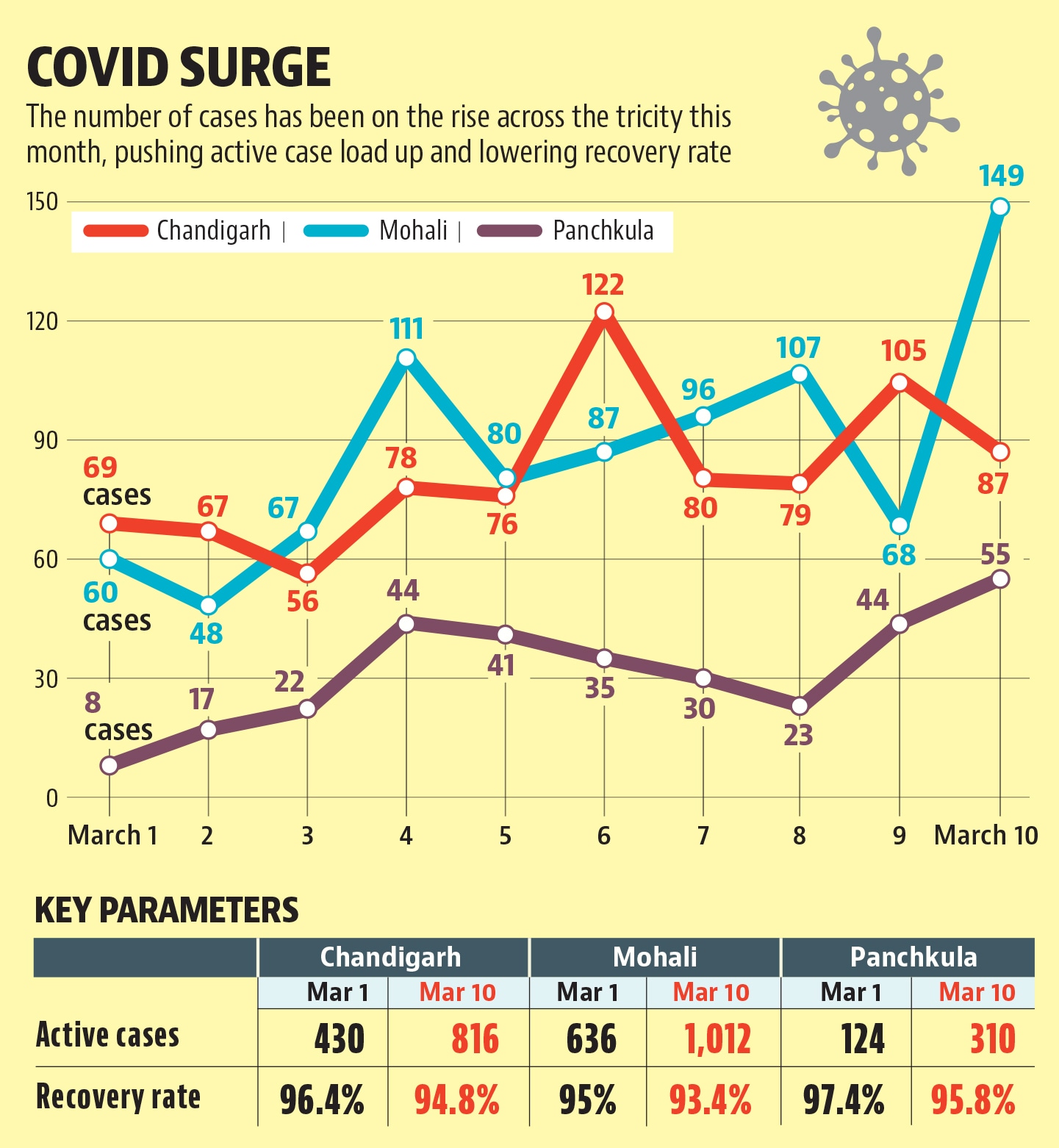
At 819, the number of Covid-19 cases reported in the first 10 days of March has already surpassed the total reported in February (813). With 87 fresh cases on Wednesday, the number of active cases shot up from 430 in the beginning of the month to 816. The recovery rate dropped from 96.4% to 94.8% in the same period.
Meanwhile, the death of a 55-year-old man from Sector 48 took the toll to 357. The total number of cases has climbed to 22,589, with 21,416 patients cured so far.
‘Increase testing, checking for violations’
Expressing deep concern over the rising number of cases, Badnore asked the officials to ensure strict implementation of Covid appropriate behaviour. He directed the deputy commissioner and police to intensify checking and impose fine on people violating the guidelines.
A special drive will be started by police to ensure that social distancing is properly maintained at restaurants and inside shops at various markets and also at crowded places.
The administrator also said there should be an increase in testing and contact tracing all over the city. He said crowded places, such as bus stands, railway station, apni mandis, markets and Sukhna Lake, should be focused. He also called for special arrangements to screen and test residents of various welfare homes and hostels.
Badnore asked the health department to again use the hospital in Sector 48 for Covid-19 patients and to keep Covid care centres earlier opened at Dhanwantry Hospital, Sector 46, and Sood Dharamshala, Sector 22, ready for any exigencies.
More vaccination sites made operational
The officials concerned were also directed to provide proper facilities at vaccination centres, so that senior citizens do not have to wait for their turn for a long time. They should not be asked to stand in queues and instead should be provided with proper seating arrangement before and after vaccination, it was decided.
Meanwhile, more vaccination centres have been operationalised in the city, with the total number of sites reaching 40. The new sites have been opened at health centres in Sectors 26, 35, 38, Panjab University and Palsora. On Wednesday, 2,867 people were inoculated, including 1,930 senior citizens and comorbid group.
Parida blames Mohali for infection surge
UT adviser Manoj Parida has attributed the rise in cases to the spike seen in the neighbouring Mohali district.
“Besides social gatherings, there were municipal elections in Mohali last month, leading to a huge mobility in the area. The maximum increase is being witnessed in Mohali, and we see it as a major cause for the spike in Chandigarh as well,” he said.
Sharing details about testing to be carried out across 144 government schools in the city, Parida said mobile testing teams will be deputed for the purpose.
“The process will be voluntary for teachers as well as children who are visiting the schools. The education and health departments will fix the modalities,” he said.


