
 E-Paper



South Malwa chokes as farm fires rage in Punjab
The seven districts in south Malwa belt of Punjab have contributed over 40% cases of paddy stubble burning reported across the state this kharif season


The seven districts in southern Malwa belt of Punjab have contributed over 40% cases of paddy stubble burning reported across the state this kharif season.
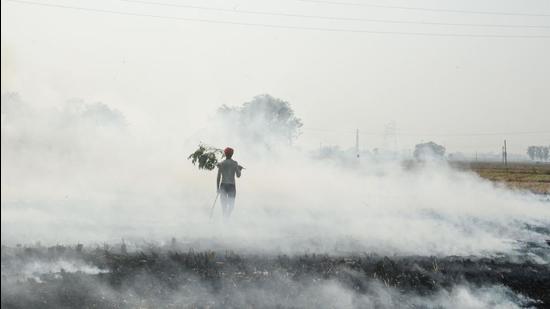
The number of farm fires across Ferozepur, Moga, Bathinda, Faridkot, Muktsar, Mansa and Fazilka has climbed to 19,383, with as many as 15,537 recorded in November, according to figures available with the Punjab Pollution Control Board.
Meanwhile, the state has recorded 47,409 incidents of stubble burning, of which 5,079 (10%) were reported on November 9 alone. The south Malwa belt accounted for 2,276 (45%) of them.
These farm fires have been choking the region, with hazy conditions persisting throughout the day. At the continuous ambient air quality monitoring station (CAAQMS) in Bathinda, which is the lone centre to assess air pollution in the region, the air quality index (AQI) was rated “poor” (231) on Tuesday.
According to the Punjab Agricultural University’s observatory at the regional research centre in Bathinda, even bright sunshine hours have been reduced by 50% due to the haze.
“An average bright day in winter lasts for 8-10 hours, but due to ongoing smog conditions, sunshine hours have dropped drastically in the last few days. Hazy conditions are expected to continue for a few more days,” said Raj Kumar, an agrometeorology scientist at PAU.
No means to monitor air pollution
Despite stubble burning being an annual affair, Punjab has no CAAQMS in 16 out of its 23 districts. Such centres to record air pollution have been set up at only eight places in six districts — three in Ludhiana (Khanna, Mandi Gobindgarh and Ludhiana City) and one each in Bathinda, Jalandhar, Amritsar, Patiala and Rupnagar.
Meanwhile, districts such as Ferozepur and Moga in south Malwa, which are reporting a high number of farm fires, have no means to know the extent of air pollution being caused by the unscientific disposal of crop residue.
This season, Ferozepur has reported 4,505 farm fires, the highest in the belt, followed by 4,008 in Moga and 2,841 in Bathinda. Fazilka, where the maximum land is under cotton cultivation, has reported 855 cases of paddy stubble burning, lowest in the region.
Officials attribute a sharp spike in fire incidents to the delayed paddy harvesting in south Punjab. “Untimely rains last month forced farmers to suspend harvesting of paddy. Incidents of farm fires are likely to continue for another two weeks,” said an official of the agriculture department.


