
 E-Paper



Squatters galore, yet Chandigarh admn has no concrete record
Geo-mapping plan announced by the previous Chandigarh deputy commissioner in July 2024 to maintain a record of encroachments has failed to take off


With the illegal Sector 53/54 furniture market likely to be removed in two weeks, residents’ hopes for an encroachment-free City Beautiful have risen.
The Chandigarh administration recently issued eviction notices to the furniture traders who have been illegally occupying government land since 1985.
However, while the administration notably excels in navigating paperwork, it surprisingly lacks a clear record of squatters across the city—leaving the full scale of encroachments in the city undocumented and overlooked.
This, even though last year in July, the then deputy commissioner, Vinay Partap Singh, had announced UT’s plan to undertake geo-mapping to ascertain the areas under encroachment.
Six months later, the announcement remains only on paper with no on-ground measures to check encroachments.
Conversely, the Chandigarh municipal corporation has identified 68 acres of its land that is under encroachment in 23 villages in the city, with most cases already in court.
As per rough estimates, at least 100 acres of precious government land in Chandigarh is under encroachment.
Deputy commissioner Nishant Yadav has now vowed to identify all instances of encroachment on government land.
He emphasised the critical importance of land in a planned city like Chandigarh and highlighted the detrimental effects of illegal occupation, including unplanned urban growth and significant financial losses due to the high value of land.
Illegal colonies thriving under UT’s nose
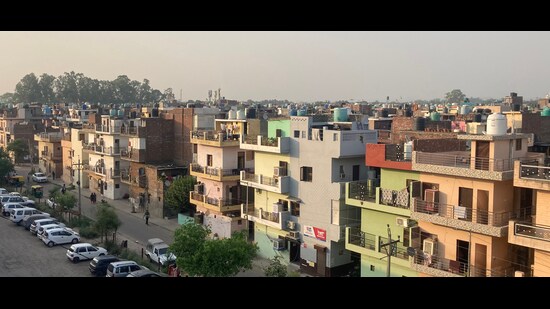
From what is apparent, at least 30 acres of government land has been encroached by illegal settlers in two colonies: 20 acres in Sanjay Colony, Industrial Area, Phase 1, and 10 acres in Janta Colony, Sector 25.
In Janta Colony alone, approximately 2,500 shanties, housing over 10,000 people, have taken over government land, making it the largest slum area in the city after the demolition of Colony Number 4 on May 1, 2022.
The encroached land, valued at approximately ₹500 crore, was designated for a dispensary, a primary school, a community centre and a shopping area. Similarly, Sanjay Colony has around 3,000 shanties.
The UT administration had in the past issued demolition notices for Janta Colony, Sanjay Colony, Shahpur Colony near Sector 38, and Kabadi Colony in Maloya, but action remains elusive.
40 illegal shrines grabbing 16 acres
Chandigarh also has at least 40 illegal religious structures encroaching upon no less than 16 acres of land, primarily on the outskirts and in villages such as Kaimbwala, Dhanas, Mauli Jagran, Maloya, Karsan and Ram Darbar. The administration is involved in at least 18 legal cases concerning these illegal religious structures.
According to the law, religious structures can only be constructed on plots specifically earmarked for them. Under the Punjab New Capital Periphery Act, 1952, even if the land is registered with the UT Estate Office or owned by a private individual, it cannot be used for constructing religious structures. Land in the periphery is designated for agricultural purposes and is limited to structures such as a hut, kitchenette and toilet.
Staff crunch leaving encroachments unchecked
Enforcement employees within the administration claim it is “humanly impossible” to monitor every nook and cranny of the city due to understaffing.
In UT’s land acquisition department, only two patwaris are working against a required strength of 10, and one of them is often occupied with court cases.
To check encroachments in an area, the patwari is required to first visit and conduct a survey, following which a report is submitted to the land acquisition officer. After a review, a 45-day notice is issued to remove the encroachment, before any demolition action.


