E-Paper



Western disturbances likely to end Valley’s lingering dry spell
The Indian Meteorological Department’s (IMD) Srinagar centre has issued a weather advisory to the Kashmir divisional commissioner informing about chances of a major snowfall from January 22 onwards

 Prefer HTon Google


The extended dry spell has left the Kashmir valley grappling with 85% precipitation deficit in November, December and January--traditionally the wettest phase of winter.
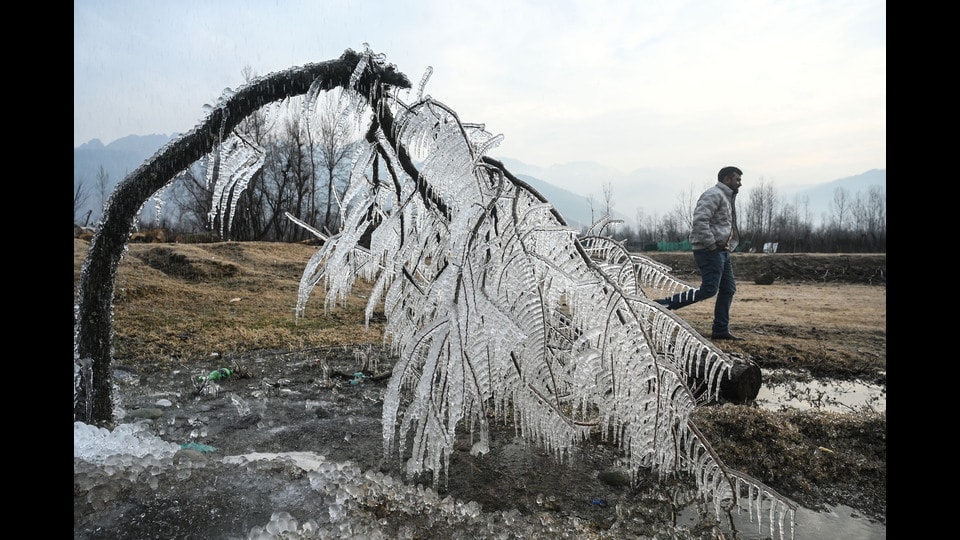
Now, everyone, including farmers, orchardists along with people, have pinned their hopes on the approaching two Western Disturbances (WD) or weather systems bringing snow and rains, which are expected to hit Valley between January 22 and 28.
The Indian Meteorological Department’s (IMD) Srinagar centre has issued a weather advisory to the Kashmir divisional commissioner informing about chances of a major snowfall from January 22 onwards.
“Two WD in quick succession are most likely to affect J&K and adjoining areas during January 22 to 24 (intense) and 26 to 28 January 2026 (moderate),” said meteorologist Parveen Kumar in the communication.
Under the influence of these systems, widespread light to moderate rainfall and snowfall is expected with heavy snowfall at few places mainly on January 23 and 27.
“The system during January 22-24 with peak activity on January 23 will most likely cause heavy rainfall and snowfall over Pirpanjal Range, including Chenab valley of Jammu division, and middle and higher reaches of South Kashmir,” the advisory said.
The areas which are expected to be affected are Anantnag, Pahalgam, Kulgam, Shopian, Pir Ki Gali, Gulmarg, Sonamarg- Zojila axis, Bandipora-Razdan Pass and Kupwara-Sadhna pass, Doda, Udhampur, Reasi, Kishtwar and Ramban.
“The system during January 26-28 with peak activity on January 27 will most likely cause moderate to heavy rains and snowfall over Pirpanjal Range, including Chenab valley of Jammu division, and middle and higher reaches of South Kashmir,” the MeT advisory further said.
The precipitation may lead to disruption of surface and air transport, including Jammu-Srinagar National Highway and other major roads of middle and higher reaches of J&K. “People in snow bound areas are asked to avoid venturing into sloppy and avalanche prone areas. Farmers are advised to suspend irrigation, fertilizer and chemical spray activities during the above period. There is also the possibility of landslides, mudslides and gusty winds (40-60 KMPH) at vulnerable places,” the MeT said.
So far the winter has been largely dry except some light to moderate snowfall in hilly areas of Gulmarg, Sonamarg and Pahalgam.
“J&K is witnessing an exceptionally dry winter, with rainfall figures pointing to one of the sharpest seasonal deficits in recent years. Data from November 1, 2025 to January 17, 2026, shows that the Union territory has recorded an overall rainfall deficit of 85%. The UT received only 20.6 mm of rainfall against a normal of 139 mm,” said independent weather forecaster Faizan Arif on X.
Ladakh has also registered a 77% deficit for the same period.
He said that in Kashmir Valley, all districts recorded severe to extremely severe rainfall deficits.
“Srinagar, the summer capital, recorded 22.4 mm against a normal of 115.4 mm, a deficit of 81%. Budgam reported 16.4 mm (–80%), and Ganderbal registered 29.3 mm against a normal of 127.9 mm, reflecting a 77% shortfall,” Arif said.
In the Jammu region, the rainfall deficit has been even more pronounced in several districts. Kathua recorded 1.1 mm against a normal of 131.3 mm, a staggering 99% deficit. Doda (94%), Ramban (87%), Udhampur (94%), and Samba (98%) have seen negligible rainfall. Jammu district itself recorded 8.6 mm against 94.7 mm, a deficit of 91%.
“The dry trend has intensified sharply in January. From January 1 to January 17, 2026, Jammu and Kashmir received just 1.5 mm of rainfall against a normal of 44.4 mm, translating into an extraordinary 97% deficit,” he said.
In Ladakh, rainfall between January 1 and 17 stood at 1.1 mm against a normal of 2.6 mm, a 56% deficit, while Leh recorded a sharp 79% shortfall.
Director MeT, Ladakh, Sonam Lotus said that the wait for snowfall was going to be over from the night of January 22. “Good snowfall most likely during January 22 (night) to 24 with main activity on January 23 in Jammu and Kashmir, Ladakh and Himachal Pradesh - heavy over higher reaches and moderate in plains,” Lotus said.