
 E-Paper



Wildbuzz | Giants prepare for winter
Pythons abandon the isolation and solitariness of their summer lives to congregate in burrows for winter; they bask regularly during deep winter to regulate body temperature and to facilitate mating

 Prefer HTon Google


As winter tightens its grip on the tricity region, the giant serpents are in a hurry to eat. Rock pythons are very active after the monsoon wanes and lurk near game trails in the scrub so as to waylay prey. The pythons’ intense hunting period continues till November. The pythons need to eat solidly and store “fuel” for the deep winter in terms of stored fat. In winter, they will not hibernate as such but will reduce activity and collect in congregations for mating around burrows.
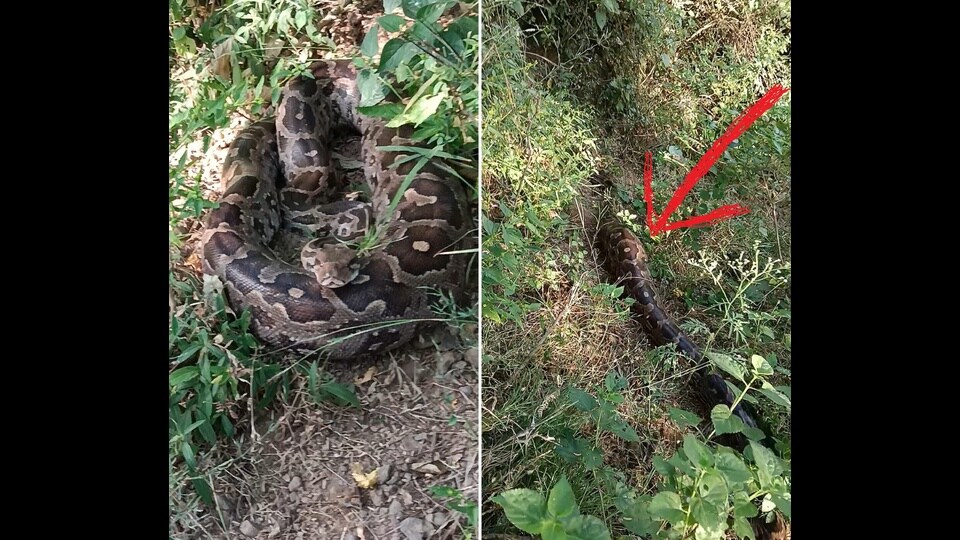
Delving on how pythons prepare for the icy weather, Aditi Mukherjee told this writer: “All through the summers, from July onwards and especially during the post-monsoon, pythons are on the prowl and going around and ambushing prey. Winter is mating season for pythons and they tend not to feed for at least two to three months of winter (ie the males) while females may not feed for about six months till the eggs are about to hatch in May-June.”
Mukherjee has conducted fascinating field research on python behaviour in multiple states of India. Her research included sending into python burrows video cameras mounted on four-wheeled platforms with a powerful traction and relaying live feed of deep internal activity.
“Another sign of pythons preparing for winter is moulting. As the pythons feed, their body size increases, so they go in for moult especially the sub-adults and the juveniles. The adult pythons shed their skins just before winter when the congregations for mating start to build up,” added Mukherjee.
Pythons abandon the isolation and solitariness of their summer lives to congregate in burrows for winter. They bask regularly during deep winter to regulate body temperature and to facilitate mating. Impregnated females spend more time basking than the non-gravid females. Come February-March, impregnated females disperse to isolated spots to lay eggs.
The golf club’s other birdies
A gentle knock on a tree trunk may bring a surprised, curious face at the doorway above. May I know, who is there?
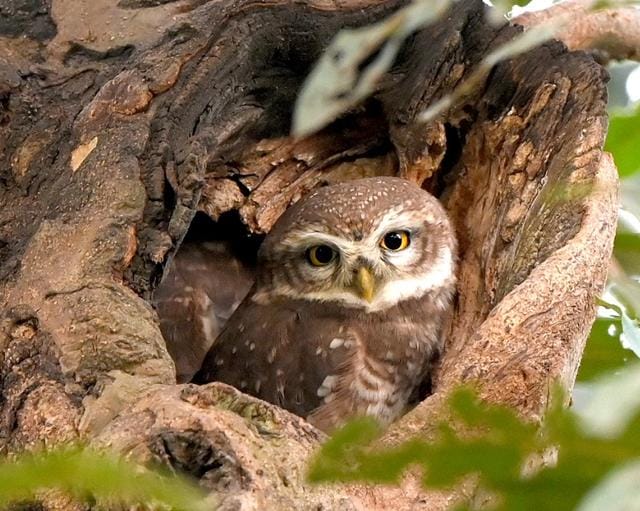
Peeping out of the hollow in the tree is an endearing little bird, the Spotted owlet. Not an uncommon species, the owlet frequents city groves and emits characteristic calls that go ‘chirrur-chirurr-chirurr’ at dusk and night. During daytime, the owlet infrequently lets out calls from a leafy hideout. It is also not a purely nocturnal hunter.
Its small face has a rather granddaddy look to it, with sweeping white eyebrows and an extension of white feathers under the beak. The irises sport a hue ranging from a pale yellow to deep gold, and they bear a straightforward look that reflects “the importance of being earnest”! Families or pairs of owlets will perch together on a cold day, cuddling so cutely that they become a photographer’s delight and a romantic poet’s muse.
The Chandigarh Golf Club’s mature groves flanking the fairways are home to owlets. During the recent ₹1 crore Trident Open staged under the aegis of the Professional Golf Tour of India, one such family was photographed in a tree hollow along the 10th hole on Wednesday. Such avian sightings lent variety to a week of “birdies” galore as the professional golfers were adept at bagging the latter.
Describing a typical owlet behaviour which never fails to charm the observer, Dr Salim Ali wrote: “The birds betray their presence by dashing out fussily to a neighbouring branch whence they bob and stare at the intruder in clownish fashion, with the head often screwed completely round.”
vjswild2@gmail.com


