
 E-Paper



Wildbuzz: Hey Judas! Let it bee
Chauhan’s paintings seek inspiration from mythology, spirituality and astrology to send a message: save the bees, they symbolise fertility; the largest of the weasel species found in India, the Siberian weasel is distinguished by a darkish Zorro-like mask extending from snout to eyes


Ajmer artist Monika Chauhan’s feminine, nurturing instincts extend to the humble denizens of her garden brimming with greenery. A beehive had flourished for years because she would not allow it to be destroyed. Her neighbour, a cranky old uncle, had dispensed with all the beehives in his garden but the sensitive artist believed in co-existence and tolerance. One day, the bees abandoned her garden’s hive and Chauhan took the decaying honeycomb and put it up in her room. Her gaze would often turn to it and a painting ensued, lush in complexity, of the flower-bee mutuality. It was on display at the recent 20th All-India Annual Exhibition of WE – A Group of Indian Contemporary Women Artists (Chandigarh).
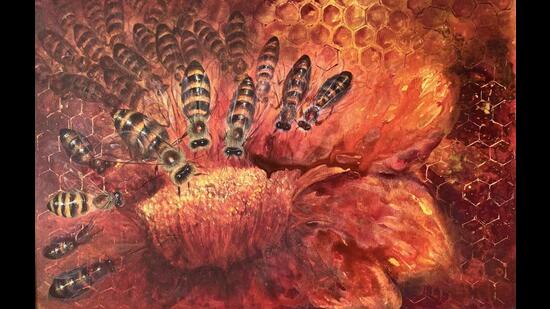
Chauhan’s paintings seek inspiration from mythology, spirituality and astrology to send a message: save the bees, they symbolise fertility. “My painting titled, Paraag (which means pollinator), depicts a famous relationship: bees and flowers. Bees carry the weight of the world on their tiny shoulders. As pollinators, they perform a foundational role supporting planetary life. I chose vibrant, warm colours for the painting due to astrology. My zodiac sign is Aries, which is a fire sign ruled by Mars, the dynamic red planet. Red symbolises energy, passion, warmth, courage, strength and hard work; orange: an individual’s relationship to the external world, the needs and wants of the physical body and the ways in which these are satisfied; yellow: intellect, creativity and happiness. The queen bee is a powerful symbol of feminine leadership and power,” Chauhan told this writer.
Honey and bees are blessed, they find mention in the Rig Veda, but modern humans have betrayed God’s own creatures. “Even the Gods, Vishnu and Krishna, were known as Madhava, meaning ‘the nectar-born ones’, and their symbol was a bee. Vishnu is depicted as a blue bee resting on a lotus flower (symbol of life, resurrection and Nature). There is Goddess Brahmari (an incarnation of Goddess Shakti), the ‘Goddess of Black Bees’, regarded as the female principle of the divine, destroyer of demons and embodiment of Gods’ energies. It is said that Brahmari resides in the heart chakra and emits the buzzing sound of bees, which is often imitated in Vedic chants representing the essential sound of the Universe. Kamadeva, the Lord of Love, had his arrow of sugarcane and his bowstring of bees, the honey neutralising anger and negativity,” said Chauhan.

Killing machine
He was tracking birds at Rajgarh (a popular birding spot for tricity hobbyists) in Himachal Pradesh. The birds led him to a surprise, a “perfect killing machine”, the creature’s cute looks notwithstanding.
They were heckling a four-legged carnivore roving the Himalayas at altitudes ranging between 1,500-4,800 m. It so happened that Chandigarh birder Pushkar Bali’s attention was drawn to a posse of streaked laughing thrushes that seemed as agitated as cats on a hot tin roof deep in a searing Thar. The subject of their ire soon presented itself, an uncommon Siberian weasel (Mustela sibirica hodgsoni), that looks and behaves quite like a mongoose. The weasel was hunting for nests of the thrushes in the bushes while contemptuously dodging their weak, non-dissuasive pecks.
The largest of the weasel species found in India, the Siberian weasel is distinguished by a darkish Zorro-like mask extending from snout to eyes. Not many birders on the prowl in Himachal can credibly claim a sighting. Weasels hunt rodents, birds / eggs, reptiles and insects. A pugnacious hunter, the weasel can bring down prey bigger than itself. Described by the late naturalist, SH Prater, the weasel, “its long neck thrust out, its head a-swaying, eyes a-glitter, awaits its chance to spring. Its attack is always aimed at some vital part, the head or the back of the neck, to bite down to the brain or spine, or to the side of the throat to sever the jugular vein.”
vjswild1@gmail.com


