
 E-Paper



City’s AQI becomes poorest this year, likely to cross 200
Rose to 198 on Thursday as per the data available with the Central Pollution Control Board observatory, official blames construction activity


The Air Quality Index (AQI) of the city became poorest this year after rising to 198 on Thursday as per the data available with the Central Pollution Control Board (CPCB) observatory in Sector 25.
As per officials, it is likely to cross 200 in the next two days, falling in the ‘poor’ category for the first time this year.
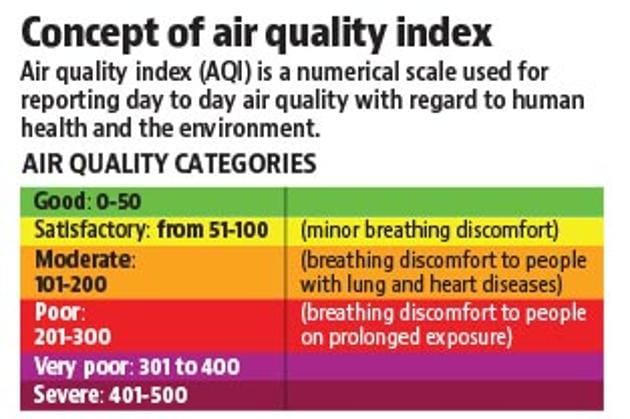
AQI is a numerical scale used to measure day-to-day air quality. A value between 101-200 is considered moderate, while that between 201-300 is considered poor.
The Chandigarh Pollution Control Committee (CPCC) vice-president, Debendra Dalai, said, “ The real-time monitoring station in Sector 25 has registered a spike in the air quality level–due to some construction work in the area, there has been a slight rise in the respirable suspended particulate matter (RSPM) level. But the overall pollution level in the city is manageable.
“Since it is the only Continuous Ambient Air Quality Monitoring Station in the city, the picture will become clearer when two more stations will soon open at Sector 26 and Daria under the National Clean Air Programme,” he added.
Even as the air quality is slated to cross from ‘moderate’ to ‘poor’, the situation is better than last year.
In 2018, the AQI had shot up to 280 on Dusshera (October 19) and is yet to cross 200 this year–Dalai said this was a result of weather fluctuations over the years.
“Last year, Dusshera was celebrated later as compared to this year, so the temperature was lower. Cool temperature causes the AQI to become worse.”
He said the department is working on improving the AQI in the long run and controlling traffic congestion is their top priority.
As per the Chandigarh India Meteorological Department (IMD) director, Surender Paul, the air quality is expected to improve in the next few days. “There were no winds in the city due to the anti-cyclonic movement with the passing of the monsoon. But in the next two to three days, light winds between 15 to 20 km/hr are expected to blow in the city which will disperse the pollutants and improve the AQI,” he said.
However, he cautioned that as the wind activity will slow down around Diwali, a poor AQI can be then expected.
The IMD officials predict partially cloudy skies in the next three days with chances of light rain. Maximum temperature remained consistent at 32 degrees between Wednesday and Thursday while the minimum temperature rose up from 20.6 degrees on Wednesday to 20.8 degrees on Thursday.
In the next three days, maximum temperature will remain between 31 and 32 degrees while minimum temperature will remain between 18 and 21 degrees.


